
For OEM seat sensor mat assembly module sourcing, buy a bare mat when your team owns interconnects and signal processing; buy a wired assembly when routing and connector quality must arrive controlled; and buy a calibrated module only when electronics, software, calibration records, and output responsibility are explicitly contracted. As a practical first-article planning baseline, budget 20 units per released configuration and electrically check 100% of those samples against a defined fixture. Neither figure substitutes for installed-seat validation.
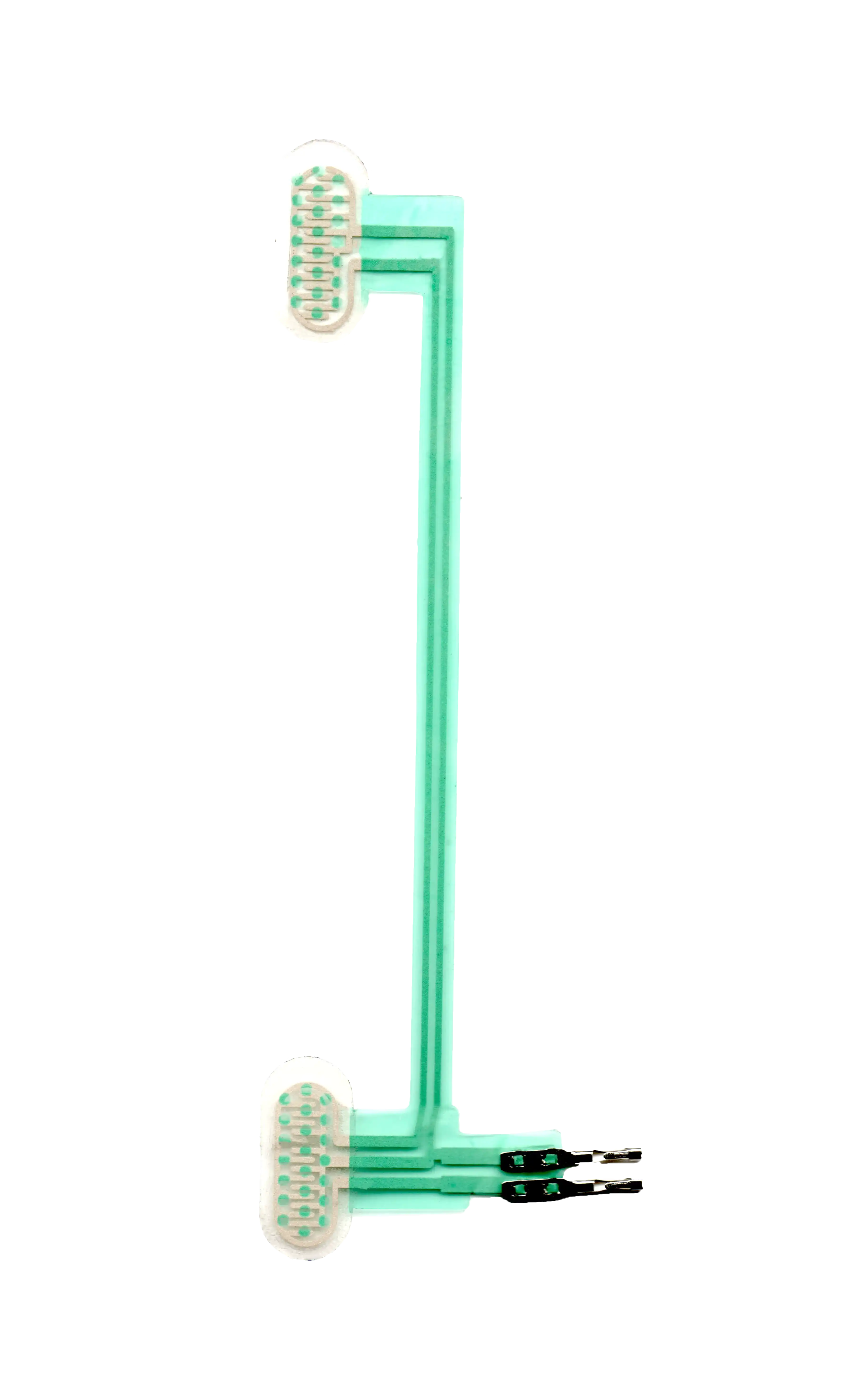
Choose the deliverable before comparing suppliers
A passive pressure mat versus calibrated module comparison is primarily a comparison of who completes the work. A lower component price can transfer harness assembly, electronics integration, fixture development, testing, and change management to the buyer. A higher-priced module may consolidate these tasks but also introduce software ownership, version control, and a different failure-analysis boundary.
The following five named configurations are an RFQ scope taxonomy, not a universal set of standardized products or proof that any one factory offers all five:
| RFQ configuration | What physically arrives | Buyer still needs to arrange | Best-fit purchasing condition |
|---|---|---|---|
| 1. Bare passive mat | Printed sensing film, protected active area, and defined exposed tail or contacts | Termination, harness, readout, system calibration, seat tests | OEM controls electrical integration and wants maximum design ownership |
| 2. Terminated mat | Mat plus specified tail termination or connector interface | Vehicle-side wiring, readout, logic, seat tests | Interconnect method is known, but the harness remains separate |
| 3. Wired mat assembly | Mat, lead or harness, connector, and agreed assembly checks | Electronic readout, system logic, installed-seat validation | Cable routing and connector integrity are recurring build risks |
| 4. Mat with conditioning electronics | Sensor assembly and a defined signal-conditioning board or circuit | Any unprovided firmware, calibration, decision logic, seat tests | Buyer needs an agreed analog or digital electrical interface |
| 5. Calibrated sensing module | Contract-defined sensor, wiring, electronics, firmware/configuration, calibration evidence, and output specification | Vehicle integration, independent seat/system approval, any excluded diagnostics | One qualified integrator accepts responsibility for a specified module output |
A product advertised as a “module” may contain only analog conditioning. Ask for its bill of materials (BOM), firmware state, calibration method, connector drawing, output definition, and exclusions before assigning it to configuration 4 or 5. Conversely, a “complete assembly” may mean no more than a mat with a cable. The label is not a scope guarantee.
For a seat belt reminder input, contact-type membrane construction may be appropriate where the controller requires a defined open/closed event. An FSR-type construction is relevant when the electrical system is designed to interpret a force-related response. Neither construction is a stand-alone weight scale, occupant classification system, or airbag controller. The system owner defines the permitted seat-state decisions and fault behavior.
Use a scope-of-supply matrix with an accountable owner
The most useful seat sensor supplier scope of supply document is a row-by-row agreement. Put Included, Customer-supplied, Subcontracted, or Excluded in every commercial quotation. Do not leave a blank and assume the supplier will fill it later. The table below gives an ownership starting point; a module integrator can take additional tasks only through an agreed statement of work.
| Work package or BOM item | Bare mat purchase | Wired assembly purchase | Calibrated module purchase | Required acceptance owner |
|---|---|---|---|---|
| Printed film, conductive pattern, sensing zone, spacer/lamination | Supplier | Supplier | Named sensor supplier | Component supplier: drawing and bench characteristics |
| Tail reinforcement and termination | Buyer unless ordered | Supplier if quoted | Named assembly supplier | Party delivering the termination |
| Cable length, strain relief, pinout, connector | Buyer | Assembly supplier | Module supplier if included | Harness deliverer: fit, continuity, retention |
| Signal-conditioning PCB and power interface | Buyer | Buyer | Module integrator if included | Board supplier: electrical interface and build tests |
| Firmware, diagnostics, configuration files | Buyer | Buyer | Module integrator only if specified | Code owner: version and functional evidence |
| Calibration method, parameters, and records | System owner | System owner | Module integrator for contracted module output | System owner approves applicability to the seat |
| Installation jig, foam, upholstery and mounting path | Seat manufacturer | Seat manufacturer | Seat manufacturer | Seat integrator: fit and process control |
| ECU logic, occupant decisions and vehicle diagnostics | OEM/Tier 1 | OEM/Tier 1 | OEM/Tier 1 unless a separate contract changes scope | Vehicle system owner |
| Installed-seat and vehicle-level verification | OEM/Tier 1 | OEM/Tier 1 | OEM/Tier 1 | Vehicle/system release authority |
| Production traceability, packaging and change notice | Each supplying party for its deliverable | Each supplying party for its deliverable | Each supplying party for its deliverable | Purchasing/SQE verifies combined records |
This distinction matters when separating suppliers for the mat, harness, and electronic board. A component vendor can establish a good resistance or switch-response result at a controlled test point; the seat manufacturer may still introduce foam preload, cable tension, fold stress, or connector damage during installation. Responsibility must follow the physical interface and the released acceptance test, not the supplier name on the purchase order.
JASPER's car seat occupancy sensor product family addresses custom printed sensing components, mat geometry, tails, leads, connectors, and component-level checks. JASPER's stated product boundary leaves ECU logic, calibration, diagnostics, installed-seat validation, and regulatory responsibility with the OEM, Tier 1, or system owner. A request for an entire calibrated electronic module therefore needs a separately identified module/system supplier or an explicitly agreed additional scope; it should not be assumed from the sensor listing.
Specify the interface that determines the purchasing choice
The physical seat changes the response delivered to the electronics. Define the foam grade or stack, trim tension, support ribs, mounting layer, compression zone, bend points, cable exit, and assembly sequence. For the wider mechanical design considerations, see the pressure sensor mat design guide.
At minimum, the technical specification should establish four boundaries:
- Mechanical: outline and cutouts in mm; active and forbidden zones; mounting face; cable path; installation bend and pull exposure; permissible position tolerance.
- Electrical: contact/open-circuit behavior or resistance-versus-load characterization, measured at named pins; power and signal levels for any board; pin assignment; reference instrument, fixture, dwell, and test temperature.
- Application: empty, occupied, edge-load, object-load, preload, release, and fault conditions selected by the OEM; expected electrical evidence for each without inventing a universal occupant threshold.
- Commercial/quality: drawing revision, controlled materials, inspection records, lot identification, deviation handling, service conditions, and evidence delivered with each build.
A passive FSR can vary with loading area, interfacing materials, direction, dwell, and environment. A contact-style mat has its own transition and mechanical integration issues. Thus, an ohmic value at a bench fixture is a component acceptance criterion only under that fixture's conditions. Module calibration adds a defined transfer function, settings, versioning, and test record; it does not establish vehicle approval. System threshold and hysteresis design belong to the responsible electronic/vehicle program, not to an unqualified purchasing default. Those engineering concepts are treated separately in the calibration and hysteresis guide.
Send an RFQ package that makes quotes comparable
Use the same RFQ revision and volume bands for every bidder. Purchasing can circulate this table directly as a submission checklist; the quotation must identify any missing input as an assumption with an owner and an open action, not silently substitute a different scope.
| RFQ field | Information to supply or require in the bid | Quotation comparison rule |
|---|---|---|
| Application and seat variant | Seat position, program phase, cushion section, mounting plane, expected annual usage | Quote each materially different seat stack separately |
| Sensing principle and output | Contact or force-responsive input; raw pin behavior or conditioned output specification | No change of sensing principle without written approval |
| Mechanical drawing | Outline, zone map, cutouts, datum, foam/trim and tail route; file revision | State exactly which drawing revision was costed |
| Harness and connector | Cable length in mm, wire construction, mating interface, pinout, strain relief, labeling | Separate supplied harness price from mating-connector responsibility |
| Electronics/software | Board, firmware and diagnostic boundaries, calibration data, file ownership | Include or explicitly exclude each deliverable |
| Environmental and service scope | Installed exposure profile, cleaning/liquids, temperature, flex, storage and service expectations | List the actual test conditions, not a generic “automotive grade” claim |
| Acceptance evidence | Component fixture, required measurements, production test approach, records and sampling | Identify which test is offered at what build stage |
| Volumes and timing | Prototype quantity, pilot demand, annual range, ramp, delivery destination | Use matching quantity breaks and Incoterms basis |
| Tooling and IP | Artwork, die, fixture, software, calibration data, NRE payer, transfer rights | Separate nonrecurring engineering (NRE) from unit price |
| Quality agreement | Traceability, material control, deviations, change notice, warranty start and remedy process | Name approval authority for each proposed change |
Ask bidders to return the five-configuration choice, marked BOM scope, revision-coded drawings, sample plan, unit price, NRE, and unpriced exclusions as separate entries. Require a dated milestone schedule for drawing freeze, tool authorization, first-article shipment, installed-seat feedback, pilot delivery, and production readiness. Quote elapsed time in calendar weeks from a named starting event; list long-lead materials and capacity reservations separately. Do not compare an untested bare film price against a harness-tested module price and call the spread a purchasing saving.
A useful RFQ sentence is: “Price the released sensor drawing and define exactly which mat, tail, lead, connector, conditioning electronics, firmware, calibration record, fixture, and component tests are included; itemize exclusions and the OEM-owned installed-seat tests.” This lets SQE, engineering, and purchasing review one agreed boundary rather than three interpretations of the word assembly.
Normalize total cost, not just purchase price
The appropriate comparison is the cost of a deliverable accepted at the same handoff point. For each option, calculate:
Comparable landed-and-integrated cost per accepted unit = quoted unit price + inbound freight and duties + buyer-side termination or assembly + buyer-side inspection/test + expected rework/scrap + amortized NRE.
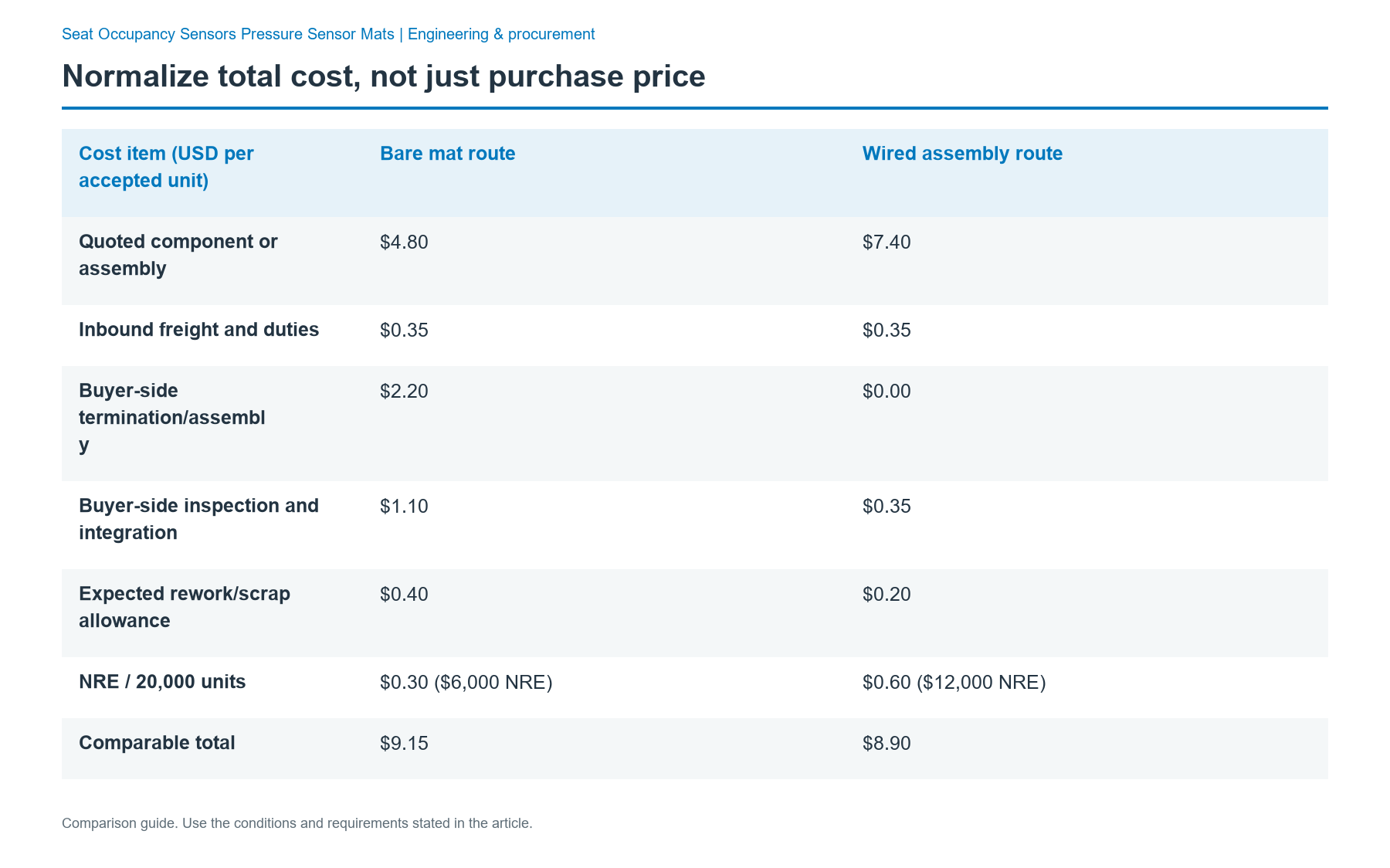
The following is an illustrative purchasing scenario, not a JASPER quotation, market price, or actual customer result. Assume 20,000 accepted units over the NRE allocation period, with identical finished harness and component acceptance boundaries:
| Cost item (USD per accepted unit) | Bare mat route | Wired assembly route |
|---|---|---|
| Quoted component or assembly | $4.80 | $7.40 |
| Inbound freight and duties | $0.35 | $0.35 |
| Buyer-side termination/assembly | $2.20 | $0.00 |
| Buyer-side inspection and integration | $1.10 | $0.35 |
| Expected rework/scrap allowance | $0.40 | $0.20 |
| NRE / 20,000 units | $0.30 ($6,000 NRE) | $0.60 ($12,000 NRE) |
| Comparable total | $9.15 | $8.90 |
On those assumptions the wired assembly is $0.25 less per accepted unit, despite its higher quoted price. At 5,000 units with unchanged NRE, the bare route becomes $10.05 and the wired route $10.70 per accepted unit, reversing the result. The sensitivity comes from NRE amortization, so revise volume, scrap, labor rate, and tested yield before selecting a supplier. A calibrated module cannot join this table until its output acceptance and software support are costed on the same basis.
Qualify evidence and reject scope gaps early
A sourcing scorecard should reward evidence that is specific to the proposed seat sensor deliverable, not broad marketing language. Require artifacts with revision identifiers and test conditions. The signals below can be used in supplier reviews.
| Criterion | Good signal | Red flag |
|---|---|---|
| Scope and exclusions | Marked BOM plus named engineering/quality owners | “Complete system” without board, software, or seat responsibility |
| Seat geometry | Annotated drawing and credible tail/cable route review | Generic pad photo offered as proof of seat fit |
| Electrical method | Repeatable fixture, pinout, measured response and units | Hand pressure or unspecified meter reading as final acceptance |
| Connector control | Mating specification, pin map, pull/retention method if relevant | Cable length or connector altered without revision control |
| Materials and process | Controlled film, ink, spacer, adhesive, lamination and substitution rules | Unannounced material equivalents or undocumented tooling changes |
| First-article samples | Identified samples, test records, disposition and open issues | Samples approved on appearance alone |
| Ramp and continuity | Capacity assumptions, long-lead items, alternate-material process | Unqualified “always in stock” claim for custom hardware |
| Ownership and remedy | Traceability, failure-return method, change notice and warranty boundary | No agreed fault-isolation or return responsibilities |
Evidence from a general quality-system certificate may be relevant, but it cannot replace the actual part drawing, a test specification, and the supplier's recorded result. If formal production approval documentation is required by the OEM, agree on its level, submission contents, approver, and timing in the purchase agreement instead of assuming it comes with every quote.
Release samples and production in six gated steps
A six-gate plan keeps supplier approval separate from the vehicle release authority. For early budgeting, 20 samples per proposed configuration with 100% identification and defined electrical fixture checks is a clear planning reference. Increase or redesign the sample plan based on seat variability, failure consequences, measurement uncertainty, and the OEM's formal validation program; it is not a universal statistical or safety qualification number.
| Gate | Buyer and supplier action | Evidence needed to move forward |
|---|---|---|
| 1. Scope freeze | Select deliverable 1–5; assign every BOM, software, and validation owner | Signed scope matrix, seat variant list, revision baseline |
| 2. Comparable bids | Normalize exclusions, volume breaks, NRE, fixture/test cost, timeline | Bid comparison sheet and resolved commercial assumptions |
| 3. First article | Inspect actual supplied construction, verify identity, pinout, continuity/response in the specified fixture | Revision-coded results for every submitted sample; deviation log |
| 4. Installed-seat evaluation | Seat integrator builds realistic foam/trim/harness configurations and runs OEM-defined seat states | Seat assembly records, recorded signals, disposition by system owner |
| 5. Pilot and quality release | Exercise production-intent process, packaging, labeling, traceability and change rules | Approved control plan, inspection format, pilot deviation closure |
| 6. Purchase order release | Issue PO against approved revisions, forecasts, delivery schedule and acceptance/warranty terms | Signed PO/SOW, authorized revision, evidence and escalation contacts |
The handoff must include a test record that can survive a supplier change. Use a sample approval register with these columns, for every sample and seat variation: sample ID; mat drawing revision; harness/connector revision; PCB/firmware revision if present; fixture ID and calibration status; measured component result with units; seat and foam build ID; installed-seat test report reference; deviations; approver; disposition date. This is a usable record structure—not a substitute for the OEM's signed validation protocol. A compact approval record should assign the following entries and signatures:
| Approval record field | Evidence to enter | Decision authority |
|---|---|---|
| Identified configuration | Part, mat, harness and electronics revisions; sample IDs | Component purchasing/SQE |
| Bench method | Fixture ID, units, applied load or state, environment and limits | Component engineering/SQE |
| Bench outcome | Individual measurements, deviations, retests and disposition | Component approval signatory |
| Seat installation | Cushion/foam and routing build IDs; installation observations | Seat integrator |
| System outcome | OEM-defined seat-state and diagnostic test report reference | OEM/Tier 1 release authority |
| Release status | Named approver, decision date, open action and purchase revision | Authorized release owner |
Do not mark Gate 3 as vehicle acceptance. If a sample passes a fixed-load fixture yet misbehaves after foam installation, investigate load distribution, preload, installation damage, wiring strain, and electronics before assigning root cause. Component release and installed-seat approval have distinct evidence and decision owners.
Write component acceptance and warranty responsibility separately
Seat sensor component acceptance asks whether the supplier delivered the specified physical and electrical item. Installed acceptance asks whether the entire seat-and-controller arrangement handles the OEM-defined states and failure conditions. A contract can require both types of evidence, but must name the party that creates and approves each record.
| Evidence or obligation | Supplier deliverable | OEM/Tier 1 system responsibility |
|---|---|---|
| Incoming appearance, dimensions and revision | As ordered and measured at specified datums | Review approved part/seat fit |
| Pinout, continuity and fixture-defined resistance/switch response | Record under named fixture, load and environment | Verify the method represents the intended input |
| Harness retention and insulation, if supplied | Record against agreed drawing and test | Confirm installed routing and protection |
| Calibration file and module output, if contracted | Supply versioned records for defined conditions | Approve mapping and vehicle use |
| Occupied, empty, preload, edge, object and diagnostic seat conditions | Provide component data for analysis | Design, execute and approve installed/system tests |
| Field failures, warranty and life expectations | Analyze returned parts within stated storage/use envelope | Supply vehicle/seat history; diagnose integration and ECU contributions |
Specify warranty coverage by delivered part number and revision, start event, storage and operating envelope, installation method, proof required for return, failure-analysis turnaround, and replacement or rework process. Define service-life targets as tested duty and exposure conditions, not a vague number of years. These commercial terms require contractual agreement; a supplier's generic website language should never become an automatic warranty promise.
For a split-source program, add a joint investigation rule: preserve the failed mat, connector, controller logs, lot history, and seat build record before destructive analysis. Decide who owns interface investigations and temporary containment when failures cross a connector or calibration boundary. Without this clause, each vendor may claim its individual item passed, while purchasing absorbs the unassigned problem.
Decide when split sourcing or replacement purchasing fits
Split sourcing the mat, harness, and board makes sense when the OEM has a strong integration team, controls the electrical interface, and values independent supplier options. It is less attractive when test fixtures, assembly variation, and fault investigation would be unowned. A single contracted integrator can simplify deliveries, but still needs open BOM access, software/calibration transfer rules, and a credible alternate-source plan. One invoice is not equivalent to one technically accountable release authority.
Service replacement is a different demand from custom OEM sourcing. A catalog part that fits a vehicle connector is not necessarily interchangeable with its seat foam design, controller interpretation, diagnostics, or approved service procedure. Source an approved replacement by vehicle and seat part-number control; source a custom mat by released drawing, installation stack, and validation ownership. JASPER's OEM component route should not be described as a universal plug-and-play repair part for every vehicle model.
Before signing, eliminate four common deal breakers: a module price with no firmware/calibration ownership; a harness included in photos but excluded from the quotation; a “passed resistance” certificate without load fixture and temperature; and an unspecified change-notice obligation for sensing film or connector substitutions. The cheapest quotation often becomes the most expensive one when a missing interface is discovered during pilot builds.
Frequently asked questions
Is a bare seat sensor mat cheaper than a wired assembly?
It can have a lower purchase price, but it is not automatically cheaper at the accepted handoff point. Add harness termination, connectors, buyer labor, inspection, rework, inbound freight, and NRE amortization. If the buyer already runs a qualified harness line, a bare mat may win. If assembly errors and testing are costly, a supplier-tested wired assembly may have lower total cost.
What is the difference between a passive pressure mat and a calibrated module?
A passive mat delivers a contact or load-related electrical behavior to external electronics. A calibrated module adds contracted conditioning, configuration, and a specified output backed by versioned evidence. The exact electronics, firmware, diagnostics, and calibration deliverables vary by contract. A calibrated output is not proof that the complete vehicle seat or occupant classification function has been approved.
Can an FSR seat mat be purchased as a weight-measuring device?
Not without a separately engineered and validated measurement system. An FSR-type mat produces a force-related response that depends on loading geometry, interface electronics, time, and environmental conditions. The supplier can characterize the component using a defined fixture; the OEM must decide whether the installed arrangement supports the required seat-state decision. Do not turn an unspecified resistance reading into a universal occupant-weight threshold.
Who approves the seat sensor when the mat supplier passes its own tests?
The component supplier approves the part against the released component drawing and agreed bench test. The seat integrator and OEM or Tier 1 system owner approve installation, electrical interpretation, diagnostics, and vehicle-level behavior. Those are separate release decisions. The purchase order should identify the signatories and the records linking a sensor lot and revision to the tested seat configuration.
What should a buyer request before approving first-article samples?
Request marked drawings, part and connector revisions, a pinout, the defined fixture and measurement conditions, individual sample records, deviation dispositions, and traceability. A planning baseline is 20 samples per configuration with electrical checks on all 20, adjusted to program risk. Reserve a separate installed-seat sample and approval plan for the system owner rather than using bench approval as production authorization.
Should one supplier provide the mat, harness, and electronic board?
One supplier can simplify logistics and interface fault ownership if that supplier has demonstrable competence and accepts an explicit statement of work. Split suppliers can increase sourcing flexibility when the buyer controls drawings, fixture access, change management, and integration testing. Compare the cost of managing interfaces and technical evidence, not just the number of purchase orders. The OEM still owns the final vehicle system release.
Are catalog replacement seat sensors interchangeable with custom OEM mats?
Not by appearance, connector shape, or printed label alone. Seat stacks, load paths, pin behavior, diagnostics, and vehicle approvals differ. Replacement sourcing follows the correct approved service part and vehicle application. Custom OEM sourcing follows a controlled drawing, seat and electronic interfaces, and a dedicated validation plan. A made-to-drawing component should not be marketed as a universal ready-to-install repair kit.
What warranty terms belong in a seat sensor purchase order?
List the delivered part and revision, accepted tests, storage and installation limits, specified exposure and duty conditions, traceability, return evidence, analysis timing, and remedy. State who investigates failures spanning the sensor, harness, electronics, and seat. Warranty duration or service life alone does not define a technical acceptance criterion, and component warranty does not transfer vehicle compliance responsibility to a mat supplier.
Start with one agreed drawing and scope
For a custom printed sensor or wired mat quotation, send the seat section, foam and mounting position, load path, desired output or interface requirements, cable/connector details, validation boundary, sample demand, and annual quantity. Mark which of the five supply configurations you are requesting and identify the organization responsible for the electronics and installed-seat release. Request a quote with that package so the first response can address a specific, comparable OEM component scope.
Bring the drawing, stack and operating conditions
JASPER engineering will review the interfaces, open risks and evidence required for a production quote.