
How to choose a membrane switch manufacturer is not a price-ranking exercise. It is a membrane switch supplier evaluation of drawing review, revision control, representative samples, inspection evidence, approved-change handling, and repeat-order support. A low unit price does not repair an unclear stack or an unowned revision.
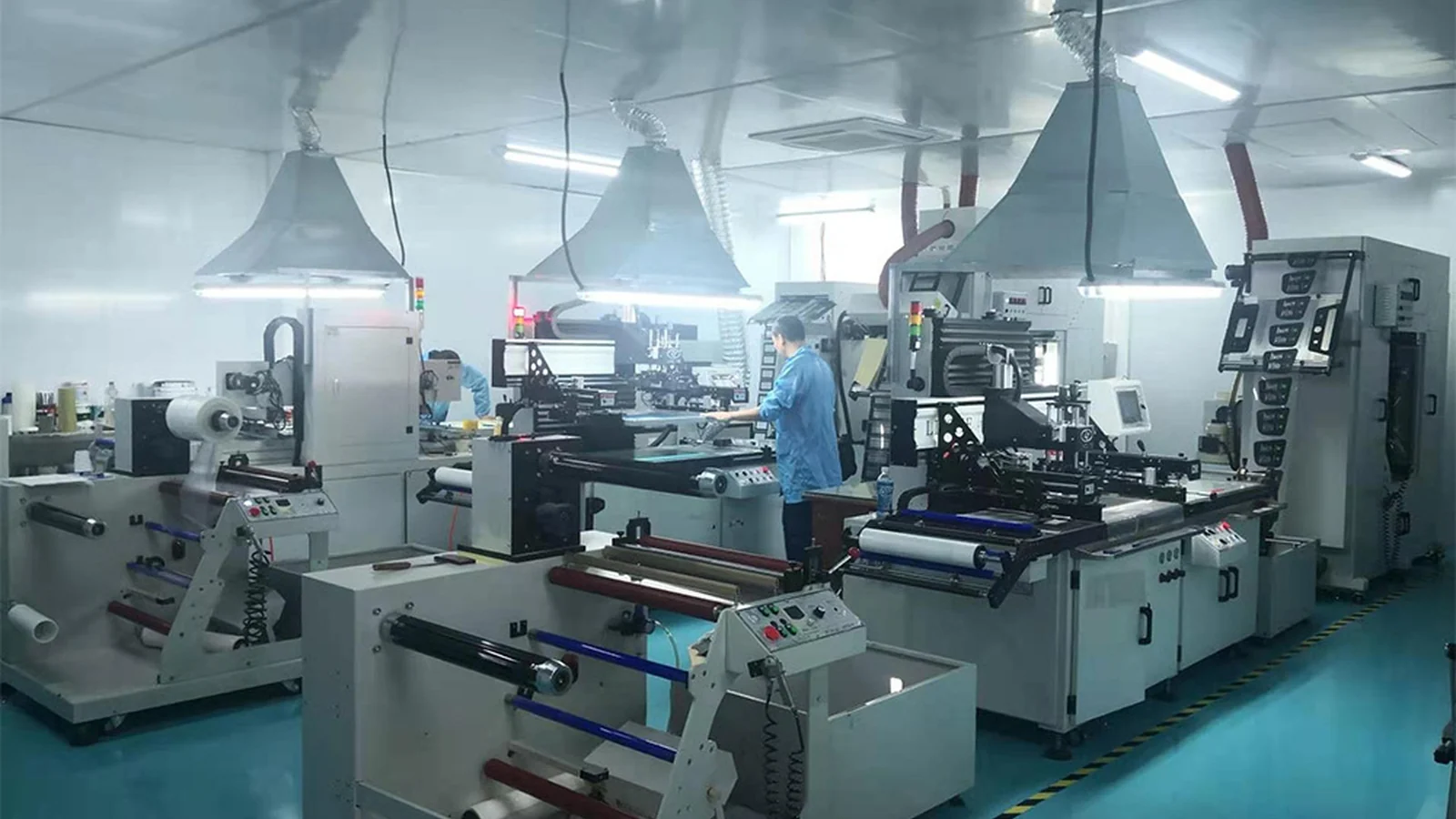
The decision boundary is simple: either the supplier can run a controlled membrane switch manufacturer checklist on the current project, or the project is still shopping for a printer that only copies a PDF.
1. Why This Decision Matters
Membrane switches are multi-layer assemblies, not catalog SKUs. One RFQ that says “PET panel, IP67, tactile, ZIF tail, 5,000 pieces” still leaves open Covestro-class film grade (Bayfol/Makrofol families are examples, not a single polymer acronym), 3M adhesive chemistry (467MP / 200MP versus 9495LE / 300LSE classes), Snaptron-style dome support, vent path, TE Connectivity connector pitch, sample acceptance, and whether the IP67 label is an IEC 60529 system claim or a wish.
When membrane switch sourcing picks the cheapest unit price before those items are owned, the failure chain is predictable:
- Open interfaces (connector, enclosure surface, cleaning chemistry, revision letter) stay unmarked.
- Each supplier fills blanks with a local default.
- Samples pass electrical continuity and still fail housing fit, adhesion, or tactile feel.
- Tooling assets—screen sets, cutting tools, emboss tools, fixtures—lock the wrong stack.
- Procurement restarts with “why did the second sample change everything?”
That cost shows up as schedule slip and re-tooling, not only as a line on a quote. Medical-component programs add another boundary: choosing a component manufacturer is not finished-device validation under ISO 13485 process discipline or equipment-level claims such as IEC 61000-4-2 ESD immunity. Those are separate scopes.
A reliable supplier evaluation covers certifications and capacity, then goes further into revision ownership, representative samples, inspection records, and engineering change control after first article. It delivers ten evaluation criteria with good-signal and red-flag pairs, a scorecard table, a drawing-review checklist, a sample-approval matrix, a step sequence from shortlist to repeat order, and the disqualifiers that stop multi-supplier ranking.
Cost-of-wrong-choice is not only scrap. A wrong connector thickness forces PCB respins. A wrong adhesive on powder-coated paint lifts after burn-in. A free-floating IP67 claim fails an enclosure audit under IEC 60529 even though continuity still passes. Those failures sit downstream of a thin membrane switch supplier evaluation.
2. How to Choose a Membrane Switch Manufacturer: Ten Evaluation Criteria
These ten criteria are a membrane switch supplier evaluation ordered by how often they break production after a “good” unit price. Treat each criterion as a go/no-go gate, not as a marketing form field.
2.1 Drawing package ownership and revision control
A production quote follows the revision that was actually reviewed. If two files disagree about window size, key pitch, or tail exit, suppliers will pick different “current” files and both will look compliant until assembly fails.
One current mechanical package (PDF for review; DXF/DWG or STEP when fit matters) with revision letter or date, cut lines, windows, key centers, adhesive boundary, and tail exit marked. Older files labeled obsolete. A named owner for the next revision.
Multiple unmarked PDFs, screenshots without scale, or “use whichever looks latest.” That is reconstruction work, not a controlled review.
2.2 Engineering review depth (not silence)
A useful manufacturer asks about enclosure surface energy, cleaning chemicals, life target, backlight viewing, connector family, and assembly process. Silence can be faster. Silence is not safer when stack tradeoffs conflict.
Written questions that map to the stack (overlay grade, adhesive family, circuit type, dome/vent, connector, IP framing). Tradeoffs named when thin stack, strong tactile feel, sealed tail exit, bright backlight, and low cost cannot all improve together.
Instant price with zero application questions, or generic “any construction is fine” language with no stack proposal.
2.3 Quality system match to the vertical
Certification evidence must match the legal entity, manufacturing site, scope, and validity period. ISO 9001 is a baseline QMS framework. ISO 13485 matters for medical-device related manufacturing discipline. IATF 16949 matters for automotive supply-chain programs. Buyers verify certificate scope, issuing body, and validity—not logo images alone.
Certificate copy with scope that matches the product type, plus a clear statement of what the plant will and will not document for the buyer’s audit package.
Certification claimed without number, scope, or issuing body; or a medical claim built only on ISO 9001 marketing copy. Component manufacturing is not finished-device regulatory approval.
2.4 Materials and construction fluency
Polyester (PET) circuits, polycarbonate overlays, FPC hybrids, metal-dome tactile layers, and rear adhesives are not interchangeable by acronym. Overlay films are grade- and finish-specific (Covestro Bayfol/Makrofol-class families are examples). Adhesives differ: 3M 467MP (200MP) is positioned for metals and high-surface-energy plastics; 3M 9495LE (300LSE) is positioned for many low-surface-energy plastics and powder-coated paints (3M product data).
Named film grade or clear grade options, adhesive family tied to substrate, circuit type (silver PET / FPC / PCB hybrid) with a reason, and which layers the buyer owns versus which layers the supplier may propose. Example: polycarbonate overlay with hard coat for abrasion, 3M 9495LE-class rear adhesive on LSE plastic, silver PET circuit unless flex life forces FPC.
“PET + acrylic + IP67” as the entire construction note, with no substrate callout and no film grade.
2.5 Circuit, pinout, and connector ownership
Membrane switch sourcing fails when the faceplate drawing is complete and the electrical interface is not. The supplier needs key map, matrix or common-bus logic, LED polarity if present, and the intended pinout—or an explicit “pinout open, propose.”
FPC/ZIF-style connectors (TE Connectivity family examples) control pitch, contact side, cable thickness, orientation, and actuator style. The selected connector drawing remains controlling.
Pinout table or marked open options; connector family or mating PCB constraints; tail exit and bend rules stated.
Artwork-only package, no pinout, no connector note, and a promise that “any ZIF will fit.”
2.6 Tactile response and vent path
Metal-dome tactile stacks need a vent path. Trapped air can change feel and travel (Snaptron venting guidance). Non-tactile constructions remove the dome click but still need spacer and contact design ownership.
Dome force target or open options, vent path owned (spacer / carrier / board), and a note when non-tactile is preferred for quiet panels or sealed faces.
“Tactile” with no force band, no dome support description, and no vent discussion—then sample feel is pure luck.
2.7 Environment and IP framing under IEC 60529
IP codes classify enclosure protection for electrical equipment under IEC 60529. An IP65 or IP67 label without enclosure definition, test article, and gasket/window strategy is incomplete. Cleaning chemistry and outdoor UV also drive overlay hard-coat and adhesive choices.
Use environment written as conditions (splash, immersion claim, wipe-down chemistry, temperature range intent) plus who owns the enclosure test article.
“IP67 membrane switch” as a free-floating product feature with no system boundary.
2.8 Representative samples and inspection evidence
Continuity alone is not sample approval. Visual, dimensional, tactile, electrical, optical (if lit), assembly fit, and environmental checks must match the product. Generic “100% tested” language without a method list is weak evidence.
Written sample plan: which checks run on first samples, what records ship with the lot, and which failures stop production.
Photo-only samples, no force or dimensional data when the housing is tight, or refusal to share an inspection checklist.
2.9 Change management after first-article
Approved samples become the reference. Material substitutions, ink system changes, dome vendor swaps, and connector thickness changes all need a controlled ECO path. Unannounced “equivalent” swaps are a classic field-failure source.
Written change-control rule: what requires buyer re-approval, how revisions are labeled, and how old stock is segregated.
Continuous material “improvements” promised without a re-approval gate.
2.10 Repeat-order and documentation support
Production is not one shipment. The supplier must re-run the same revision with the same construction notes months later. That requires retained drawings, approved sample records, and a contact path when the next PO arrives.
Named document set retained with the part number: revision, stack note, inspection criteria, approved sample reference.
New engineer every order, no retained stack sheet, and a re-quote that changes construction without flagging the delta.
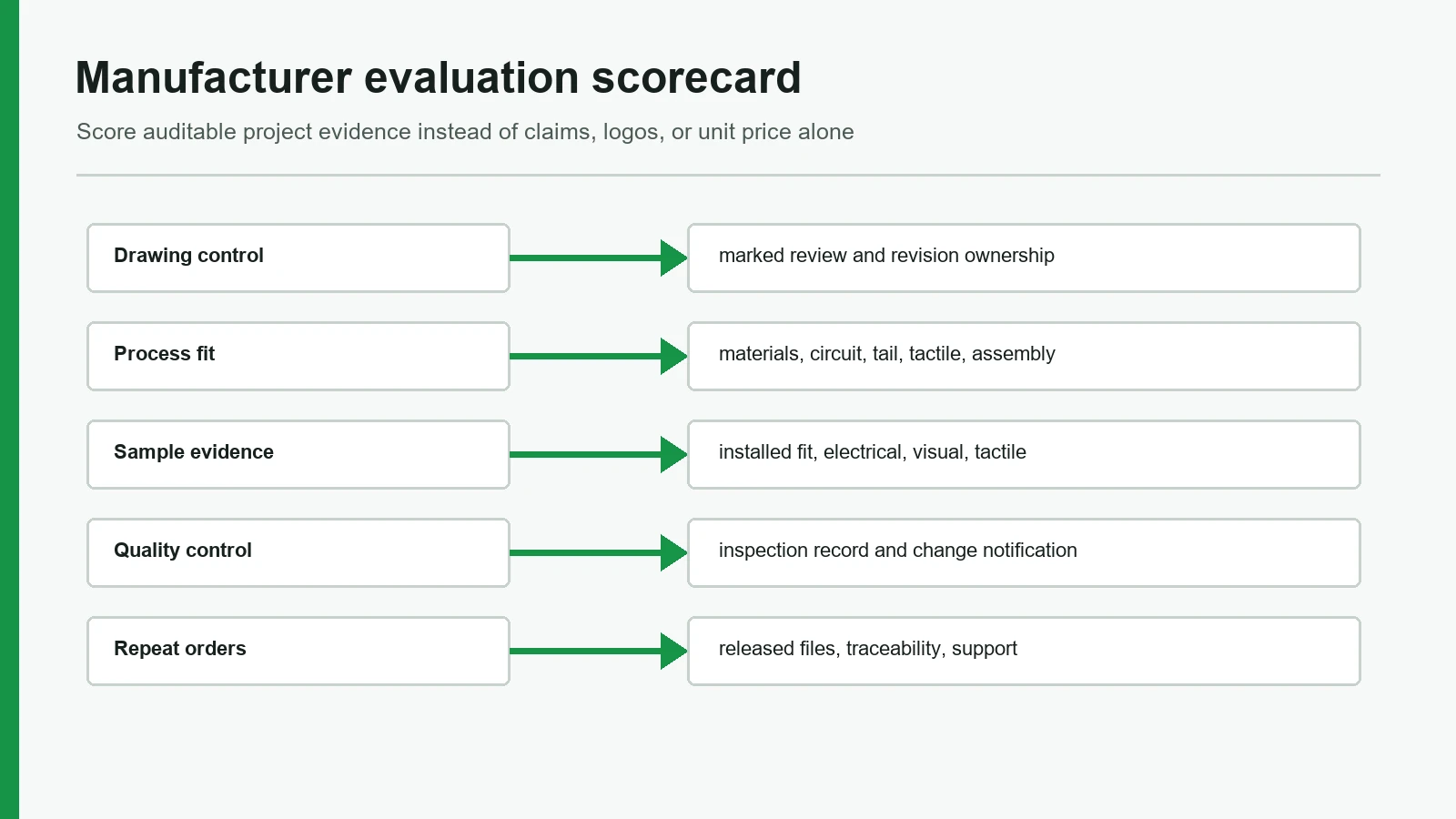
3. Membrane Switch Manufacturer Checklist: Scorecard and Drawing Review
Use this membrane switch manufacturer checklist on the current project before ranking unit prices.
3.1 Supplier scorecard (evidence to request)
| Criterion | Evidence to request | Pass note | Fail note |
|---|---|---|---|
| Drawing / revision control | Current file set + revision letter/date | Single current package | Conflicting unmarked files |
| Engineering review | Written questions / construction proposal | Tradeoffs named | Price-only reply |
| QMS match | Certificate + scope statement | Scope fits vertical | Logo only / wrong scope |
| Materials fluency | Film grade, adhesive family, circuit type | Named options with reasons | Acronym-only stack |
| Circuit / connector | Pinout + connector constraints | Mating drawing respected | “Any ZIF” |
| Tactile / vent | Dome force / vent ownership | Path owned | Feel left to sample luck |
| Environment / IP | Conditions + test-article owner | IEC 60529 framing | Free-floating IP label |
| Samples / inspection | Method list + records | Product-matched checks | Continuity photo only |
| Change control | ECO / re-approval rule | Buyer gate defined | Silent substitutions |
| Repeat order | Retained stack + part history | Same revision re-runnable | Construction drifts |
3.2 Drawing review checklist
| Artifact | What “reviewed” means | Failure if missing |
|---|---|---|
| Mechanical drawing | Outline, windows, key centers, thickness budget, mounting | Housing fit and cut errors |
| Graphic artwork | Colors, windows, emboss zones, dead-front intent | Cosmetic rework after electrical freeze |
| Circuit / key map | Functions, matrix/bus, LEDs, pinout status | Non-comparable quotes |
| Connector / tail note | Family, pitch, thickness, exit, bend | Assembly and reliability failures |
| Environment note | Cleaning, sealing claim, temperature intent | Wrong film/adhesive choice |
| Quantity / sample plan | Prototype vs production intent, acceptance checks | Wrong tooling and inspection depth |
Text process ownership (minimum):
A. RFQ package (drawings + environment + quantities)
B. Drawing review + construction proposal
C. Representative samples + inspection records
D. First-article / production approval
E. ECO / approved change control
F. Repeat-order release on same revision
3.3 Sample approval matrix
| Check family | Typical questions | When mandatory |
|---|---|---|
| Visual | Color, print defects, window clarity, emboss | Always for graphic faces |
| Dimensional | Outline, window positions, tail length/width | Always when housing is tight |
| Tactile | Force, travel, feel consistency | Tactile / dome stacks |
| Electrical | Continuity, shorts, LED polarity | Always for active circuits |
| Optical | Uniformity, light leak, dead-front | Backlit / dead-front designs |
| Assembly | Fit to enclosure, adhesive wet-out, connector mate | Always before production |
| Environmental | Wipe chemistry, sealing intent, temp intent | When conditions are named |
A sample that “works on the bench” and fails in the enclosure is not approved. Optical and assembly checks often decide that.
3.4 Planning bands for sample loops
| Project state | Industry-typical planning band | Why it is only a band |
|---|---|---|
| Drawings stable, connector fixed | 1 sample loop may be enough | Fewer open interfaces |
| Drawings still moving | 1–3 sample loops common | Each revision can change stack |
| Backlight + tight housing | Extra optical/assembly pass often needed | Continuity ≠ lit-enclosure OK |
| Medical-component documentation heavy | Extra document cycle beyond electrical sample | QMS paperwork is separate from feel |
These are planning estimates for OEM scheduling, not guaranteed lead times or free rework promises. Confirm against the live RFQ before freezing tooling.
4. Step-by-Step Membrane Switch Sourcing Process
This sequence turns the framework into work buyers can run. Industry-typical planning bands (adjust to project risk and drawing maturity): shortlist 3–5 names, deep-evaluate 2–3, expect 1–3 sample loops when drawings still move.
Step 1 — Freeze the decision package, not every construction detail
Mark what is fixed versus open: outline, connector, environment, acceptance checks, and quantity intent. Open options are allowed if they are named. Unnamed blanks become supplier defaults. A partial package is acceptable for a concept review; it is the wrong basis for multi-supplier unit-price ranking.
Step 2 — Build a shortlist for membrane switch sourcing
Use directories, prior vendors, and engineering networks. Include at least one source that can review drawings in writing. Use manufacturing / capabilities and quality & certifications to verify process depth and available evidence. Location (domestic revision speed versus offshore unit economics) is a project variable, not a moral ranking.
Step 3 — Issue the same RFQ package to every shortlisted plant
Identical drawings, environment notes, quantities, and acceptance expectations. If packages differ, quotes are not comparable. Pair this guide with a field-level membrane switch RFQ checklist when the package is incomplete. Ask each plant to mark open assumptions in the quote response so hidden defaults become visible.
Step 4 — Run the supplier evaluation scorecard
Score only on evidence, not on brochure claims. Disqualify on release blockers in §5 even if the unit price is attractive. Ask for certificate scope statements and sample method lists early. When two plants pass the same gates, compare total project risk—revision loops, inspection depth, ECO discipline—before chasing a few cents on unit price.
Step 5 — Order representative samples, not only electrical demos
Require the sample-approval matrix checks that match the product. Approve in the real enclosure when fit, adhesive, or lighting matter. Continuity is necessary; it is not sufficient. For backlit or dead-front faces, add off / ambient / lit viewing states so light leak is not discovered after tooling.
Step 6 — First-article freeze and change-control rule
Lock revision, stack note, inspection criteria, and ECO rules before production tooling is treated as final. State what substitutions require re-approval: film grade, adhesive family, dome vendor, ink system, connector thickness, and spacer geometry are common triggers. Keep the approved sample as a physical or documented reference, not only an email “OK.”
Step 7 — Repeat-order release
Confirm the retained document set and contact path for the next PO. A supplier that cannot re-run the approved revision is not production-ready, even if the first lot looked fine. Re-order releases should cite the same revision letter that first-article approved; if the plant proposes a “drop-in improvement,” treat it as a new ECO, not a silent line-item change.
5. Release Blockers That Disqualify a Supplier
These override soft scores elsewhere in the membrane switch supplier evaluation.
- Refuses to work from a single controlled revision — conflicting files will be “resolved” by whoever prints first.
- Prices without application questions — construction defaults are hidden in the number.
- Certificate logos without scope or issuing body — unverifiable QMS claims.
- Free-floating IP67/IP65 labels with no enclosure/test-article ownership under IEC 60529.
- “Any ZIF / any PET / any acrylic adhesive” when substrate and connector are already fixed.
- Photo-only samples with no dimensional, tactile, or electrical records when the housing is production-intent.
- Silent material substitutions after first-article approval.
- No retained stack sheet for repeat orders.
- Medical or automotive regulatory promises based only on component manufacture without finished-device scope.
- Cannot explain tradeoffs when thin stack, strong click, sealing, backlight, and cost conflict.
When NOT the best choice:
- Lowest unit price is the wrong primary selector while drawings, stack, or acceptance remain open.
- A pure graphic printer is the wrong fit for connector-controlled FPC hybrids, controlled vent paths, or documented ECO after first-article.
- Single-sourcing a new design before representative samples and revision ownership is wrong.
- Treating supplier selection as finished-device biocompatibility or regulatory approval is wrong.
6. Frequently Asked Questions
How to choose a membrane switch manufacturer without ranking on unit price alone?
Run a membrane switch supplier evaluation on revision control, construction proposal quality, sample methods, inspection records, change control, and repeat-order documentation. Rank unit price only among suppliers that pass the same evidence gates.
What belongs on a membrane switch manufacturer checklist?
At minimum: controlled drawings, engineering questions answered in writing, QMS scope match, named materials, pinout/connector ownership, tactile/vent path, environment/IP framing, sample approval matrix, ECO rules, and retained production documents.
How many suppliers should enter membrane switch sourcing?
An industry-typical planning band is 3–5 candidates, then 2–3 deep evaluations with identical RFQ packages. Adjust the count to project risk and dual-source policy.
Do ISO 9001 or ISO 13485 alone prove the plant is right?
No. ISO 9001 is a baseline QMS framework. ISO 13485 indicates medical-device related QMS discipline, not automatic finished-device approval. Always verify certificate scope and what documentation the plant will provide for the buyer’s audit package.
Should IP rating decide the supplier?
IP claims must follow IEC 60529 system framing: enclosure, gasket/window strategy, and test article. Choosing a supplier because a brochure says “IP67” without that boundary is incomplete.
What sample checks matter before production?
Visual, dimensional, tactile (if dome), electrical, optical (if lit), assembly fit, and any environmental checks named in the RFQ. Continuity alone is not enough for enclosure-critical interfaces.
How should change management work after first-article?
Define which material, process, or vendor changes need buyer re-approval. Label revisions. Segregate obsolete stock. Unannounced “equivalents” are a release blocker.
Can JASPER be one of the evaluated manufacturers?
Yes. JASPER reviews drawings and RFQ packages for custom membrane switches. Evaluate that review, the proposed construction, sample evidence, quality controls, and change-management records against the same scorecard used for every shortlisted source.
Is medical electrode or finished medical device approval included?
No. This article covers component manufacturer selection for membrane switches and related HMI stacks. Finished-device validation, biocompatibility, and regulatory submissions remain the device manufacturer’s scope.
What should buyers do next on the current project?
Fill the scorecard in §3 against the live drawing package, send the same RFQ to shortlisted plants, and refuse to freeze tooling until sample-approval matrix checks and ECO rules are written.
7. What to Do Next
How to choose a membrane switch manufacturer comes down to evidence: controlled revisions, construction fluency, representative samples, inspection records, change control, and repeat-order support. Use the supplier review checklist and scorecard on the current project before comparing unit prices.
Send the drawing package for review, or open a quote path when the package is ready:
- Custom membrane switches
- Manufacturing capabilities
- Quality & certifications
- Send drawing
- Request a quote
- Related: Membrane switch RFQ checklist · Membrane switch design guide · Membrane switch design mistakes
Technical References
- Source: ISO 9001 quality management systems requirements. Accessed 2026.
- Source: ISO 13485 medical devices quality management systems. Accessed 2026.
- Source: IATF 16949 automotive quality management system requirements. Accessed 2026.
- Source: IPC-D-325 documentation requirements for printed boards and assemblies. Accessed 2026.
- Source: IPC-6013 qualification and performance specification for flexible circuits. Accessed 2026.
- Source: ASTM F1578 membrane switch contact closure cycling practice. Accessed 2026.
- Source: IEC 60529 enclosure protection classification. Accessed 2026.
- Source: IEC 61000-4-2 electrostatic discharge immunity testing. Accessed 2026.
- Source: IEC 60529. Accessed 2026.
- Source: IEC 61000-4-2. Accessed 2026.
- Source: ISO 9001. Accessed 2026.
- Source: ISO 13485. Accessed 2026.
- Source: IATF 16949. Accessed 2026.
Evaluate manufacturing evidence before tooling
Send the drawing package, application, quantities, required quality system, sample criteria, and change-control expectations.