
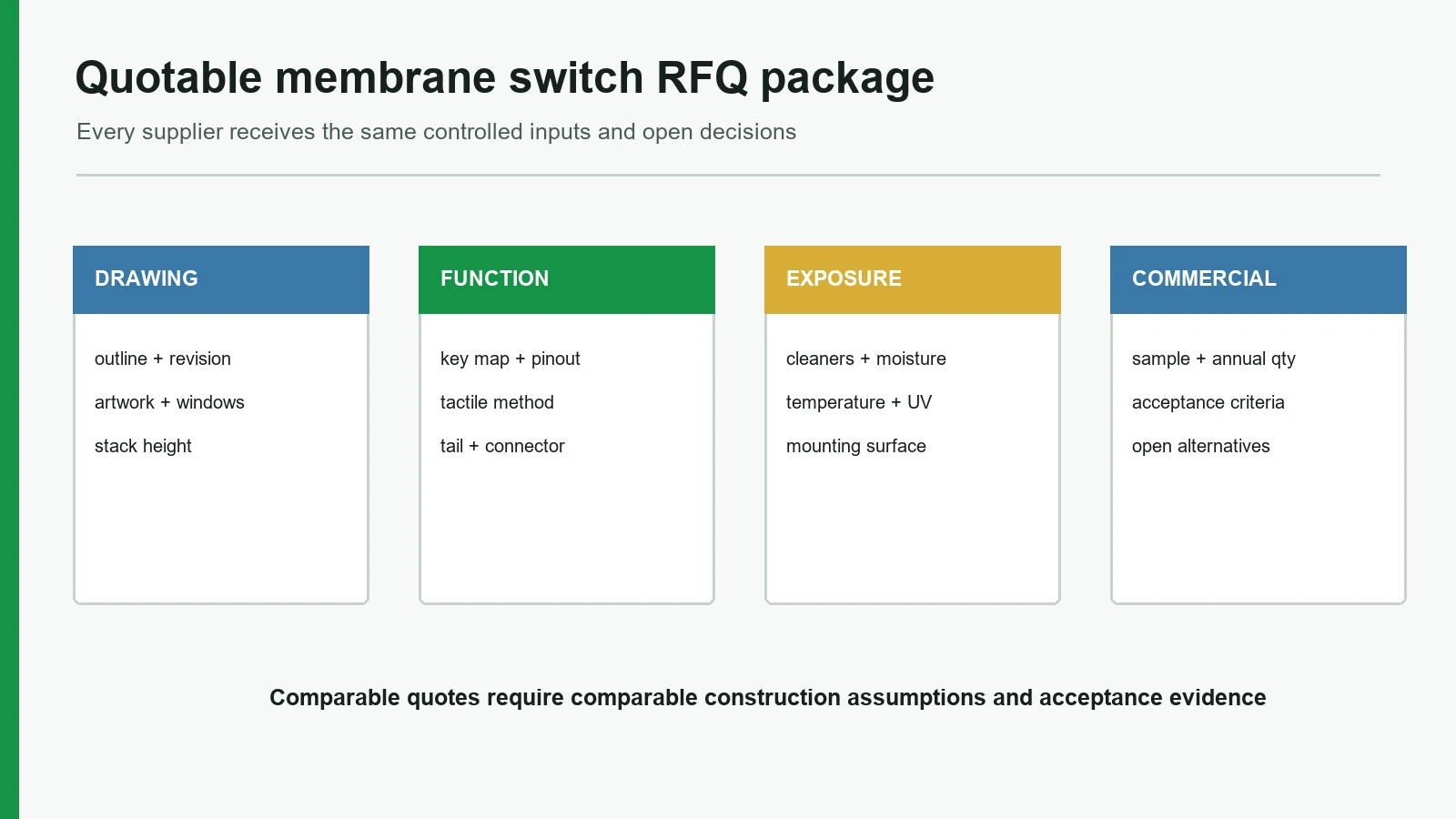
A usable membrane switch RFQ checklist is not a wish list of features. It is the minimum set of drawings, quantities, environment notes, acceptance checks, and open decisions that lets two suppliers price the same construction. Incomplete packages create non-comparable quotes; complete packages create comparable ones.
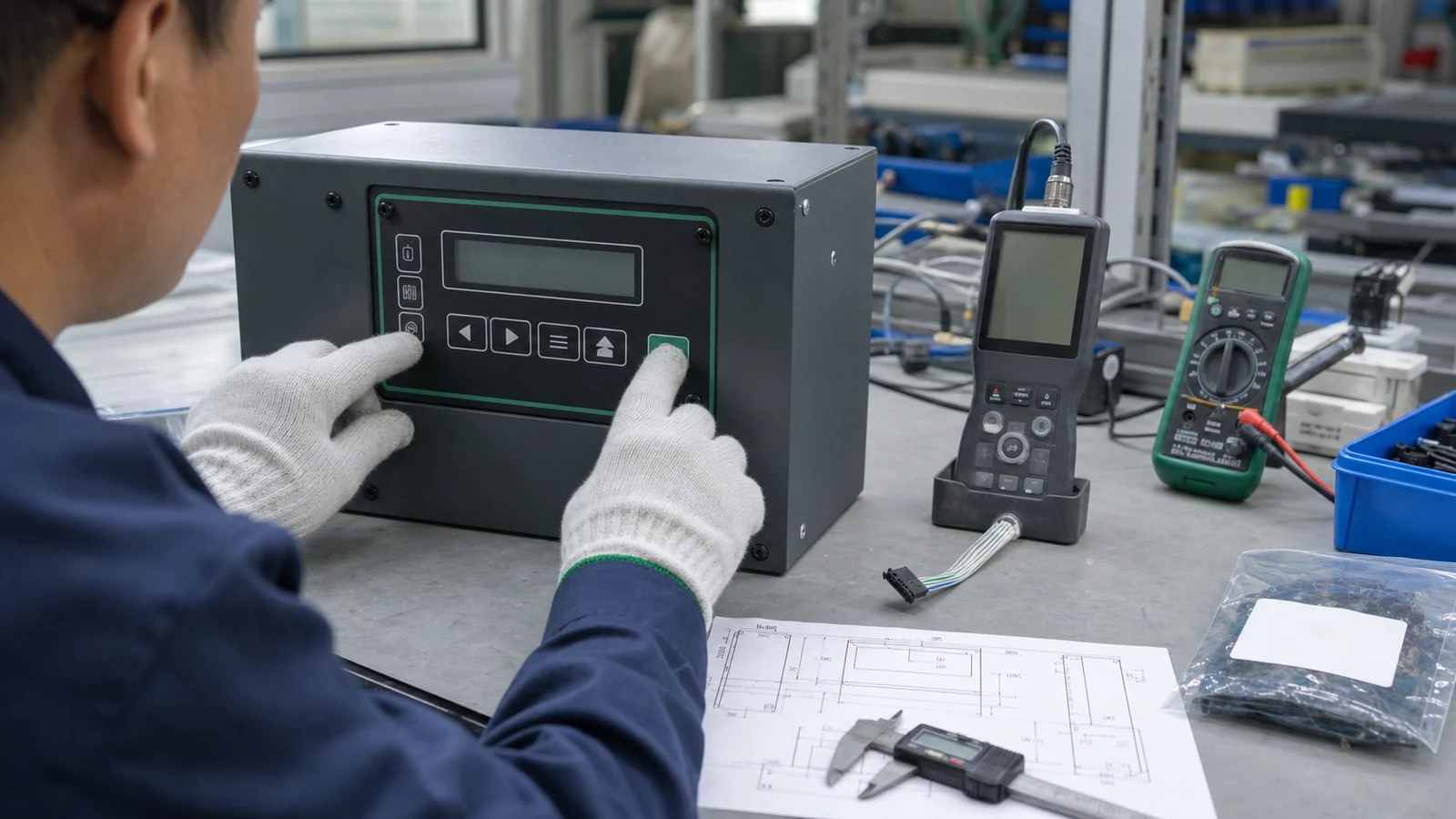
This membrane switch RFQ checklist is for OEM mechanical engineers, electronics engineers, and procurement buyers who need membrane switch quote requirements tight enough for production planning. The checklist applies to concept review, comparable quotation, and production transfer packages.
The target construction is a custom membrane switch stack for industrial, medical-component, appliance, automotive-interface, marine, or instrumentation equipment. The decision boundary is simple: either the package is ready for comparable quotation, or it is still a concept review.
1. Why Incomplete RFQs Destroy Quote Comparability
Membrane switches are multi-layer assemblies, not catalog SKUs. One RFQ that says “PET panel, IP67, tactile, ZIF tail, 5,000 pieces” can still produce five different supplier assumptions about film grade, adhesive chemistry, dome support, vent path, connector pitch, sample acceptance, and whether the IP67 label is an IEC 60529 system claim or a wish.
That gap is expensive in project time, not only in unit price. Supplier A prices a silver-flex PET circuit with a generic acrylic adhesive and a guessed pinout. Supplier B prices an FPC hybrid, a 300LSE-class adhesive, and a named TE-style connector family. Both return numbers. Neither number is comparable, so the buyer either re-quotes or freezes the wrong construction into tooling.
The failure chain is predictable:
- Open interfaces (connector, enclosure surface, cleaning chemistry) stay unmarked.
- Each supplier fills the blanks with a local default.
- Samples pass electrical continuity and still fail housing fit, adhesion, or tactile feel.
- Tooling assets—screen sets, cutting tools, emboss tools, fixtures—lock the wrong stack.
- Procurement restarts with “why did the second sample change everything?”
A membrane switch RFQ checklist exists to stop that chain before quotes are ranked. It does not force every decision to final status on day one. It forces every open decision to be named, so suppliers either quote the same fixed basis or quote named options against the same package.
This article delivers that package: ten evaluation criteria with good-signal and red-flag pairs, a drawing checklist, a quotation-input decision table, a sample-approval matrix, a step sequence from partial package to comparable quotes, and the release blockers that make multi-supplier ranking invalid.
2. Membrane Switch RFQ Checklist: Ten Quotation Inputs
These ten membrane switch quotation inputs are ordered by how often they break comparability. Treat each criterion as a go/no-go gate for multi-supplier pricing, not as a marketing form field.
2.1 Drawing package ownership and revision control
A quote follows the revision that was actually reviewed. If two files disagree about window size, key pitch, or tail exit, suppliers will pick different “current” files.
One current mechanical drawing (PDF for review, DXF/DWG or STEP when fit matters) with revision letter/date, cut lines, windows, key centers, adhesive boundary, and tail exit marked. Conflicting older files are labeled obsolete.
Multiple unmarked PDFs, screenshots without scale, or “use whichever looks latest.” That is not a membrane switch drawing checklist; it is a reconstruction task.
2.2 Artwork and graphic intent
Electrical layout and graphic layout are not the same file. Artwork controls color, dead-front icons, transparent windows, emboss zones, and legend text. Missing artwork forces cosmetic guessing after electrical design is already priced.
Vector artwork (Adobe Illustrator AI, CorelDRAW CDR, or PDF) with Pantone or CMYK notes, window clarity, hard-coat or texture intent, and which legends are fixed brand marks versus functional labels.
JPEG-only icons with no color system, no window callouts, and no note on selective texture or dead-front behavior.
2.3 Outline dimensions, thickness budget, and stack ownership
Suppliers need the outer envelope and the thickness the housing can accept. Without a thickness budget, lighting, emboss, adhesive, and shield layers are free variables.
Text stack ownership (minimum callouts):
A. Graphic overlay film + hard coat / texture / print
B. Overlay adhesive
C. Circuit layer(s): silver PET / FPC / PCB hybrid
D. Spacer / dome carrier / vent path
E. Rear adhesive + optional stiffener / gasket
F. Enclosure surface + connector / PCB mating face
Outline dimensions with critical tolerances on mounting features, maximum stack thickness, and which layers the buyer owns versus which layers the supplier may propose.
“Same size as sample photo” with no caliper data, no window-to-edge keep-outs, and no maximum thickness.
2.4 Circuit function, key map, and pinout
Membrane switch quote requirements fail when the buyer sends only a faceplate drawing. The supplier still needs key count, matrix or common-bus logic, LED polarity if present, and the intended pinout or the explicit statement that pinout is open.
Key map with function names, circuit type preference or open options (silver flex PET, flexible printed circuit FPC, or rigid PCB hybrid), and a pinout table or “pinout open—propose.”
Artwork only, no key functions, no LED or shorting-risk definition, and no confirmation that the controller pinout is fixed by an existing PCB.
2.5 Tail exit, connector family, and mating constraints
Connector mismatch is a common post-sample failure. Pitch, contact side, accepted flex thickness, actuator style, and exit direction are controlled by the selected connector drawing, not by verbal “ZIF-compatible” language. TE Connectivity FPC-style examples show why those attributes must be treated as connector-controlled dimensions rather than free drawing notes.
Named connector series or mating part, pitch, pin count, contact side, tail length range, exit edge, and stiffener needs—or a clear “connector open, housing limits are…” note.
“ZIF tail” with no pitch, no contact side, and no enclosure clearance for the actuator.
2.6 Tactile choice, dome support, and vent path
Tactile, non-tactile, metal-dome, and polydome constructions are not interchangeable line items. Snaptron’s venting guidance is useful here: trapped air can change tactile response, and vent path may run through spacer, carrier, or board depending on the stack.
Target feel (tactile click, soft tactile, flat non-tactile), glove use yes/no, acoustic limits if any, and whether venting into the enclosure is allowed.
“Need good feel” with no support surface description, no glove note, and a sealed IP claim that leaves no legal vent path.
When this is not the best choice: Metal-dome tactile is a poor default when the product needs very low travel, near-silent actuation, or extreme thinness that favors non-tactile or another HMI technology.
2.7 Overlay film family and surface finish
Writing “PET or PC” is not a material callout. Graphic and membrane films are sold by grade, finish, and functional variant. Chemical wipe-down, outdoor UV, deep emboss, and optical windows can force different grades inside the same polymer family.
Polymer family preference if known, finish (matte/gloss/texture/hard coat), optical window needs, and chemical and UV exposure details supporting the family.
“Use cheapest PET” while also requiring outdoor UV, aggressive disinfectants, and deep emboss without stating which requirement wins.
2.8 Rear adhesive and mounting surface energy
Adhesive failure is often a substrate problem, not a “stronger glue” problem. 3M 467MP is positioned around 200MP acrylic for metals and high-surface-energy plastics. 3M 9495LE is positioned around 300LSE chemistry for low-surface-energy plastics and powder-coated paints. 3M surface-preparation guidance still starts with clean, dry, unified surfaces and firm pressure.
Housing material, paint/powder/texture state, temperature during bond and use, removable vs permanent intent, and any edge-lift history from a previous part.
“3M adhesive” with no series, no substrate, and no textured powder-coat housing callout.
2.9 Environment, cleaning, and IP framing
“IP67 membrane switch” without an enclosure definition is incomplete. IEC 60529 classifies degrees of protection provided by enclosures for electrical equipment. The RFQ should describe splash, immersion intent, dust, washdown, cleaning agents, UV, oil, salt, and whether the rating is a full-equipment claim or a sealed-switch design target pending system test.
Real use environment in plain language, cleaning chemistry, temperature range if already specified by the product, and IP language tied to a test article or marked as design target.
Bare “IP67 required” on a loose part RFQ with no housing, no gasket plan, and no test ownership.
If ESD matters, frame it correctly. IEC 61000-4-2 is an equipment-level immunity test method. A keypad RFQ can note ESD design features (shield, ground path), but it should not invent a free-floating kilovolt rating for a bare overlay.
2.10 Quantities, sample path, and acceptance criteria
Quantity context is not only a purchasing field. Prototype count, first production lot, and annual forecast change tooling amortization, inspection sampling, and whether temporary fixtures are acceptable. Acceptance criteria decide whether a sample is “approved” for feel, fit, lighting, adhesion, or only continuity.
Sample quantity, first-order quantity, annual quantity or range, and a short acceptance list (visual, dimensional, tactile, electrical, optical, assembly, environmental as applicable).
“Quote production only” with no sample plan, or “approve sample for everything” with no measurement method.
3. Membrane Switch Drawing Checklist and Quotation Input Tables
3.1 Membrane switch drawing checklist
Use this table as the file-level gate before multi-supplier RFQ.
| File / input | Must show | If missing, suppliers will... |
|---|---|---|
| Mechanical PDF | Outline, windows, key centers, revision, critical notes | Guess cut lines from artwork |
| DXF/DWG or STEP | Exact outline, bosses, ribs, display pocket | Mis-size adhesive and tail exit |
| Artwork AI/CDR/PDF | Colors, legends, dead-front, windows | Quote generic print and rework cosmetics later |
| Circuit / pinout | Matrix, LED polarity, connector pins | Invent a pinout that fails the PCB |
| Connector datasheet | Pitch, contact side, thickness, actuator | Build a tail that will not mate |
| Enclosure photo/drawing | Mounting surface, edge conditions | Pick wrong adhesive and gasket |
| Quantity note | Samples / first lot / annual | Mix prototype and production assumptions |
| Environment note | Cleaning, moisture, UV, gloves, temperature | Under- or over-build the stack |
| Acceptance note | What the first sample must prove | Ship a continuity-only sample as “approved” |
3.2 Membrane switch quotation inputs decision table
| Quotation input | Main drivers affected | Prefer fixed before price ranking? | Acceptable open state |
|---|---|---|---|
| Outline + windows | Tooling, material yield, fit | Yes | Dimensioned sketch with scale |
| Connector family | Tail process, stiffener, assembly | Yes if PCB is fixed | Named housing limits only |
| Annual quantity | Tooling path, inspection plan | Yes for comparable unit price | Explicit range, same for all suppliers |
| Adhesive substrate | Rear adhesive chemistry | Yes if housing is fixed | Substrate photos + material family |
| IP / sealing intent | Gasket, spacer, vent, test plan | Partially | Environment text + system-test owner |
| Tactile construction | Dome, spacer, support, acoustic | Only if UX is locked | “Propose tactile and non-tactile” |
| Overlay polymer | Film grade, emboss, chemical life | No, if environment is complete | Environment-driven recommendation |
| Backlighting | Circuit, windows, light control | Only if night use is fixed | “No backlight” or “LED indicators only” |
| Compliance docs | Material options, records | Yes if customer audit needs them | Named docs, not “all certificates” |
| Sample acceptance | Sample loops, inspection cost | Yes | Matrix of pass/fail checks |
3.3 Sample approval matrix
Do not approve a first article against an undefined “looks good.”
| Check | Typical evidence | Pass meaning | Do not over-claim |
|---|---|---|---|
| Visual | Artwork proof, color notes | Legends, windows, defects within agreed cosmetic standard | Pantone match without lighting condition |
| Dimensional | Drawing critical dims | Mounting and window fit | Full GD&T if not on drawing |
| Tactile | Force feel vs reference or named target | Operator feedback intent met | Million-cycle life without test method |
| Electrical | Continuity, opens/shorts, LED polarity | Circuit matches pinout | Full EMC of finished equipment |
| Optical | Backlight/indicator photos in dark | No unacceptable light bleed | Uniformity grade without meter method |
| Assembly | Dry-fit in housing | Tail, adhesive, and connector clearances work | Production line cycle time |
| Environmental | Agreed coupon or system test | Meets named project test | Universal IP label for loose part |
| Quote comparison gate | Required evidence |
|---|---|
| Construction | Controlled stack and named alternatives |
| Commercial basis | Sample quantity, annual quantity, and tooling scope |
| Acceptance | Visual, dimensional, electrical, tactile, and fit criteria |
| Exceptions | Every deviation listed before price ranking |
4. Step-by-Step Process: From Partial Package to Comparable Quotes
This sequence turns the framework into a buyer process that procurement and engineering can run together.
Step 1 — Freeze the product family and project stage
Identify the part as a membrane switch (or keypad/panel variant), not a silicone rubber keypad or capacitive touch panel, unless those are alternate constructions under review. Mark stage: concept, preliminary drawing, prototype revision, or production transfer. The JASPER public RFQ intake on bestmembraneswitchs.com uses the same stage framing because construction risk changes at each stage.
Step 2 — Assemble the membrane switch drawing checklist package
Collect mechanical drawing, artwork, circuit/pinout, connector note, and enclosure context. If files cannot upload through a web form, use a controlled link or email the package under one project name. JASPER’s send-drawing and request-a-quote paths both treat unfinished packages as valid if open items are marked.
Step 3 — Separate must-have constraints from open preferences
Must-haves might be a fixed TE-style connector pitch, disinfectant wipe-down, glove use, or a customer documentation pack. Preferences might be film brand, dome force band, or matte versus soft-touch texture. Suppliers can optimize preferences. They cannot silently rewrite must-haves.
Step 4 — Add quantity context, including annual quantity
Provide sample quantity, first production quantity, and annual quantity or a stated range. Annual quantity is what makes multi-supplier unit prices comparable. Without it, one supplier amortizes tooling aggressively and another assumes a one-lot project.
Step 5 — Attach environment and acceptance criteria
Write the cleaning chemistry, moisture exposure, outdoor/UV notes, temperature if known, and the sample approval matrix rows that matter for this device. If IP language is required, state whether it is a design target or a system test owned by the equipment team under IEC 60529 framing.
Step 6 — Issue the same package to every supplier
Send identical drawings, revision, quantities, and open-question list. Ask each supplier to restate assumptions in the quote. If one supplier invents a connector or adhesive not in the package, treat that as a non-conforming response, not a bargain.
Step 7 — Review construction alignment before ranking price
Compare stack proposal, connector interpretation, adhesive substrate match, sample scope, and documentation scope. Only then rank commercial terms. A lower unit price that omitted shielding, hard coat, or first-article checks is not a win.
Step 8 — Move accepted construction into sample and production records
After sample approval against the matrix, freeze the released drawing set. Later production orders should reference that revision, not the original concept email.
When a partial RFQ is the wrong tool: If the buyer’s goal is already a ranked price decision among three suppliers, a concept-only package is the wrong instrument. Run a concept review first, then re-issue a fixed-basis RFQ.
5. Release Blockers That Make Quotes Non-Comparable
These conditions override otherwise tidy paperwork. Any one of them is enough to pause multi-supplier ranking.
- No revision control on drawings or artwork — suppliers may price different files.
- Artwork without circuit or pinout — electrical content is invented.
- Connector described only as “ZIF” — pitch and contact side remain free variables.
- Housing substrate unknown — rear adhesive is a guess (see 3M 467MP vs 9495LE positioning).
- IP rating claimed on a loose switch with no test article — conflicts with IEC 60529 enclosure framing.
- Quantity missing or inconsistent across suppliers — unit prices are not on the same basis.
- “Approve sample for production” with no acceptance matrix — feel/fit failures appear after tooling.
- Conflicting must-haves — e.g., fully sealed IP intent plus an undefined vent path for metal domes.
- Compliance requested as “all certificates” — documentation scope is unbounded and unpriced.
- Finished-device regulatory approval expected from a component RFQ — membrane switch manufacturing is not the same as medical device validation or market authorization.
RFQ guides from Niceone, LID (tactilemembrane.com), and BX-Panel can serve as process reminders. Lead time and MOQ must come from current project quotations. Material and connector facts come from primary sources such as 3M 467MP and 9495LE data, TE Connectivity FPC drawings, Snaptron venting notes, Covestro Bayfol and Makrofol selectors, IEC 60529, and IEC 61000-4-2.
6. Frequently Asked Questions
What should a membrane switch RFQ checklist include at minimum?
Include current drawings/artwork with revision, outline and windows, key map or pinout, connector or open-connector limits, sample and annual quantity, environment/cleaning notes, material preferences if any, and sample acceptance priorities. That package is enough to start comparable quotation even if some preferences remain open.
What are the most important membrane switch quote requirements for price ranking?
The requirements that most often break comparability are connector definition, adhesive substrate, quantity basis, sealing/IP framing, and sample acceptance scope. Feature lists without those five still produce scattered prices.
Can a supplier quote without Gerber files?
Yes. PDF drawings, Adobe Illustrator or CorelDRAW vector artwork, sketches, photos, and a pinout note can start review. Gerber files or detailed circuit drawings help when the silver flex or FPC layout is already designed, but they are not always required for the first RFQ pass.
What belongs on a membrane switch drawing checklist if only a sample exists?
Send front, back, tail, connector, and side photos with a scale reference, measured outline if possible, known failures, and the mating housing material. Mark every unknown. A physical sample is evidence, not a complete production package.
Should annual quantity be included before the design is final?
Yes, as a range if needed. Annual quantity changes tooling path and inspection planning. State the same range to every supplier so unit prices share one commercial basis.
How should IP65 or IP67 appear in an RFQ?
Describe the real exposure and whether the claim is a system test target. IEC 60529 rates enclosures, so a loose membrane switch callout without housing and test ownership is incomplete.
Is “PET overlay” enough material detail?
No. Film grade, finish, chemical exposure, and optical windows matter. Covestro-style selectors show multiple grades inside PET and PC families. Environment notes often matter more than the polymer acronym alone.
Which adhesive information prevents the most rework?
Mounting surface material and finish. Metals and high-surface-energy plastics map differently from low-surface-energy or powder-coated surfaces. Use the 3M 467MP (200MP) versus 3M 9495LE (300LSE) positioning examples as a starting split, then confirm with the housing finish. Clean, dry, unified surfaces still matter at install.
Can unfinished drawings go to RFQ?
Yes, if open decisions are listed. A concept package is valid for engineering review. It is the wrong package for final multi-supplier unit-price ranking.
Does a component RFQ replace finished-device validation?
No. Custom membrane switch manufacturing can support drawings, samples, and inspection records. Finished medical, automotive, or safety equipment validation remains with the device manufacturer and applicable regulatory process.
7. What to Do Next
Build one package: drawing checklist files, quotation inputs table filled as fixed or open, annual quantity, environment notes, and sample approval matrix. Send that same package through the request a quote flow, and use send drawing when the file set needs an engineering note first.
If the construction is already known to be a custom membrane switch, start from the product context on the custom membrane switches page, then attach the RFQ package rather than a feature slogan. For pre-tooling drawing risk, pair this checklist with membrane switch design mistakes and before freezing screens and dies.
Technical References
- Source: IPC-D-325 documentation requirements for printed boards and assemblies. Accessed 2026.
- Source: ASTM F1578 membrane switch contact closure cycling practice. Accessed 2026.
- Source: IEC 60529 enclosure protection classification. Accessed 2026.
- Source: 3M membrane switch spacer and adhesive technical data. Accessed 2026.
- Source: Covestro Makrofol and Bayfol Film Selector Guide. Accessed 2026.
- Source: Snaptron metal dome venting and actuator guidance. Accessed 2026.
- Source: TE Connectivity FPC connector product drawings. Accessed 2026.
- Source: ISO 9001 documented information and configuration control principles. Accessed 2026.
- Source: IEC 60068-2-14 temperature change testing. Accessed 2026.
- Source: ASTM D3330 pressure-sensitive tape peel adhesion test method. Accessed 2026.
- Source: UL 94 flammability classification for plastic materials. Accessed 2026.
- Source: RoHS Directive 2011/65/EU restricted substances scope. Accessed 2026.
Issue a complete and comparable RFQ
Send the current drawing revision, artwork, electrical map, annual quantity, environment, open choices, and sample approval criteria.