
A custom HMI assembly RFQ checklist needs a controlled drawing, BOM, interface data, supply-owner matrix, sample/test rules, quantities, and milestone dates. For a firm quote, assign ownership for 100% of six assembly subsystems and clear every critical drawing/BOM revision conflict. Have each supplier price the same handoff, quantity, and acceptance scope before comparing totals.
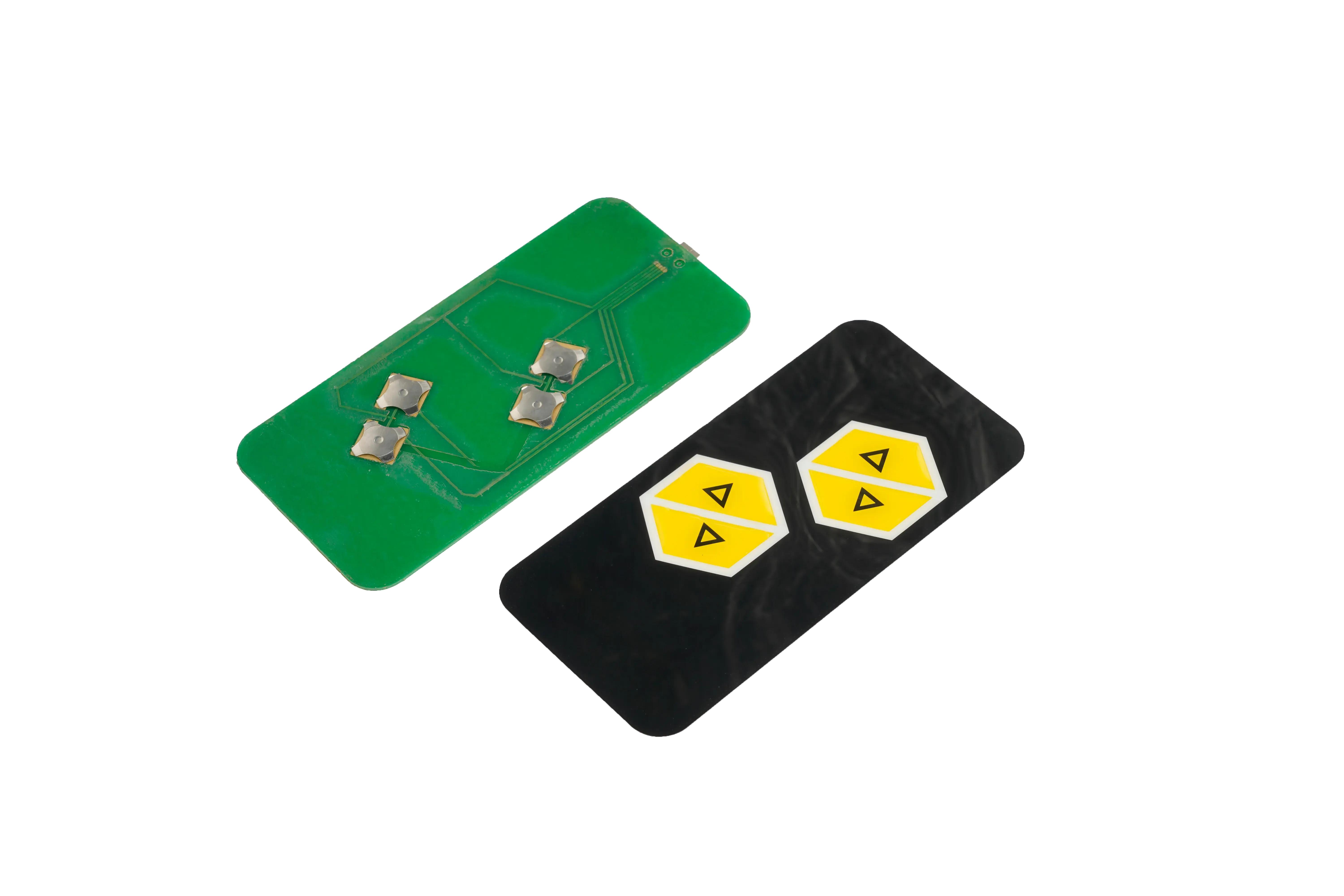
Start with one controlled buying baseline
A useful operator panel assembly request for quotation defines what the OEM expects to receive, not just what the finished front looks like. An attractive rendering cannot tell a buyer whether the display, input device, PCB, connector, gasket, mounting hardware, test, or protective packaging is included.
Choose the purchased assembly route that best describes the handoff: membrane switch HMI assembly, capacitive touch HMI assembly, silicone keypad HMI assembly, display-integrated HMI assembly, PCB/FPC HMI assembly, or enclosure-mounted front-panel HMI assembly. These six categories organize this RFQ; they are not mutually exclusive technologies or a claim that every project uses six separate products.
For every relevant item, choose a supply model: supplier-sourced, customer-supplied, or mixed supply. A mixed build might use a customer-nominated display with supplier-sourced overlays and harnesses. Record the source, part number, revision, expected condition on receipt, and who carries loss or defect risk for customer-supplied parts. An RFQ that says only “complete HMI” leaves all of those costs open.
The 100% ownership and zero critical revision-mismatch gates are recommended buyer controls, not factory test results or universal industry requirements. They apply to the quote baseline: the front panel, display/window, keys/touch, PCB/FPC, cable/harness, and rear mechanical structure. If a subsystem is absent, record it as excluded with the OEM as owner rather than silently skipping it.
Copy this RFQ cover sheet into your inquiry
A one-page cover sheet establishes the HMI panel quote information required for a usable bid. Copy the following table into your procurement form, complete the open cells, and distribute the same version to every bidder. If a field does not apply, enter “N/A” deliberately rather than leaving an unexplained blank.
| RFQ field | Buyer entry | Why the bidder needs it |
|---|---|---|
| RFQ ID and issue date | Controls which inquiry is being answered | |
| OEM project and purchased assembly part number | Prevents confusion with the finished machine part number | |
| Assembly drawing number and revision | Defines the mechanical/electrical deliverable | |
| BOM number, revision, and approved alternatives | Sets sourcing assumptions and component identity | |
| Intended assembly route and supply model | Defines integrated versus customer-supplied content | |
| Prototype quantity; pilot quantity; annual demand | Separates short-run setup from repeat-volume economics | |
| Requested production quote quantities | Ensures all prices use identical quantity breaks | |
| Destination, shipping terms, and required packaging | Makes logistics and landed-cost comparisons possible | |
| Expected RFQ return date and quote-valid-through date | Supports procurement decisions before price expiry | |
| Sample approval owner and required decision date | Connects samples to a named release authority | |
| Required first-article/pilot and production shipment dates | Exposes long-lead dependencies | |
| Open assumptions and bidder clarification deadline | Keeps uncertainty visible to all bidders |
Use separate, clearly identified budgetary and firm production quote requests when design maturity differs. If only an appearance drawing exists, ask for a budgetary scenario with its exclusions and cost drivers. Do not treat that price as a firm build-to-print offer or release tooling against it.
Attach a revision-controlled document manifest
Send the current assembly definition as an indexed package so a supplier can trace each cost and technical question to the same revision. A PDF can be the controlled viewing copy; editable CAD, artwork, and electrical files may be needed for the agreed manufacturing work. The buyer's manifest should identify both, without assuming any particular file format is universally required.
| Attachment to send | Minimum information to include | Rev / filename in buyer's manifest |
|---|---|---|
| Assembly drawing and exploded view | Envelope, installed condition, orientation, tolerances, stack, datum scheme | |
| Front panel and artwork | Cutouts, display window, legends, finish, visible cosmetic zones | |
| Display or window specification | Supplied module ID, active/view area, orientation, retention and optical acceptance | |
| Keypad/touch definition | Input map, switch or touch type, connector/tail, operating states | |
| PCB/FPC package where supplied | Board outline, schematic, BOM, pinout, firmware/configuration boundary | |
| Harness and connector detail | Mating part, pin 1, pin map, lengths, bend/strain relief and cable exit | |
| Mechanical integration | Enclosure cutout, mounting pattern, rear keepout, gasket joint and fasteners | |
| Conditions and acceptance | Temperature/exposure, cleaning, visual limits, inspection and functional tests | |
| Supply and approval records | Supply-owner matrix, sample plan, deviations, approval signatures |
State units and reference conditions, especially for front-panel fit, mounting force, operating environment, display performance, and ingress expectations. A requested enclosure ingress rating is not automatically a certified rating for an uninstalled front module. Similarly, the drawing should distinguish window only from display supplied and installed.
Each attachment needs a revision and issue date. Put the manifest at the front of the RFQ and require bidders to identify any document they priced against a different revision. The critical mismatch rule is simple: do not compare or convert a quote to a purchase order while a cost- or fit-relevant revision conflict remains unresolved.
Assign supply, integration, and test responsibilities
Price comparability depends on a named owner for each physical assembly subsystem. Use this responsibility matrix even when an item is explicitly excluded. The roles below are prompts for a project-specific agreement, not a promise that every supplier provides all six subsystems.
| Assembly subsystem | Sourced by / part and rev | Installed by | Acceptance evidence and owner |
|---|---|---|---|
| Front surface, bezel, graphics, or overlay | |||
| Display module or optical window | |||
| Membrane keys, silicone keys, or touch interface | |||
| PCB, FPC, controller interface, or board carrier | |||
| Cable, tail, harness, and mating connector | |||
| Rear carrier, gasket, fasteners, and mounts |
Add rows for supplied labels, adhesives, fixtures, protective films, and spare parts when they affect the physical handoff. For customer-owned material, agree on incoming inspection, surplus disposition, shortage handling, scrap allowance, replacement responsibility, and the point at which inventory risk transfers.
Decide who designs a test, who performs it, which units are tested, what evidence accompanies shipment, and who approves a deviation. A continuity test alone does not validate optical quality, touch behavior in its mounted stack, enclosure sealing, machine safety functions, or finished-system electromagnetic performance.
An assembly can be a useful single purchased module while the OEM retains PLC programming, SCADA functions, cabinet integration, host software, machine wiring, safety logic, and final equipment compliance. Record that division in the quotation instead of using “turnkey” to imply an entire control system.
Specify the interfaces that can change the quote
Mechanical and electrical interfaces drive tooling, test access, assembly labor, and rework risk. At minimum, describe the panel outline and cutout in millimeters, mounting datums, mating surface, stack height, gasket path, rear clearance, connector location and orientation, cable exit, strain relief, and the expected installed state.
For a supplied display, specify its controlled model and revision, active/viewing window, data/power connection, backlight behavior, visible cosmetic criteria, and service strategy. For keys or touch, provide the input map and operating conditions; for a PCB or FPC, define pinout, test pads if used, connector mating pair, power/interface boundary, and configuration ownership. State the environmental exposure and how the assembly will be installed before choosing a test method.
A product-specific mounting drawing may require an exact cutout tolerance, fastener engagement, and tightening torque. Those figures belong to that model and mount; copying them into a different custom panel RFQ would be unsafe. Request the mechanical evidence for your enclosure rather than treating another operator panel's dimensions as an industry default.
For physical HMI assemblies, JASPER's HMI assembly overview describes the component and handoff boundaries that the quotation should make explicit. A design team needing a deeper engineering release review can also use the HMI panel assembly design checklist; the buying form here remains focused on what is priced, approved, and ordered.
Define every charge and quotation exclusion
An HMI price can be lower because the buyer will perform more work. Require each bidder to state whether a line is included, separately priced, buyer-provided, or excluded. Do not accept an empty cell as “included.”
| Cost or delivery line | Required bidder response | Buyer comparison rule |
|---|---|---|
| Recurring assembly unit price | Currency, quantity tier, assembly revision | Same revision and quantity for all bids |
| Tooling and nonrecurring engineering (NRE) | Amount, payment trigger, deliverable, ownership and reuse rights | Treat as one-time cost unless stated otherwise |
| Display, PCB, harness, and nominated parts | Exact included items and approved substitutions | Price missing items into the evaluated scope |
| Sample and first-article builds | Quantities, setup fees, reports, approval support | Do not hide pilot expense in unit pricing |
| Functional, visual, and dimensional testing | Test level, coverage, fixtures, report retention | Compare equivalent acceptance evidence |
| Programming or configuration | Supplied file/revision, loading and verification owner | Exclude unrelated system software |
| Labels, protection, and packaging | Individual/bulk, ESD/moisture needs, shipment state | Equalize material and handling charges |
| Engineering changes and requalification | Rate basis, new tooling trigger, disposition fees | Document who authorizes each change |
| Freight, duties, tax, and shipping terms | Included/excluded, destination, shipment basis | Normalize only defensible landed costs |
| Warranty and nonconforming material | Defect handling, inspection records, replacement terms | Compare liability and evidence, not promises alone |
Ask who owns and may transfer the tools, artwork masters, programming files, inspection fixtures, and test software funded through NRE. Ownership, access, maintenance, storage, transfer costs, and repeat-order use are separate questions. A tooling payment by itself does not necessarily convey the tool's rights.
A usable quote should identify assumptions about yields, scrap, customer-furnished material, freight basis, currency, minimum order quantity, price-break quantities, and substitutions. Agree what happens when a customer revision, an approved alternate component, a new test requirement, or an expedited schedule changes the cost. Require written authorization before work on chargeable changes.
Compare HMI assembly quotations on the same scope
Use a normalized lot cost, not a single quoted unit price, when comparing custom HMI suppliers. First resolve differences in supplied components, sample/test coverage, acceptance records, packaging, shipment terms, and revision; only then compare evaluated cost.
Evaluated lot cost = (recurring unit price × lot quantity) + one-time NRE/tooling allocated to that purchase + separately charged test and packaging + freight and other buyer-relevant landed charges.
This formula answers a defined purchase scenario, not lifetime total cost of ownership. Do not count an NRE charge again in later lots if it has already been paid, and do not guess duties or engineering labor that you cannot substantiate.
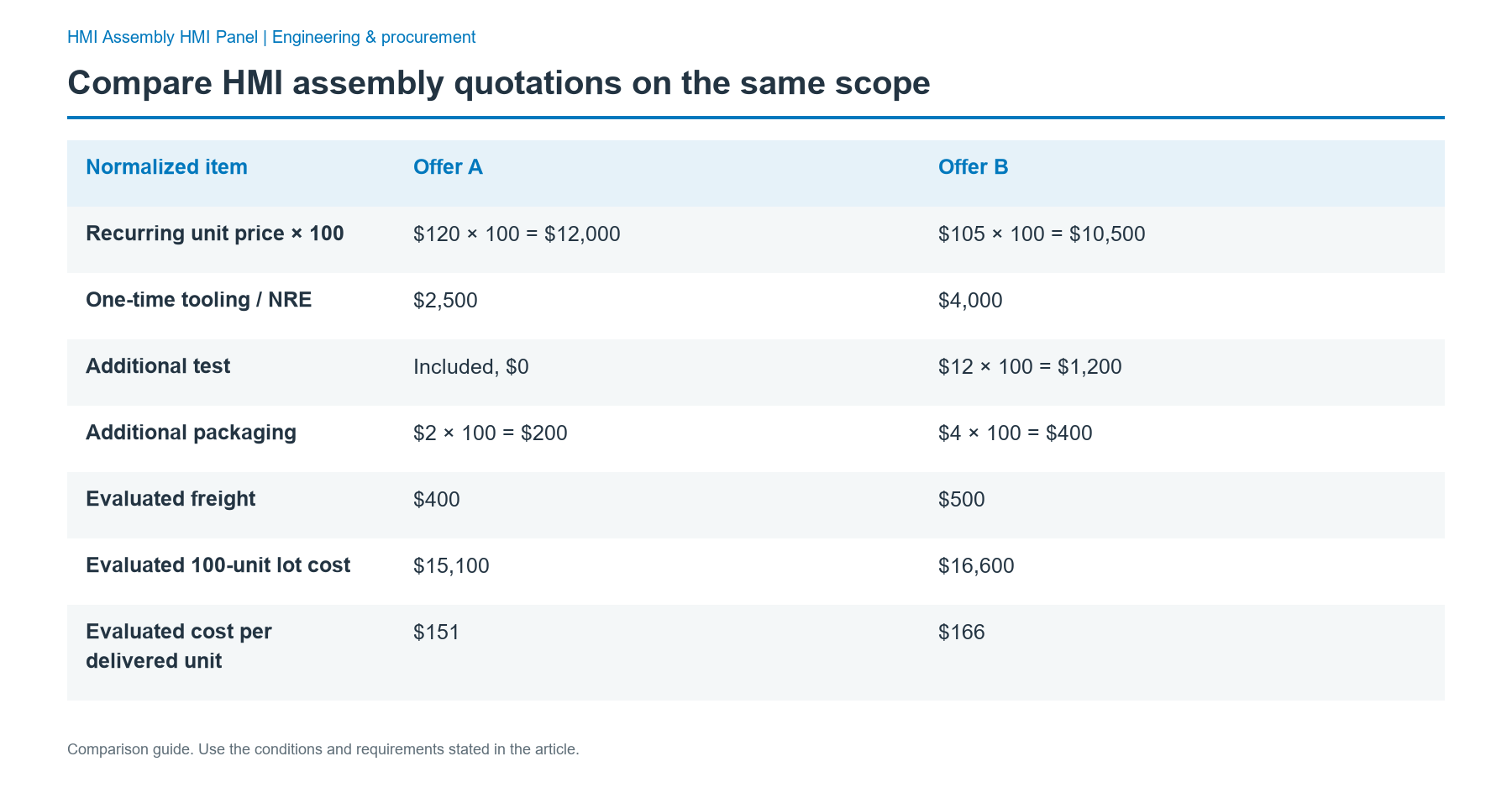
The following illustrative 100-unit scenario shows why the cheapest unit offer need not win. These are invented calculation inputs, not supplier quotations, market averages, or JASPER prices. Both offers are assumed to meet the same drawing and acceptance scope.
| Normalized item | Offer A | Offer B |
|---|---|---|
| Recurring unit price × 100 | $120 × 100 = $12,000 | $105 × 100 = $10,500 |
| One-time tooling / NRE | $2,500 | $4,000 |
| Additional test | Included, $0 | $12 × 100 = $1,200 |
| Additional packaging | $2 × 100 = $200 | $4 × 100 = $400 |
| Evaluated freight | $400 | $500 |
| Evaluated 100-unit lot cost | $15,100 | $16,600 |
| Evaluated cost per delivered unit | $151 | $166 |
Under these inputs, Offer A is $1,500 less for the initial 100-unit lot, despite its higher quoted unit price. The outcome changes with quantity: if every recurring charge, fixed charge, and freight assumption stayed unchanged for a single 2,000-unit order, the corresponding figures would be $246,900 for A and $246,500 for B. Real orders require fresh capacity, freight, quote-validity, and volume-price confirmation before using a different quantity.
For an operational comparison sheet, copy these columns into the bid tab: RFQ/revision; quantity; supplied subsystems; exclusions; unit price; NRE ownership; test; packaging; transport; evaluated lot cost; sample evidence; delivery milestone; quote expiry; unresolved deviations; decision. Write “not comparable” until material scope differences are priced or resolved. A red flag is a bid that looks cheaper only because it omits the display, incoming inspection, or test records specified in the RFQ.
Separate budgetary pricing from a firm quote and track validity
A front-view drawing can support budgetary pricing if the supplier lists the assumed panel construction, input technology, display ownership, mechanical stack, connection, volumes, and missing decisions. It usually cannot justify an unconditional firm price for a fully integrated operator module.
| Quote status | Buyer may use it for | Evidence needed to advance |
|---|---|---|
| Budgetary / concept | Planning scenarios and sourcing conversations | Assumptions, major exclusions, cost drivers, missing dimensions and interfaces |
| Firm for a named revision and scope | Bid comparison and potentially a production PO within validity | Controlled drawing/BOM, supply matrix, test/pack scope, accepted deviations, written commercial terms |
Add valid through, currency, named quantity tier, long-lead display/semiconductor status, approved substitute policy, and material reservation or purchase authorization status to the quote log. If validity expires, ask the bidder to reconfirm affected component pricing, availability, minimums, lead times, freight, and currency, rather than assuming the entire old quotation still stands. “Material identified” is not the same as “material reserved.”
Approve samples and milestones before releasing production
A sample approval has purchasing value only when it identifies exactly what was inspected and which version can be reordered. Name the decision owner, target dates, evidence, and deviation pathway before sample fabrication. Use a gate sequence rather than treating “samples approved” as a verbal status.
| Procurement gate | Release evidence | Approval or hold decision |
|---|---|---|
| G1: RFQ baseline accepted | Manifest, BOM/revision, supply matrix, quote assumptions | Request clarified or comparable bids |
| G2: Commercial and NRE release | Selected offer, payment/tool rights, scope, milestone dates | Authorize only the agreed sample/tool work |
| G3: Sample / first article | Sample IDs, actual assembly revision, fit, input/display, inspection and test records | Approve, approve with documented deviation, or reject |
| G4: Production baseline frozen | Approved deviations, updated drawing/BOM, golden-sample reference | Authorize production PO for exact revision |
| G5: Pre-shipment acceptance | Agreed test results, labels, traceability, packaging and quantity | Release or contain affected shipment |
Create a sample decision record with the fields sample identifier, build date, drawing revision, BOM revision, installed display/board/firmware versions where applicable, visual standard, measured key dimensions, functional-test revision, deviations, rework, approver, approval date, and production disposition. “Approved for appearance only” must not be interpreted as approval of electrical function or mounted sealing.
Require each supplier to identify the quote turnaround, design-for-manufacture review, engineering question cutoff, tooling authorization, sample build, corrective-sample loop if required, pilot production, and first shipment as distinct schedule milestones. Lead time starts from a named trigger—such as approved data, payment, or released material—not simply “weeks after PO.” The buyer should maintain a milestone log with planned date, actual date, owner, open issue, and recovery action.
Match the production purchase order to the approved build
A prototype assembly part number should never be promoted silently into a mass-production order. At PO release, enforce zero unresolved critical mismatches across the buyer's released documents, the supplier's quote, and the sample approval record.
| PO cross-check | Values that must match or be explicitly authorized |
|---|---|
| Item identity | Production assembly part number, drawing revision and BOM revision |
| Configuration | Display, board, firmware/configuration and harness versions, where supplied |
| Approval record | Sample ID, approval status, dated deviations and their disposition |
| Commercial baseline | Quote reference/expiry, tier, quantity, price, NRE already paid or outstanding |
| Delivery and quality | Ship date trigger, destination, packing, test evidence, traceability, defect handling |
| Change authority | Named approvers, documented engineering-change trigger and commercial response |
State on the PO which reference governs if the quote, drawing, BOM, and approval log disagree. Do not let a packing label or a remembered prototype nickname substitute for the controlled production identifier. For an alternate part, require the approved alternate list or a signed deviation tied to the shipped lot.
Use supplier evidence and red flags to make the award
For this product, a good signal is a bidder who returns a priced scope and exceptions matrix, flags inaccessible mounting or connector details, provides example inspection/traceability formats, identifies long-lead parts and customer-furnished risks, and links sample approval to production change control. That evidence matters more than an unsupported statement that every HMI is “fully tested.”
Red flags include an unexplained quotation revision, a display listed as both supplied and excluded, an NRE fee with no deliverable or ownership terms, customer-supplied parts without incoming controls, a sample accepted without its tested configuration, and a production lead time that ignores critical component availability. Escalate unresolved fit, power, test, or safety boundary issues before a price award; do not use a discount to waive them.
Send the RFQ package with the decision criteria
Send one controlled RFQ cover sheet, the drawing/BOM and attachment manifest, mechanical and electrical interfaces, six-subsystem responsibility matrix, sample and test scope, requested quantity tiers, annual forecast, project dates, and written quotation-exclusion questions. Ask each bidder to return its signed assumptions, deviations, evidence plan, price breakdown, and validity date in the same layout.
For a project review, request a JASPER quote with the assembly drawing, BOM, mechanical/electrical interfaces, supply-responsibility table, sample and test scope, annual volume, and milestones. The resulting written scope—not a generic service description—should determine what is supplied, tested, and accepted.
Frequently asked questions
What files are required to request a custom HMI assembly quote?
Start with a controlled assembly drawing, BOM, front-panel artwork, key or touch map, display and PCB information where supplied, connector/pinout and harness details, mounting interfaces, and a supply-responsibility matrix. Add quantities, environment, packaging, sample acceptance, testing, and delivery milestones. Mark unavailable data as open assumptions, especially if the request is budgetary.
Can I get a reliable HMI quote with only an appearance drawing?
You can request a budgetary estimate, but an appearance drawing rarely defines the internal display, board, harness, mounting, sealing, and test responsibilities needed for firm assembly pricing. Ask the supplier to state its assumed construction, major cost drivers, exclusions, and the drawings required to move to a revision-specific production quote.
How should I compare two very different HMI assembly quotes?
Align the assembly revision, included components, quantity, supply ownership, tests, packaging, freight, and delivery terms first. Calculate evaluated lot cost by adding recurring units, applicable one-time charges, separately priced inspection and packaging, and relevant transport costs. Mark unresolved scope differences as not comparable instead of declaring the lowest unit number the winner.
Which hidden charges should an HMI RFQ call out?
Ask separately about tooling, NRE, sample iterations, test fixtures, programming or configuration, inspection reports, protective packaging, freight, engineering changes, and requalification. For every line, require included, priced, buyer-provided, or excluded status. Also clarify ownership and transfer rights for paid tooling and who authorizes chargeable changes before work starts.
What should I reconfirm when an HMI quotation expires?
Reconfirm the validity of display and electronic component prices, long-lead availability, minimum orders, substitution permissions, freight assumptions, currency, and the production slot. Check whether any material was actually reserved under written authorization. Keep the old quote for audit history, but use a new confirmed commercial baseline for the purchase order.
How can I stop a prototype revision from entering a production PO?
Match the production assembly part number and drawing/BOM revisions to the approved sample record and selected quote. Include the display, PCB, harness, and configuration versions where applicable. Resolve every critical conflict, record approved deviations, and name the change authority before issuing the production order. Do not rely on the prototype's informal name.
Does an HMI assembly quote include PLC software or complete machine validation?
No. A quote for a custom operator-front assembly covers only the parts, integration work, and checks expressly named in its released scope. PLC programming, SCADA, cabinet wiring, machine safety, finished-system regulatory approval, and complete equipment validation normally remain with the OEM or integrator unless separately contracted and specified.
Bring the drawing, stack and operating conditions
JASPER engineering will review the interfaces, open risks and evidence required for a production quote.