
A custom capacitive touch panel cost breakdown separates one-time engineering and tooling, recurring build cost, production losses, and delivered logistics. For comparable OEM quotes, use the same supplied assembly and acceptance plan. A practical comparison case is 1,000 accepted panels per order and 10,000 accepted panels in the first year; these are buyer-selected modeling quantities, not industry minimums or quoted prices. Ask whether each unit price already includes inspection, scrap, controller tuning, and packaging before adding those costs again.
The cost tree: what belongs in each bucket?
The cost of a custom projected-capacitive (PCAP) panel is not a single material price. A buyer needs a cost tree that distinguishes charges paid once, charges incurred on each unit or batch, production loss, and the expense of getting accepted panels to the receiving dock.
| Cost bucket | What may be included | How to quote and compare |
|---|---|---|
| One-time engineering (NRE) | Sensor artwork, stack review, controller configuration, initial validation plan | Separate project fee, deliverables, revision limits, and payment gates |
| One-time tooling and fixtures | Cover cutting/printing tools, lamination alignment fixtures, test fixtures | Separate ownership, maintenance, storage, replacement, and transfer rights |
| Samples and pilot builds | Prototype materials, setup, measurement, small-batch handling, qualification samples | Show sample quantity, price, setup charges, and whether later credited |
| Recurring materials and conversion | Cover lens, electrodes, adhesives, FPC, controller, assembly labor | Price for a specified accepted-unit lot and released revision |
| Production loss and rework | Scrap, rework, yield risk, cosmetic rejects | State whether included in accepted-unit price; never add twice |
| Batch and outbound costs | Lot setup, special inspection, protective packing, documents | Separate fixed-per-shipment and variable-per-panel fees |
| Landed logistics and OEM work | Freight, insurance, brokerage, applicable taxes, host/display integration | Assign payer and scope; distinguish invoice price from buyer's total cost |
The most useful comparison is cost per accepted, delivered panel under the same scope, with one-time spend shown separately and then allocated over a declared recovery quantity. A forecast is not automatically a binding purchase commitment. If tooling recovery depends on a minimum order, cancellation, or remaining balance, record that commercial condition beside the unit calculation.
Freeze the supplied boundary before comparing suppliers
A low quote may simply stop at an earlier assembly boundary. For a sourcing worksheet, classify every offer into one of the following five buyer-defined scope choices; hybrid offers must state their exceptions.
| RFQ scope | Included output | Typical responsibility left with the OEM |
|---|---|---|
| A. Decorated cover lens | Machined or printed cover and specified finish | Sensor, controller, bonding, integration |
| B. Sensor and FPC | Electrode sensor and tail/connector | Cover, controller, bonding, host validation |
| C. Bonded touch front | Cover, sensor, specified internal adhesive, FPC | Controller if excluded, display mating, host validation |
| D. Configured touch subassembly | Scope C plus specified controller hardware/configuration and test output | Display, enclosure, host application and finished-device tests |
| E. Display/HMI module | Touch front plus separately specified display, mounting or electronics | Only those tasks expressly excluded by the assembly agreement |
These are RFQ classifications, not five universal factory product grades. Scope D is the reference in the worked example below, excluding the display, external cable harness, enclosure, finished HMI assembly, application firmware, and finished-product compliance. Request a boundary drawing with every quote. If one offer includes a display and another does not, price the omitted display and integration work independently before ranking them.
For the available capacitive routes and component boundaries, review JASPER's custom capacitive touch panels offering. Describe the actual required scope rather than assuming every optional architecture or downstream system service is included.
Which PCAP design choices move recurring cost?
Cover construction, electrode geometry, controller choice, bonding and acceptance criteria are major custom touchscreen pricing factors. Their interactions matter: a cheaper lens or sensor can require more tuning, reduce optical acceptance, or shift work into the OEM's assembly line.
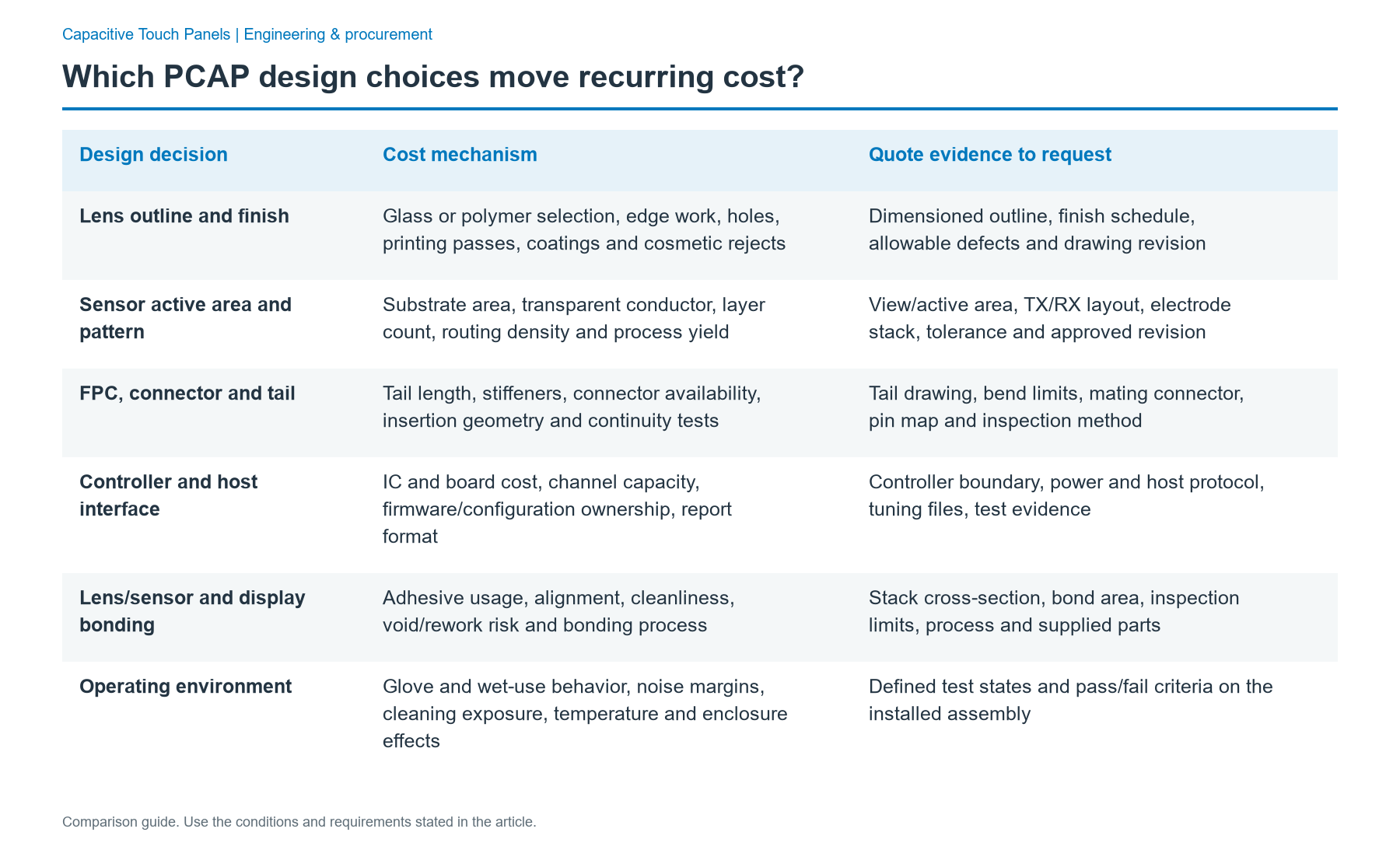
| Design decision | Cost mechanism | Quote evidence to request |
|---|---|---|
| Lens outline and finish | Glass or polymer selection, edge work, holes, printing passes, coatings and cosmetic rejects | Dimensioned outline, finish schedule, allowable defects and drawing revision |
| Sensor active area and pattern | Substrate area, transparent conductor, layer count, routing density and process yield | View/active area, TX/RX layout, electrode stack, tolerance and approved revision |
| FPC, connector and tail | Tail length, stiffeners, connector availability, insertion geometry and continuity tests | Tail drawing, bend limits, mating connector, pin map and inspection method |
| Controller and host interface | IC and board cost, channel capacity, firmware/configuration ownership, report format | Controller boundary, power and host protocol, tuning files, test evidence |
| Lens/sensor and display bonding | Adhesive usage, alignment, cleanliness, void/rework risk and bonding process | Stack cross-section, bond area, inspection limits, process and supplied parts |
| Operating environment | Glove and wet-use behavior, noise margins, cleaning exposure, temperature and enclosure effects | Defined test states and pass/fail criteria on the installed assembly |
Two display-joining alternatives require particularly clear comparison: a controlled air gap and full optical bonding. Air-gap assembly can make display replacement easier but adds optical interfaces and space. Full optical bonding can address reflection and contamination at those interfaces, while introducing adhesive, alignment, yield and rework requirements. Neither is automatically cheaper across the full lifecycle. A touch-front adhesive layer is not the same purchasing line as bonding the touch front to the display; quote them separately.
Panel outline and cover thickness are continuous design variables within the chosen process capability, not universal step sizes. Similarly, touch count, interface speed and coating life cannot be reduced to a common price ladder. If water or gloves are part of the use case, define the actual glove material, wetting condition, powered display state and intended/false-touch acceptance. Component capability does not replace installed-device validation.
Separate NRE, tooling, samples and production price
Nonrecurring engineering (NRE) buys project work; production price buys accepted repeatable units. Do not compare an expensive prototype with a production quotation as if both were made under the same process and purchase volume.
Ask for line items for sensor artwork, cover tooling, controller tuning, host-interface verification, electrical/optical test fixtures, prototype setup and any pilot-process development. For each charge, record the output: a drawing set, sample revision, stored tool, test method, configuration file or approved first article. A tooling payment should not be treated as proof of title unless the agreement establishes ownership and access.
Prototype samples may use temporary tooling, hand assembly, extra inspection or individually tuned configurations. Those are valid reasons for a high sample unit price, not evidence that the same price will apply to a released production lot. Request three separate commercial views: initial engineering/tooling, sample/pilot charges, and recurring price at named accepted quantities. Specify whether a prototype deposit is credited against tooling or future orders; never assume a credit.
A buyer can ask for price breaks at 100, 1,000 and 5,000 accepted units per order, paired with a 10,000-unit annual forecast. These quantities are an illustrative RFQ comparison grid, not standard market breaks. Note order frequency, material lead-time exposure, minimum shipment, volume commitment and price-validity period. If the same supplier can offer different stack architectures, compare them under separate drawing revisions rather than placing unlike designs in one price-break column.
Calculate cost per accepted panel, not per started panel
The model should name units and prevent double counting. If a supplier charges per accepted shipped panel and absorbs normal scrap, use that quoted unit price as the recurring starting point. If the supplier instead discloses cost per unit started and yield is not priced in, a simplified full-cost yield model is useful for scenario comparison:
Adjusted recurring cost ($/accepted panel) = started-unit conversion cost ($/started panel) ÷ accepted yield (accepted panels/started panels).
This simplified formula assumes all listed conversion cost is exposed to the same yield loss. In a real process, material and inspection costs enter at different stages; request a stage-level model before turning the estimate into contractual pricing. Rework can have its own costs and recovery rate. Never add an extra scrap percentage on top of an accepted-unit quote that already incorporates it.
For initial program evaluation:
First-year equivalent cost ($/accepted panel) = adjusted recurring cost + export packing + allocated freight + insurance + brokerage/handling + NRE ÷ recovery quantity + sample spending ÷ recovery quantity + applicable duties/taxes per unit + OEM integration cost per unit.
Include the last two terms only when the actual tariff/tax treatment and OEM integration scope are known. Recoverable tax is not necessarily a permanent cost. Compare cash timing separately: paying NRE before first article approval affects exposure even when the eventual amortized cost is small.
Illustrative USD cost breakdown and sensitivity test
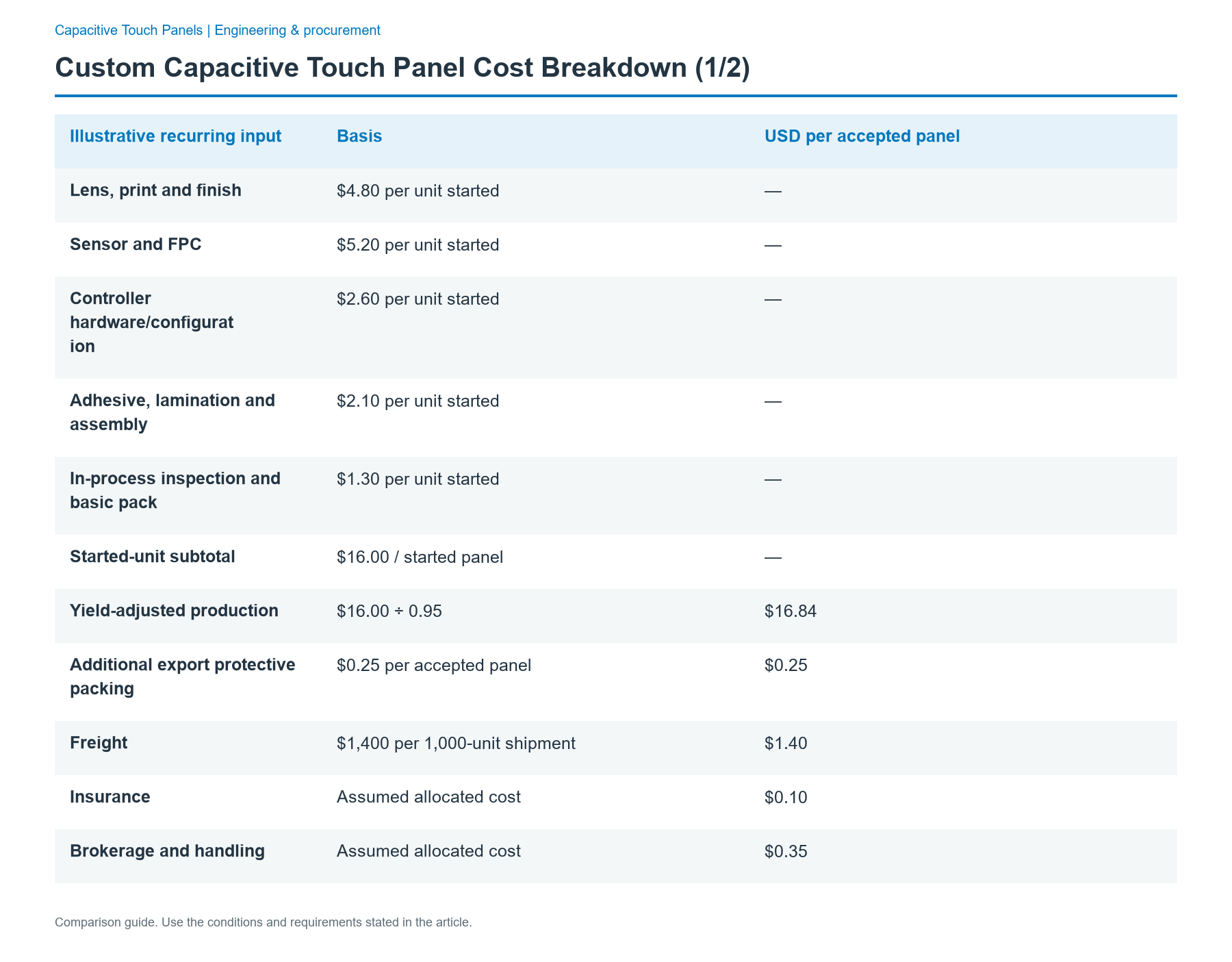
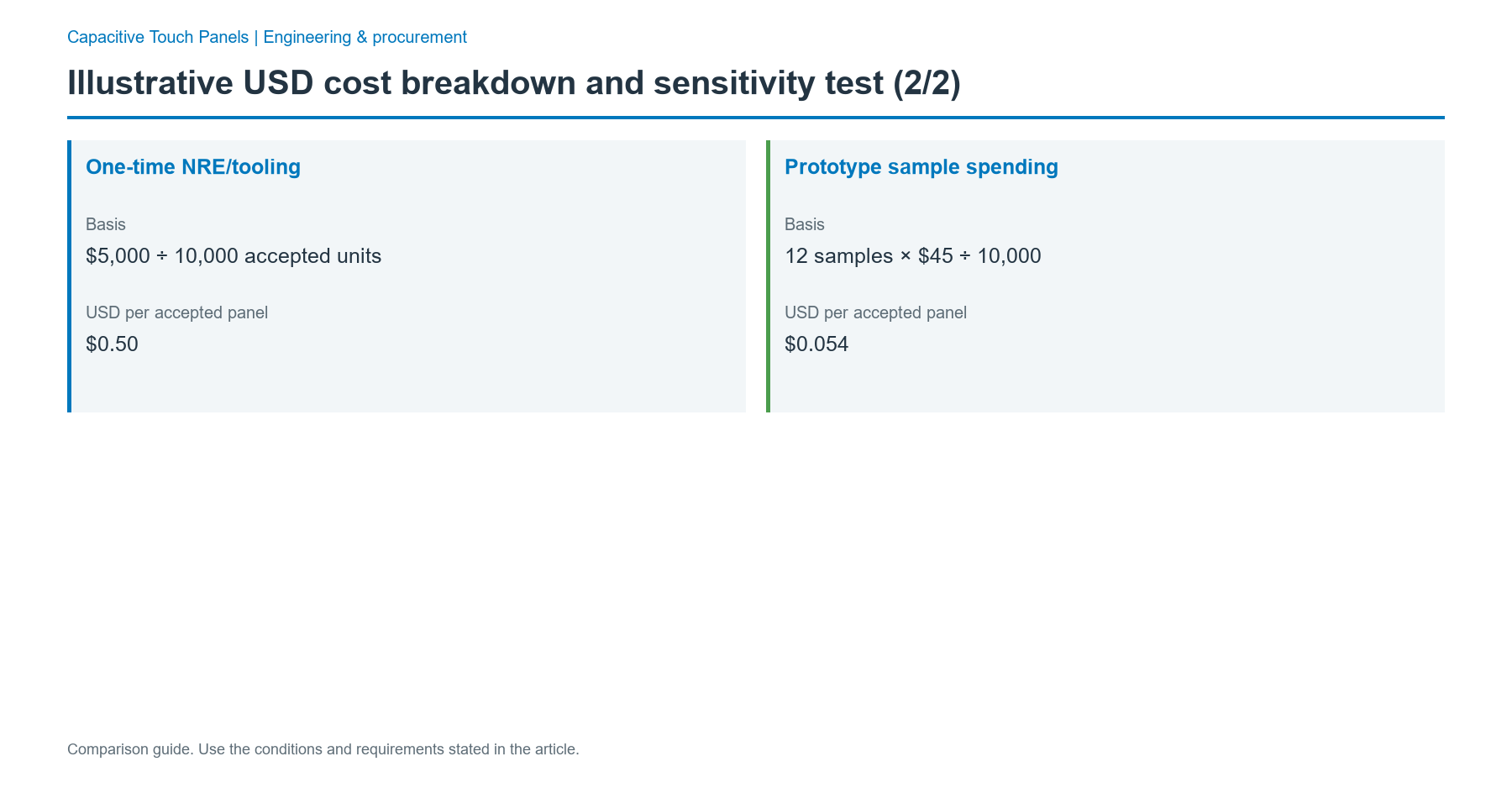
The following is a made-up arithmetic example, not a supplier quotation, JASPER price, industry average, target margin or promised production yield. The assumed deliverable is one Scope D PCAP touch subassembly without a display. The project assumes 1,000 accepted units per shipment, 10 shipments, 10,000 accepted units for first-year cost recovery, and 95% accepted yield where started-unit costs are disclosed.
| Illustrative recurring input | Basis | USD per accepted panel |
|---|---|---|
| Lens, print and finish | $4.80 per unit started | — |
| Sensor and FPC | $5.20 per unit started | — |
| Controller hardware/configuration | $2.60 per unit started | — |
| Adhesive, lamination and assembly | $2.10 per unit started | — |
| In-process inspection and basic pack | $1.30 per unit started | — |
| Started-unit subtotal | $16.00 / started panel | — |
| Yield-adjusted production | $16.00 ÷ 0.95 | $16.84 |
| Additional export protective packing | $0.25 per accepted panel | $0.25 |
| Freight | $1,400 per 1,000-unit shipment | $1.40 |
| Insurance | Assumed allocated cost | $0.10 |
| Brokerage and handling | Assumed allocated cost | $0.35 |
| One-time NRE/tooling | $5,000 ÷ 10,000 accepted units | $0.50 |
| Prototype sample spending | 12 samples × $45 ÷ 10,000 | $0.054 |
The assumed $5,000 NRE could be itemized as $1,200 sensor design, $2,500 cover/tooling, and $1,300 controller tuning plus test-fixture setup. The assumed $540 for 12 samples remains distinct from both NRE and recurring volume production. The sample price is an intentionally separate build condition, not a basis for extrapolating annual purchase spend.
Using unrounded inputs, the normalized first-year result is $16.00 / 0.95 + $0.25 + $1.40 + $0.10 + $0.35 + $5,000 / 10,000 + $540 / 10,000 = $19.50 per accepted panel, rounded to cents. This is before applicable duty, nonrecoverable tax, customs classification-dependent costs and OEM-side integration. Values depend on the chosen quantities and are not transferrable to a different design or shipping route.
| One changed assumption | Resulting first-year USD/accepted panel | Difference from $19.50 baseline |
|---|---|---|
| Baseline: 95% yield; 10,000-unit NRE recovery; $1.40 freight | $19.50 | — |
| Yield 90%, other inputs unchanged | $20.43 | +$0.94* |
| Recover NRE and samples over 5,000 units | $20.05 | +$0.55* |
| Freight $2.20 per accepted unit | $20.30 | +$0.80 |
| All three changes | $21.79 | +$2.29* |
*Differences are rounded from unrounded scenario results; subtracting displayed rounded totals can differ by $0.01. In the 5,000-unit case, both $5,000 NRE and $540 sample spending are divided by 5,000 accepted units. This is a scenario for lower realized volume, not an automatic supplier price escalation. Model a separate currency case if the quotation and settlement use different currencies rather than hiding an arbitrary exchange buffer inside every line.
Compare landed cost, not just the factory invoice
A cross-border PCAP purchase needs an identified Incoterms® 2020 rule and named place. The complete eleven-rule set is EXW, FCA, CPT, CIP, DAP, DPU, DDP (any mode or modes of transport) and FAS, FOB, CFR, CIF (sea or inland waterway only). These rules allocate tasks, costs and risk; they do not determine the freight rate, customs classification or all contractual obligations by themselves.
A quote labeled only “freight included” leaves too many questions unanswered. Build a separate landed-cost worksheet for export cushioning, carton quantities, pallet/case protection, booked transportation mode, insurance, import entry/broker fees, destination handling, applicable duty and nonrecoverable tax, and damage-claim handling. Record who pays each item, the currency and the evidence. Do not apply a generic duty percentage: rate and treatment depend on the actual goods, origin, destination, classification and transaction.
| Landed-cost field | RFQ entry to capture | Buyer comparison rule |
|---|---|---|
| Trade rule / named place | Rule, year, exact handoff location | Normalize responsibility before comparing totals |
| Packed quantity | Accepted units/carton and shipment; gross dimensions/weight | Allocate actual packaging and freight over accepted units |
| Freight / insurance | Payer, mode, transit target, insurance basis | Avoid adding buyer costs already in delivered price |
| Import / destination | Classification owner, duty basis, broker, terminal and local delivery | Use assessed/validated charges; show unknown taxes separately |
| Currency / payment | Invoice currency, rate source/date, deposit and balance schedule | Analyze FX sensitivity and cash exposure independently |
| Damage and returns | Inspection window, replacement freight, claims responsibility | Include realistic service cost and evidence requirements |
Copy this RFQ and quotation comparison worksheet
Send the same revision-controlled inputs to every bidder. The following table can be copied directly into a request for quotation or used as column headings in a purchase comparison sheet.
| Required RFQ field | Entry or evidence to attach | Good signal / red flag |
|---|---|---|
| Product and scope | A–E scope choice, included/excluded assemblies | Same boundary / vague “complete touch module” |
| Geometry | Outer size, view/active area, glass thickness, tolerance, CAD revision | Controlled drawing / diagonal size only |
| Cover construction | Material, ink, coating, edge detail, appearance criteria | Layer specification / undefined “premium glass” |
| Sensor and tail | Electrode technology, TX/RX plan, FPC, connector, pinout | Released stack and tail plan / no electrical boundary |
| Controller and host | Hardware, interface, firmware/config owner, signal/power states | Named deliverables / “plug and play” without host test |
| Display and mounting | Display part number, gap/bond method, housing references | Mating drawing / display assumed included |
| Use and acceptance | Bare finger, defined glove, wet states, noise, optical/cosmetic tests | Test matrix with criteria / performance adjective alone |
| NRE and tooling | Cost, milestones, file/tool ownership, storage and change fees | Transfer/reorder rights written / tooling payment without rights |
| Quantity and unit quote | Sample, pilot, 100/1,000/5,000 lot; 10,000 annual forecast | Accepted-unit basis / sample price passed off as volume price |
| Yield and inspection | Whether scrap is absorbed; test coverage, AQL if agreed, lot trace | Explicit inclusion and records / scrap added twice |
| Schedule and revision | Drawing freeze, first article, pilot, release, reorder lead-time | Milestones and revision rule / single unqualified lead time |
| Delivery and payment | Incoterms rule/place, pack plan, currency, validity, warranty/RMA | Cost allocation clear / destination charges missing |
An AQL number alone is not a quality plan. State the inspection standard/version if used, defect classifications, sampling basis and critical functional tests. A batch acceptance scheme is not a substitute for required 100% functional screening where the risk analysis calls for it. For a detailed engineering input package, use the custom capacitive touch panel design guide.
Use approval gates to control hidden spend
A purchase schedule should tie spending to testable artifacts, not just dates. Use these six gates for a custom PCAP program:
- RFQ baseline: issue the drawing, cover stack, display identity, interface boundary, operator states, quantities and acceptance matrix; resolve bid exclusions.
- Commercial and ownership baseline: approve NRE and tooling deliverables, payment milestones, tool custody/ownership, configuration-file access, price breaks, change fees and the delivery rule.
- Engineering sample: evaluate appearance, dimensions, FPC pinout, controller behavior and initial touch operation using the intended display and enclosure conditions.
- First article and pilot: sign the accepted revision, inspect dimensional/optical samples, test worst operating states, confirm yield accounting, packaging, lot records and any corrective actions.
- Production release: issue the purchase order referencing the approved drawing, test plan, quantity, acceptable quality requirements and delivery terms. Set change-notice and substitution rules.
- Receiving and change control: check shipment traceability, inspection records, quantity, transit damage and RMA route; route material, controller, firmware, process or tooling changes back through agreed approval.
Treat unapproved controller substitutions, missing tooling ownership terms, unexplained jump in unit price at fixed geometry, absent wet/glove evidence, and freight quoted without a named destination as decision blockers until the responsible party closes the gap. The cost of a delayed pilot, a retuned controller, or a rejected shipment belongs to the buyer's risk assessment even when it cannot yet be converted into a defensible dollar estimate.
Frequently asked questions
Why does a custom capacitive touch panel cost more at the sample stage?
Prototype prices may contain design setup, temporary processes, small material purchases, extra inspection and engineering labor. Ask for separate NRE/tooling charges, an identified sample quantity and price, and a production quote at the intended accepted-unit lot size. A 12-piece pilot price should not be multiplied by a 10,000-unit annual forecast to estimate the full-year purchasing budget.
Which costs are one-time and which repeat on every order?
Sensor artwork, dedicated tooling and initial tuning may be one-time if the design and contract keep them reusable. Lens material, sensor conversion, controller hardware, assembly and ordinary inspection are usually recurring. Some activities, such as setup, special testing, calibration or packaging, may be charged per production batch. Put every line into one-time, per-batch or per-accepted-unit columns before comparing offers.
Should I add scrap on top of the supplier's quoted unit price?
Not when the supplier quotes an accepted, shipped unit price that already includes its normal manufacturing yield. Adding another scrap factor would count the same loss twice. Use a yield calculation only when evaluating disclosed started-unit cost or a clearly excluded loss mechanism. Ask which reject classes and rework actions are included, and who pays if production fails the agreed acceptance criteria.
What changes the price of a PCAP cover and sensor stack?
The outline, active area, material, decorative print, coatings, cutouts, electrode pattern, transparent conductor, FPC routing, adhesive method and cosmetic acceptance all influence material use and manufacturing effort. Controller fit and installed noise performance can change the optimal sensor construction. Compare complete controlled stack drawings; a cheaper cover alone does not establish a lower accepted assembly cost.
Is full optical bonding always worth its additional cost?
No. Full bonding can reduce internal reflections and help control contamination, but it adds adhesive, alignment, inspection and possible rework costs. A controlled air gap may suit an interface whose optical and mechanical requirements permit it and whose display is intended to be replaceable. Decide using actual visibility, service, stack tolerance and installed validation requirements rather than selecting from the panel price alone.
How should I compare two overseas touch panel quotations?
Use the same accepted-unit quantity, drawing revision and acceptance criteria, then normalize both to one delivery rule and named place. Add separately paid export packing, freight, insurance, customs handling, applicable duties and nonrecoverable taxes. Record the invoice currency, exchange-date assumption, deposit schedule and damage responsibility. A lower factory invoice is not necessarily the lower delivered procurement cost.
What must be approved before I release a volume purchase order?
Approve the controlled cover/sensor/controller stack, display and host interfaces, tool and file ownership, first-article appearance, functional and environmental test outcomes, inspection records, packaging and the agreed price/lead-time schedule. The released purchase order should cite the approved revision and define change notice, substitutions and nonconforming-material handling. A working loose sample is not enough evidence for finished-device performance.
Turn the cost tree into a quote request
Before asking for a final production price, assemble the outer and active-area drawing, cover stack, display model, host/interface and pinout, glove and wet-use states, expected sample and production quantities, and the acceptance tasks. Add the intended order frequency, Incoterms rule and destination so the supplier can separate factory cost from buyer-controlled logistics. Submit those inputs through JASPER's Request a Quote process and ask for NRE, sample/pilot and accepted-unit production lines on the same revision-controlled basis.
Bring the drawing, stack and operating conditions
JASPER engineering will review the interfaces, open risks and evidence required for a production quote.