
AG, AR, and AF solve different cover-glass problems. AG spreads reflected light to reduce mirror-like glare, AR lowers surface reflection to improve contrast, and AF reduces fingerprint adhesion and makes the surface easier to clean. For a high-resolution touchscreen, select and validate them separately: start with the viewing environment, then set optical, sparkle, cleanability, and durability acceptance criteria on the assembled display.
AG, AR, and AF are three different requirements
The fastest way to make a poor cover-glass choice is to ask for a single “anti-glare coating” and expect it to control reflections, fingerprints, and cleaning behavior at once. Those are three separate engineering objectives.
| Treatment | Primary job | Main benefit | Main tradeoff to watch | Best acceptance evidence |
|---|---|---|---|---|
| AG — anti-glare | Scatter reflected light | Reduces sharp reflections and reflected image definition | Excess scattering can reduce apparent clarity and create display sparkle | Reflection appearance, haze/clarity, sparkle on the target display |
| AR — anti-reflective | Reduce reflected light at the surface | Improves contrast and readability under bright ambient light | Coating stack can be sensitive to spectrum, angle, abrasion, and contamination | Spectral or photopic reflectance, color shift, durability |
| AF — anti-fingerprint | Lower surface energy | Reduces smudge adhesion and cleaning effort | Performance can decay with abrasion and aggressive cleaning chemistry | Contact angle, wipe/abrasion retention, cleanability |
A practical design target for an industrial touchscreen is to avoid treating any one metric as sufficient. For example, a low haze number does not prove low sparkle, a low reflectance number does not prove easy cleaning, and a high initial contact angle does not prove AF durability after repeated wiping.
Use the viewing problem to choose the first treatment
Start with the visual complaint that the operator will actually see.
Choose AG when reflected images are the problem
AG modifies the surface so reflections are spread over a wider angle rather than remaining mirror-like. This can make overhead luminaires, windows, or sunlight reflections less sharply defined. The same surface structure can also scatter transmitted display light, so the acceptance plan must include image clarity and sparkle rather than only a glare judgment.
AG is usually the first route to evaluate when:
- the display is used under strong overhead lighting;
- reflected objects distract the operator even when the panel has enough luminance;
- a matte visual appearance is acceptable;
- the display is large enough that mirror reflections are a major ergonomic issue.
For high-pixel-density displays, add a dedicated sparkle check. Fine AG surface structures can interact with pixel geometry and make a uniform image look grainy. Sparkle is not the same as haze: haze is wide-angle transmitted scattering, while sparkle is a spatial nonuniformity observed through the display stack.
Choose AR when surface reflection is the problem
AR uses an optical coating stack to reduce the fraction of ambient light reflected back toward the viewer. That can increase apparent contrast without intentionally diffusing the reflected image.
AR is usually the first route to evaluate when:
- high apparent sharpness must be preserved;
- dark UI areas become washed out under bright ambient light;
- a glossy appearance is acceptable;
- the design needs lower reflectance rather than a matte surface.
For procurement, do not accept “AR coated” as a complete requirement. Specify the wavelength band, angle of incidence, measured side or total cover construction, and the state in which reflectance is measured. A useful project target for a premium visible-display AR surface is average reflectance at or below 1.0% over 450–650 nm at near-normal incidence, subject to confirmation on the actual glass and coating stack. Treat that number as a design target, not as a universal industry requirement.
Choose AF when touch contamination is the problem
AF is a low-surface-energy treatment intended to reduce the adhesion and visibility of fingerprints, oils, and smudges while improving wipe-clean behavior. It is a user-interface surface treatment, not an optical substitute for AG or AR.
For a frequently touched industrial panel, a practical initial AF design target is water contact angle ≥105°, measured with a documented droplet volume and method. Durability matters more than the initial result: repeat the contact-angle check after the agreed abrasion or cleaning cycle and define the minimum retained performance before production approval.
If oily fingerprint resistance is critical, add an oil or oleic-acid contact-angle method or a controlled fingerprint/cleanability protocol. A water contact angle alone measures hydrophobicity; it does not fully describe oleophobic behavior.
Build the coating stack from separate acceptance questions
AG, AR, and AF can be combined, but stacking them should be a deliberate optical and surface-engineering decision. Do not assume that three individually good treatments will remain good when applied together.
Use this decision sequence:
- Define the ambient-light problem. Record illuminance, dominant light source positions, likely viewing angles, and whether the complaint is a sharp reflected image or general contrast loss.
- Lock the display configuration. Record display model, pixel density, brightness setting, cover-glass thickness, air gap or optical bonding, and any polarizer or film stack.
- Choose the optical route. Start with AG for reflected-image suppression or AR for lower surface reflection. Evaluate a combined AG+AR route only when both requirements are real.
- Add AF as a separate surface requirement. Specify cleanability and durability without assuming that AF is automatically compatible with the optical layer below it.
- Validate on the assembled display. A coupon is useful for incoming inspection, but sparkle, contrast, color, and reflected-image appearance must be judged on the representative display stack.
- Freeze the acceptance method. Put the test fixture, angle, light source, display image, cleaning medium, sample conditioning, and pass/fail limits into the drawing or quality plan.
The output of this sequence is not simply “AG glass” or “AR glass.” It is a measurable surface specification tied to the end-use display.
AG needs a glare-versus-clarity acceptance matrix
AG selection should never be reduced to “more matte is better.” Stronger scattering can suppress reflected-image definition while also reducing transmitted image clarity.
Use a three-part AG acceptance matrix:
| AG attribute | What to measure or observe | Engineering decision |
|---|---|---|
| Reflected-image suppression | Controlled reflection scene or angular reflection measurement | Must reduce distracting image definition at the intended viewing angles |
| Transmitted clarity | Haze plus a clarity/resolution method on the actual display | Must preserve text, icons, and fine graphics required by the UI |
| Sparkle | Uniform green, gray, and white images on the target pixel density | Must remain below the visual limit agreed by engineering and quality |
ASTM D1003 can be used as a reference method for haze and luminous transmittance where the material and geometry are appropriate, but do not use haze as the only AG metric. A display can have an acceptable haze value and still show objectionable sparkle or loss of fine detail.
For a high-pixel-density module, use at least three full-screen images during visual review: green, 50% gray, and white. Green often makes sparkle easier to see, while gray and white reveal broader nonuniformity and clarity loss. Keep viewing distance, angle, ambient light, and display luminance fixed for lot-to-lot comparison.
AR needs spectral, angular, and durability limits
A single reflectance number can hide several AR failures. The coating should be evaluated across the visible band and at the viewing angles that matter to the product.
At minimum, document:
- average reflectance target and wavelength band;
- reflectance or color-shift behavior at an oblique viewing angle if the operator does not view the panel head-on;
- which surface is coated;
- glass type and thickness;
- whether the sample is a coated coupon, finished cover glass, or bonded display assembly;
- abrasion, humidity, temperature, and cleaning-chemical exposure required by the project.
For an OEM acceptance plan, use the ≤1.0% average reflectance over 450–650 nm near normal incidence target only as an initial premium-design benchmark. The final limit should be frozen after checking readability, color, coating durability, and supply capability on the chosen construction.
If the coating produces a visible residual color, define whether the acceptance criterion is a numeric color limit, a master-sample comparison, or both. Do not leave “no color shift” as an undefined visual statement.
AF should be accepted by retention, not by the first measurement
Fresh AF surfaces often look good. The real question is how the surface behaves after manufacturing handling, cleaning, and normal use.
A stronger AF quality plan has four checkpoints:
| Checkpoint | Suggested record | Why it matters |
|---|---|---|
| Initial surface | Water contact angle; optional oil/oleic-acid contact angle | Confirms the treatment is present and uniform |
| Abrasion durability | Defined load, abrasive medium, stroke length, cycle count | Makes durability results reproducible |
| Post-abrasion surface | Contact angle after durability exposure | Shows performance retention |
| Cleanability | Standard contaminant plus fixed wipe count and cleaning medium | Connects laboratory surface energy to operator experience |
For a premium touchscreen program, use ≥105° initial water contact angle as a starting design target and require a project-specific retained value after the agreed durability cycle. If field cleaning uses alcohol, detergent, disinfectant, or another chemistry, include that exact chemistry in compatibility testing rather than assuming a generic AF layer will survive it.
A combined AG + AR + AF stack needs interface-level verification
A combined stack can be appropriate when a product needs diffuse glare control, low residual reflectance, and easy cleaning. The risk is that each surface process can influence the next one.
Common failure paths include:
- AR performance shifting because the underlying AG texture changes effective optical behavior;
- AF deposition changing residual reflectance or color on an AR surface;
- cleaning or abrasion reducing AF before the optical layers fail;
- an AG texture hiding fingerprints visually but increasing cleaning effort in recesses;
- coating nonuniformity near printed borders, holes, edge steps, or masked regions;
- process temperature or chemistry affecting decoration, adhesive, strengthening state, or later bonding.
The acceptance sample should therefore match the final process sequence. Do not approve AG on one coupon, AR on another, and AF on a third, then assume the combined production stack is equivalent.
Record the test conditions so results are comparable
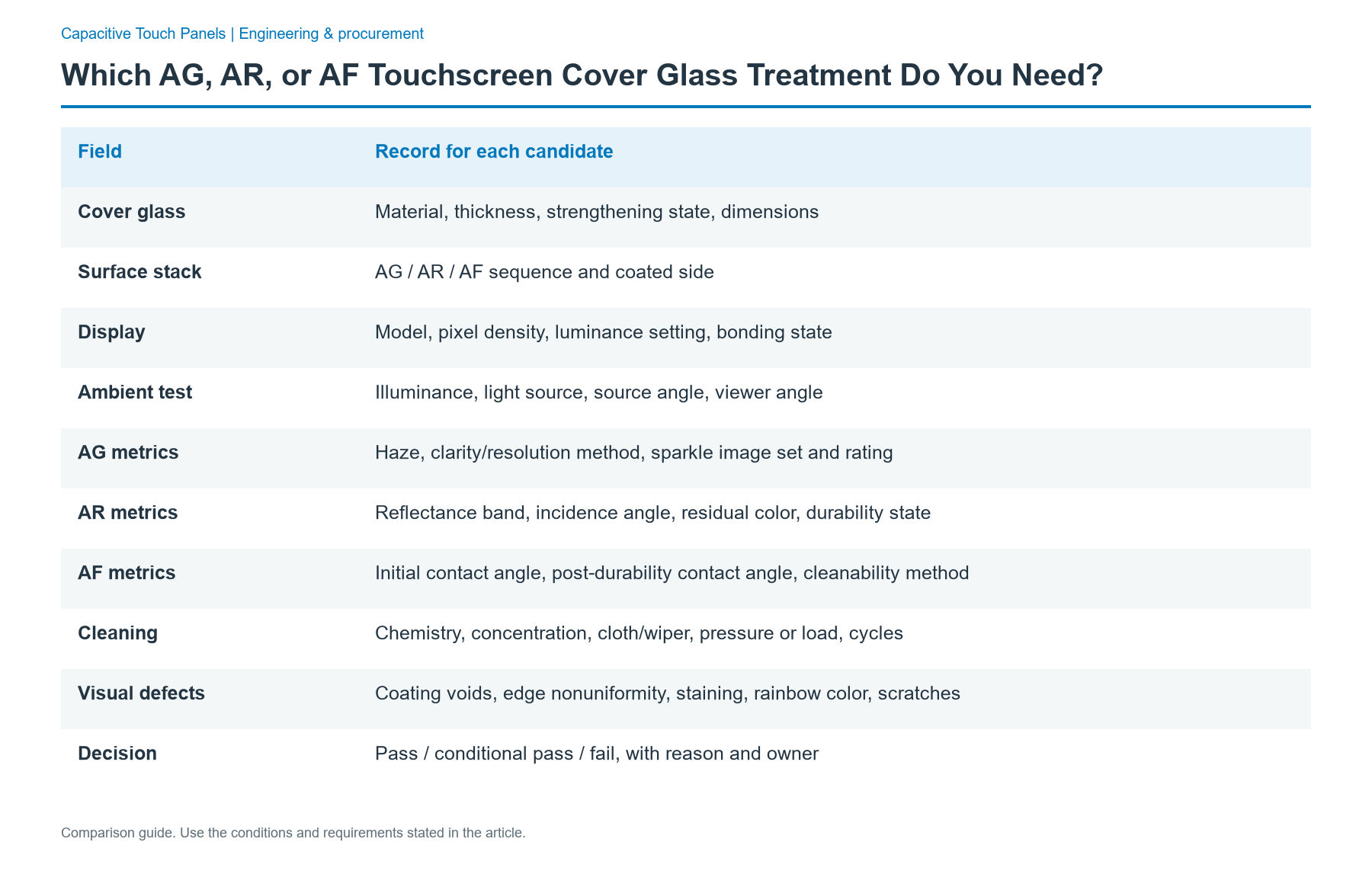
Use a single engineering record for each surface candidate. The table below can be copied into a drawing review or qualification worksheet.
| Field | Record for each candidate |
|---|---|
| Cover glass | Material, thickness, strengthening state, dimensions |
| Surface stack | AG / AR / AF sequence and coated side |
| Display | Model, pixel density, luminance setting, bonding state |
| Ambient test | Illuminance, light source, source angle, viewer angle |
| AG metrics | Haze, clarity/resolution method, sparkle image set and rating |
| AR metrics | Reflectance band, incidence angle, residual color, durability state |
| AF metrics | Initial contact angle, post-durability contact angle, cleanability method |
| Cleaning | Chemistry, concentration, cloth/wiper, pressure or load, cycles |
| Visual defects | Coating voids, edge nonuniformity, staining, rainbow color, scratches |
| Decision | Pass / conditional pass / fail, with reason and owner |
This record prevents a common sourcing problem: two samples are called “AG+AF,” but they were tested with different displays, light sources, wipe media, or acceptance limits and therefore cannot be compared directly.
Match the surface specification to the final touch-panel stack
Cover-glass surface treatment is only one part of a projected-capacitive interface. Glass thickness, dielectric stack, optical bonding, display noise, controller tuning, wet operation, and glove requirements can change the behavior of the finished product.
For display-window projects, JASPER can review the cover-glass treatment together with the touch-panel stack and drawing requirements. The touch panels with display window page is the primary product path for this type of integration.
Before release, freeze the drawing and validation inputs together: outline and active area, cover-glass stack, display model, host/interface, glove and wet-use conditions, quantity, and acceptance tasks. This keeps optical appearance, touch performance, and manufacturing responsibility from being split across disconnected specifications.
Selection matrix for OEM design reviews
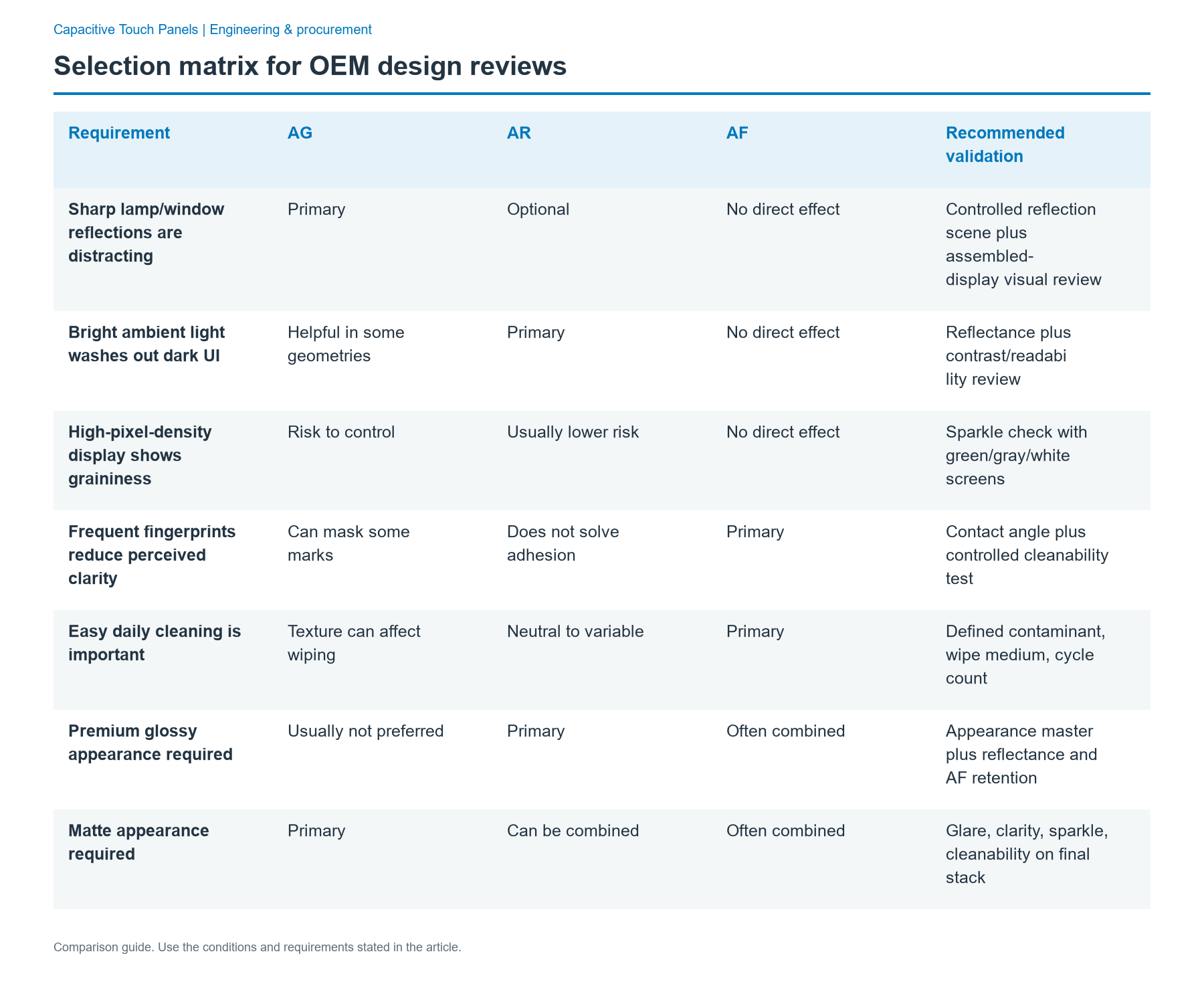
Use this matrix as a starting decision tool, then replace the provisional targets with project-specific limits after sample validation.
| Requirement | AG | AR | AF | Recommended validation |
|---|---|---|---|---|
| Sharp lamp/window reflections are distracting | Primary | Optional | No direct effect | Controlled reflection scene plus assembled-display visual review |
| Bright ambient light washes out dark UI | Helpful in some geometries | Primary | No direct effect | Reflectance plus contrast/readability review |
| High-pixel-density display shows graininess | Risk to control | Usually lower risk | No direct effect | Sparkle check with green/gray/white screens |
| Frequent fingerprints reduce perceived clarity | Can mask some marks | Does not solve adhesion | Primary | Contact angle plus controlled cleanability test |
| Easy daily cleaning is important | Texture can affect wiping | Neutral to variable | Primary | Defined contaminant, wipe medium, cycle count |
| Premium glossy appearance required | Usually not preferred | Primary | Often combined | Appearance master plus reflectance and AF retention |
| Matte appearance required | Primary | Can be combined | Often combined | Glare, clarity, sparkle, cleanability on final stack |
The most important rule is simple: accept the surface by the failure mode it is meant to prevent. AG is accepted by glare control without unacceptable clarity or sparkle loss. AR is accepted by reflectance and color behavior with durability. AF is accepted by retained cleanability and surface-energy performance after wear.
FAQ
Is AG the same as AR on touchscreen cover glass?
No. AG reduces the sharpness of reflected images by scattering light, while AR reduces the amount of light reflected from the surface. AG can introduce haze or sparkle if the texture is too aggressive for the display. AR can preserve a glossy surface, but its spectral, angular, and durability behavior still needs to be specified.
Can AG and AR be used together?
Yes, when the product needs both reflected-image suppression and lower residual reflection. The combined process must be tested as one finished stack because AG texture can change optical behavior and AR can add residual color or durability constraints. Approving separate AG and AR coupons is not enough to qualify the combined cover glass.
What does AF add if the glass already has AG or AR?
AF addresses fingerprints, smudges, touch feel, and cleanability rather than glare or reflection. It can be added over a compatible optical surface, but the final stack should be checked for contact angle, cleaning durability, reflectance or color change, and coating uniformity after the complete production sequence.
What is a useful starting target for AF contact angle?
A useful premium-design starting target is a water contact angle of at least 105° on the fresh finished surface. The drawing should also define the measurement method and a retained value after the agreed abrasion or cleaning exposure. If oil repellency is critical, add an oil or oleic-acid contact-angle or controlled fingerprint test.
Why can anti-glare glass look grainy on a high-resolution display?
AG surface structures can refract and scatter light from individual pixels, producing random brightness variation called sparkle. The effect depends on the surface texture, pixel geometry, display stack, viewing distance, and test image. That is why high-pixel-density designs should include an assembled-display sparkle check instead of relying only on haze.
Is haze enough to approve AG cover glass?
No. Haze is useful for describing wide-angle transmitted scattering, but it does not fully predict reflected-image suppression, fine-image clarity, or display sparkle. Use haze together with a clarity or resolution check, a controlled reflection assessment, and a sparkle review on the actual display configuration.
Should AR acceptance use one reflectance number?
Not by itself. Define the wavelength band, incidence angle, coated side, sample construction, and durability state. For early design comparison, average reflectance at or below 1.0% over 450–650 nm near normal incidence is a useful premium target, but the final acceptance value should come from the qualified glass and coating stack.
What information should be sent for an AG/AR/AF cover-glass review?
Send the outline and active area, cover-glass stack, display model, host/interface, glove and wet-use conditions, expected quantity, and required acceptance tasks. Include the lighting and cleaning environment if known. JASPER can use those inputs to separate optical requirements, touch-performance constraints, and surface-durability checks before samples are approved.
Next step
For a new touchscreen program, send the drawing together with the display and acceptance inputs rather than specifying only “AG,” “AR,” or “AF.” Use Send Drawing and include the outline and active area, cover-glass stack, display model, host/interface, glove and wet-use conditions, quantity, and the optical/cleanability acceptance tasks you need the sample to pass.
Bring the drawing, stack and operating conditions
JASPER engineering will review the interfaces, open risks and evidence required for a production quote.