
Medical electrode manufacturer selection starts with the item you intend to buy: a printed electrode, a converted patch, a packaged component, or a finished device. Match that handoff to the supplier's actual operations before comparing prices. For repeat-production nomination, a practical buyer-defined target is three consecutive accepted pilot lots against one controlled specification, with no unresolved critical deviations. That is a qualification target, not a regulatory minimum or a guarantee of clinical performance.
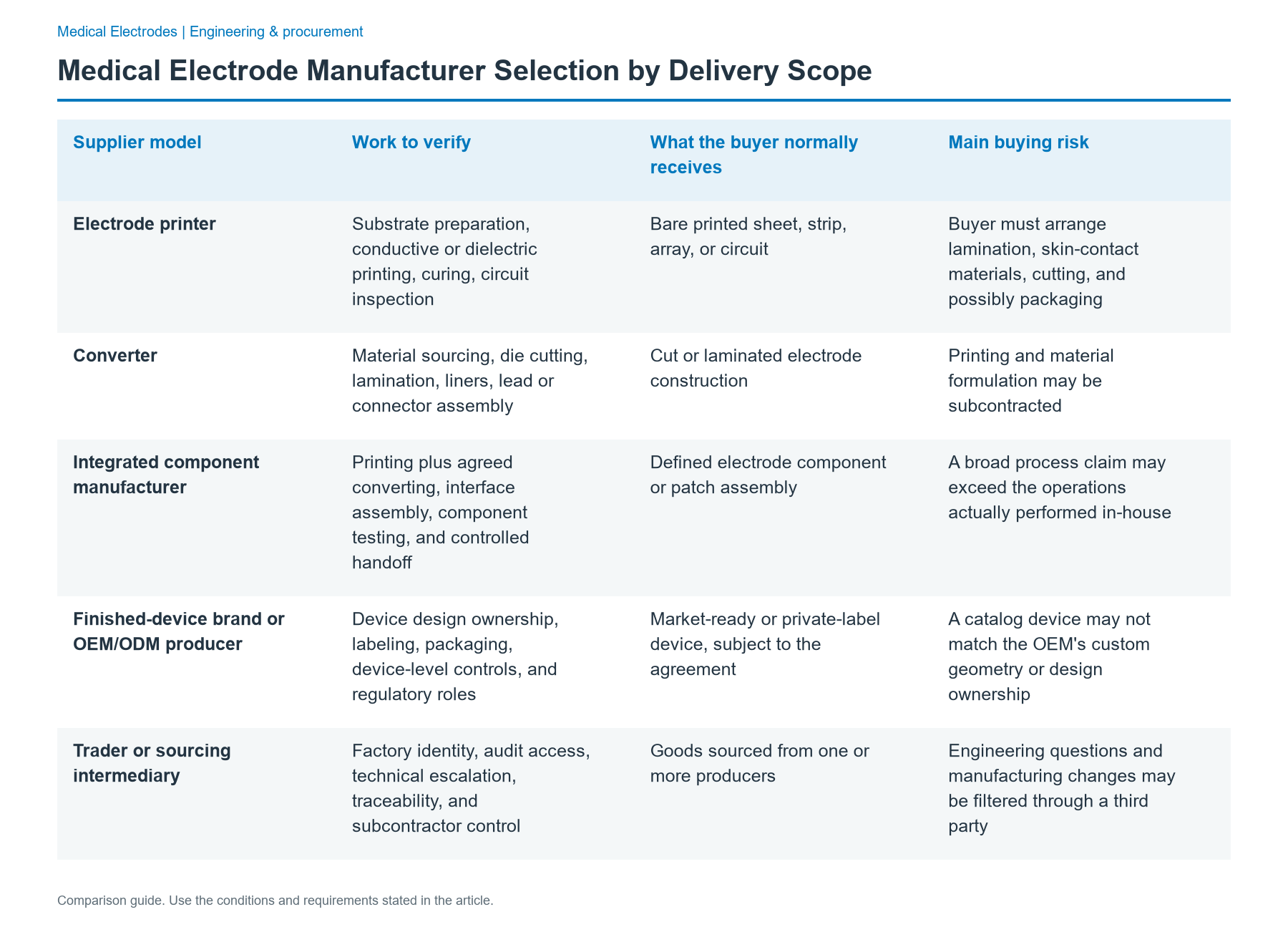
Distinguish the factory from the scope of supply
A company's description as a medical electrode manufacturer does not establish whether it prints conductive patterns, converts adhesive layers, owns a finished-device design, or buys the goods from another factory. Ask for a process map showing the actual production site and the legal entity responsible for each operation. Different models can work; hidden handoffs create avoidable qualification and change-control risks.
| Supplier model | Work to verify | What the buyer normally receives | Main buying risk |
|---|---|---|---|
| Electrode printer | Substrate preparation, conductive or dielectric printing, curing, circuit inspection | Bare printed sheet, strip, array, or circuit | Buyer must arrange lamination, skin-contact materials, cutting, and possibly packaging |
| Converter | Material sourcing, die cutting, lamination, liners, lead or connector assembly | Cut or laminated electrode construction | Printing and material formulation may be subcontracted |
| Integrated component manufacturer | Printing plus agreed converting, interface assembly, component testing, and controlled handoff | Defined electrode component or patch assembly | A broad process claim may exceed the operations actually performed in-house |
| Finished-device brand or OEM/ODM producer | Device design ownership, labeling, packaging, device-level controls, and regulatory roles | Market-ready or private-label device, subject to the agreement | A catalog device may not match the OEM's custom geometry or design ownership |
| Trader or sourcing intermediary | Factory identity, audit access, technical escalation, traceability, and subcontractor control | Goods sourced from one or more producers | Engineering questions and manufacturing changes may be filtered through a third party |
A converter is not necessarily a trader: it can operate real cutting and lamination equipment while buying printed sheets. Equally, a company with its own brand can outsource much of production. Obtain the manufacturing-site address, flowchart, outsourced-process list, sample identification, inspection location, and escalation route. Ask which party can approve a print revision, replace an adhesive, or release a nonconforming lot. A supplier unwilling to identify who makes the critical layer should not be ranked as equivalent to a traceable producer.
Use these four RFQ handoff scopes, defined here as an exhaustive set for comparing this project's quotations, rather than assuming every industry product fits a standard catalog category:
| Handoff code | Ordered deliverable | Work excluded unless separately quoted |
|---|---|---|
| S1 — printed circuit | Released printed electrode geometry, conductive tracks, dielectric openings, and cut or uncut carrier as stated | Skin-contact gel, final patch assembly, and device validation |
| S2 — converted component | S1 plus specified adhesive/backing, insulation, lamination, die cut, and tail or connector operations | Finished-device approval and any unlisted material processing |
| S3 — packaged component | S2 plus specified liner, count, pouch or protective packaging, labeling, and shipment inspection | Clinical claims, independently validated shelf life, and regulatory authorization |
| S4 — finished device | Finished product under a separately defined device design, labeling, and regulatory responsibility arrangement | No implied transfer of the OEM's legal duties without an explicit, applicable arrangement |
The right choice depends on where the OEM needs to take possession and what it can validate. A bare printed sensing strip may make S1 economical when the OEM has its own converter. S2 or S3 may reduce interface disputes if the printed pattern and adhesive stack must register precisely. S4 is a different buying and regulatory decision, not merely a higher-priced S3.
Define the electrode and its validation owner before seeking quotes
A comparable quotation requires a controlled drawing and a layer-by-layer specification. The word electrode can describe an ECG recording patch, an EEG or EMG array, a stimulation contact, an electrochemical biosensor, or a custom sensing component. Those products share manufacturing operations but not a single electrical, patient-contact, or device-performance acceptance criterion.
Record the following in the same revision-controlled RFQ package:
| Specification block | Minimum purchasing input | Evidence needed for approval |
|---|---|---|
| Printed pattern | Site count and locations; conductor widths; exposed contact and insulating zones; reference datums | Approved artwork, measurement method, print and registration checks |
| Material stack | Substrate and grade; conductive ink system; dielectric; backing; adhesive or hydrogel; liner | Bill of materials, approved sources, substitution rules, compatibility evidence |
| Connection | Snap, tab, printed tail, or drawing-specific connector; contact pitch; pinout; strain-relief geometry | Mating-part drawing, dimensional checks, agreed contact or pull tests |
| Converted outline | Die cuts, apertures, edge exposure, overlaps, layer orientation | First-article dimensional and layer-registration record |
| Use boundary | Recording, stimulation, or biosensing; intended patient-contact surface and duration; storage and environment | OEM-owned use and risk requirements that drive material and functional verification |
| Delivery state | S1, S2, S3, or S4; pack count; labeling; cleanliness or packaging requirements | Approved sample and explicit shipment acceptance plan |
For skin-contact devices, contact type and duration must be part of the OEM's biological evaluation strategy. The FDA's published duration categories are limited (24 hours or less), prolonged (more than 24 hours through 30 days), and long-term or permanent (more than 30 days). These are contact-duration categories, not universal electrode wear specifications or automatic pass/fail tests. Intended use, material processing, and final construction determine the evaluation; an ink or hydrogel material statement alone does not validate the assembled device.
For printed biosensors, distinguish the bare conductive electrode from reagent deposition, assay chemistry, analytical validation, and final sensor packaging. A supplier that prints carbon, silver, or silver/silver chloride geometry does not automatically develop enzymes, immobilization chemistry, or the detection system. Likewise, component continuity does not establish ECG signal quality or stimulation safety. Put the downstream verification owner in writing.
Send one RFQ sheet that makes prices comparable
Ask every candidate to quote the same released construction, order quantities, and delivery state. A low unit price on S1 is not competitive with S3 until the cost and lead time of converting, inspection, and packing are added. Separate one-time engineering, tooling, trial parts, recurring parts, packaging, freight, and buyer-side verification.
Copy-ready electrode RFQ worksheet
| RFQ field | Entry to provide or request |
|---|---|
| Drawing and revision | Drawing ID; revision; issue date; controlled layer stack; OEM contact for deviations |
| Delivery scope | Exactly one of S1, S2, S3, S4; included and excluded operations by site |
| Electrode geometry | Active areas, track layout, spacing, dielectric openings, datums, outline, tolerances |
| Materials | Substrate; ink; adhesive/hydrogel; backing; liner; restricted substitutions and owner |
| Interface | Snap/tab/tail/connector drawing, fit and electrical test method |
| Packaging | Bulk, sheet, reel, or pouch where applicable; quantity per pack; protection and label data |
| Quantities | Prototype units; pilot-lot quantity; annual forecast; order-release profile; minimum order quantity |
| Quotation breakdown | Tooling, nonrecurring engineering, samples, unit prices by quantity, inspection, packaging, freight terms |
| Schedule | Drawing review, tooling release, first article, pilot lots, repeat-order lead time, capacity reservation |
| Quality record | Inspection plan, lot ID, material traceability, sample retention, deviations, change notice process |
| Approval split | Who approves materials, biological evaluation, electrical/system testing, storage life, and device labeling |
Use the same response columns for all bidders: included / excluded / subcontracted / priced separately / exception. These are five explicit quote-status options for this worksheet; request one status for each operation. An empty cell is not acceptance of the work. Ask for the identity of the subcontractor controlling any critical process and whether purchase orders will identify the manufacturing site.
For commercial comparison, calculate evaluated component cost per accepted unit:
(quoted recurring spend + allocated tooling and engineering + paid freight + buyer-side required conversion or inspection + expected scrap/rework cost) / forecast accepted units
Illustrative calculation, not a market quote: On a 10,000-unit purchase, Supplier A quotes $1.20 per S1 unit, $2,000 tooling, and a further $0.55 per unit for third-party conversion. Before freight, inspection, and scrap, the evaluated unit cost is ($12,000 + $2,000 + $5,500) / 10,000 = $1.95. An S2 quote at $1.80 with $1,000 tooling equals $1.90 on that same quantity if its scope really includes the conversion. At 2,000 units, however, those same assumptions produce $2.75 for A and $2.30 for S2. The calculation exposes volume and scope sensitivity; actual supplier prices, yields, and freight must replace the examples.
Qualify suppliers with a weighted evidence scorecard
Score the evidence the supplier can supply for this construction, not the number of capabilities on its website. First apply hard stops: the candidate must identify its critical production site, accept a controlled drawing and change process, agree on objective component acceptance criteria, and name the party responsible for each excluded operation. An attractive price cannot compensate for a failed hard stop.
For each criterion use the three defined ratings, 0, 3, and 5: 0 = absent or contradicted evidence; 3 = plausible process evidence with gaps to close; 5 = complete, project-relevant evidence. The weighted score is weight × rating / 5; the maximum is 100. The weights below are a sample buyer decision tool, not a certification score.
| Criterion | Weight | Good signal for a 5 | Red flag for a 0 |
|---|---|---|---|
| Production scope and site disclosure | 15 | Site-specific operation map and named subcontractors | Factory identity or real handoff withheld |
| Drawing and process engineering | 15 | DFM review tied to controlled electrode geometry | Quote ignores exposed contacts, tail, or registration |
| Material/source control | 12 | Revisioned bill of materials and substitution approval | Unannounced adhesive or ink replacement permitted |
| CTQ inspection and test methods | 15 | Measured dimensions, electrical checks, sampling rules, records | Generic “100% quality” claim without methods |
| Traceability and change management | 12 | Lot-to-material links and written change approval path | No way to locate affected lots or versions |
| Pilot-lot repeatability | 10 | Comparable records from controlled, repeated builds | Only hand-made presentation samples |
| Quote completeness and landed cost | 8 | Line-item scope, tooling, quantities, freight basis | Critical layers priced after award |
| Schedule and capacity evidence | 5 | Milestone plan and constraint escalation | Lead time is only a verbal promise |
| Tooling, files, and exit terms | 5 | Ownership, storage, transfer format, revision access agreed | Print master or dies inaccessible on exit |
| Deviation and corrective action | 3 | Defined containment, disposition, and response owners | Supplier ships changes or defects without consent |
| Total | 100 |
A practical procurement policy is to shortlist candidates at 80/100 or above, provided all hard stops pass, then nominate only after first-article and pilot gates are accepted. These are proposed buyer thresholds, not universal norms. For early R&D, the OEM may use a staged award and retain a higher level of verification; for safety-critical production, the quality and regulatory team may require stricter gates independent of the commercial score.
ISO 13485:2016-related quality-system evidence can support a supplier review when it is applicable and its site and scope are checked. For U.S. finished-device manufacturers, FDA's Quality Management System Regulation became effective on February 2, 2026 and incorporates ISO 13485:2016 by reference. Neither a certificate nor a supplier's FDA-related claim demonstrates that a particular printed electrode meets the OEM's component acceptance criteria or shifts finished-device responsibilities automatically.
Move from a drawing to repeat orders through six approval gates
A useful sample program tests whether the production route can repeat the approved design, rather than merely whether one prototype works. Make each gate conditional on written artifacts so buyers can prevent a purchase order from overtaking unresolved engineering decisions.
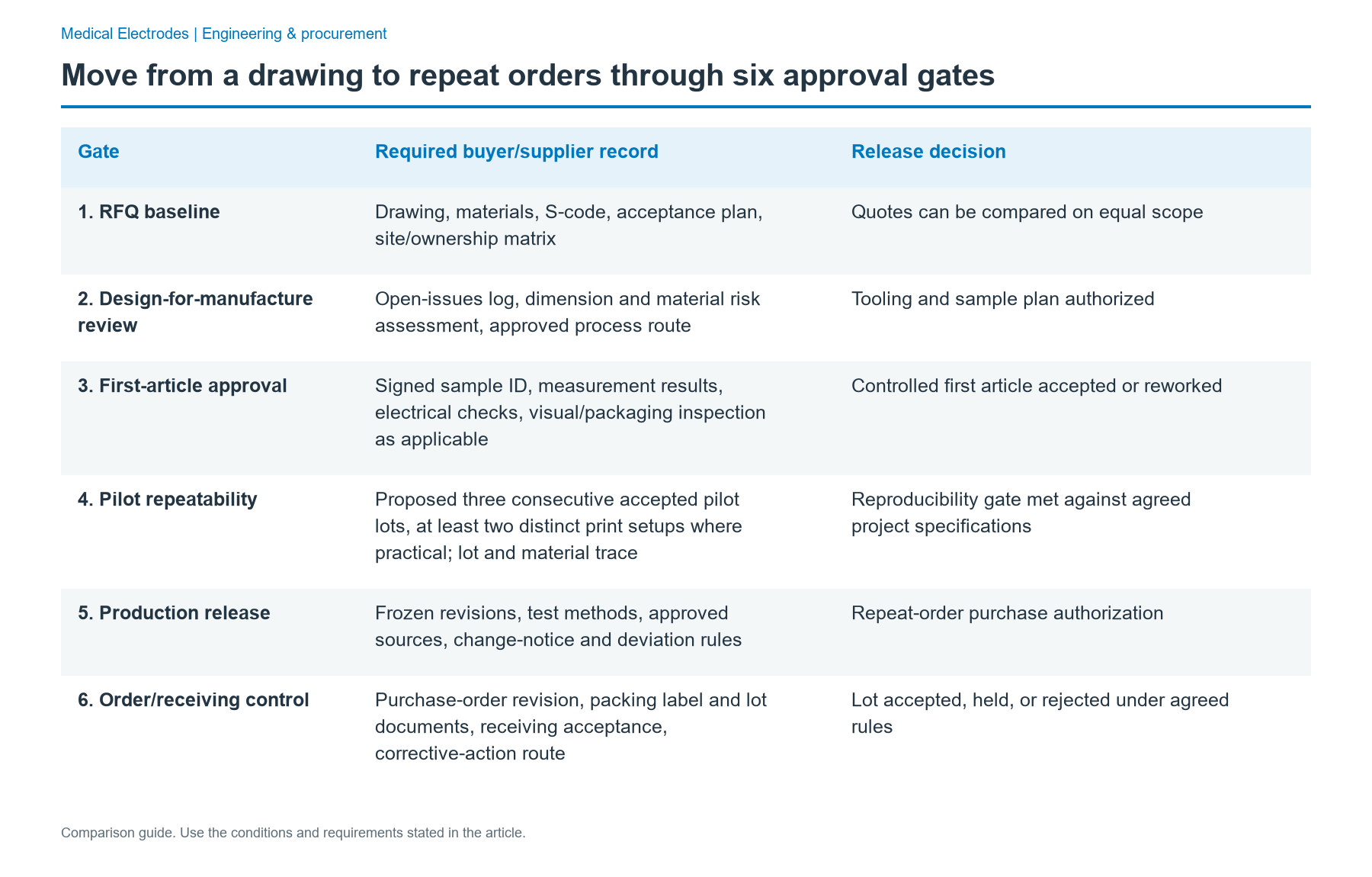
| Gate | Required buyer/supplier record | Release decision |
|---|---|---|
| 1. RFQ baseline | Drawing, materials, S-code, acceptance plan, site/ownership matrix | Quotes can be compared on equal scope |
| 2. Design-for-manufacture review | Open-issues log, dimension and material risk assessment, approved process route | Tooling and sample plan authorized |
| 3. First-article approval | Signed sample ID, measurement results, electrical checks, visual/packaging inspection as applicable | Controlled first article accepted or reworked |
| 4. Pilot repeatability | Proposed three consecutive accepted pilot lots, at least two distinct print setups where practical; lot and material trace | Reproducibility gate met against agreed project specifications |
| 5. Production release | Frozen revisions, test methods, approved sources, change-notice and deviation rules | Repeat-order purchase authorization |
| 6. Order/receiving control | Purchase-order revision, packing label and lot documents, receiving acceptance, corrective-action route | Lot accepted, held, or rejected under agreed rules |
The three-lot gate is an example of a more demanding sourcing target, not a mandated sample size, statistical demonstration of process capability, or substitute for risk-based process validation. Select sample sizes, independent setups, test coverage, and acceptance statistics using device risk, process variation, and OEM quality procedures. A failed lot should restart or extend the evidence sequence under a documented disposition, not be averaged away.
During first article, attach the sample's actual artwork revision, substrate and ink lot, curing or printing route, lamination stack, die-cut tooling revision, connector part, test method, and packaging state. Reference samples without those identifiers become difficult to compare to later deliveries. If sample acceptance changes the drawing, update both the quote and inspection plan before pilot builds.
Assign inspection, changes, and defects to named owners
Incoming, in-process, and outgoing checks answer different questions. IQC controls purchased inputs such as substrates, inks, adhesives, and hydrogel stock. PQC controls operations such as print alignment, curing, registration, lamination, and die cutting. OQC confirms that the shipped component meets the agreed lot-release plan. Recording continuity or resistance may be appropriate for printed circuits; an electrochemical assay may also need application-relevant measurement methods. A single generic outgoing test cannot validate every sensing principle.
Use this responsibility matrix in the quality agreement. The responsible parties are proposed defaults for an OEM buying S1–S3; tailor them to the actual contract.
| Decision or record | Supplier's component duty | OEM's retained duty |
|---|---|---|
| Approved materials and source changes | Buy to released bill; preserve traceability; request prior approval for critical changes | Approve material and risk-impacting substitutions |
| Component inspection and lot release | Execute agreed IQC/PQC/OQC; provide results and deviations | Define CTQs, acceptance method, and incoming policy |
| Nonconforming lot | Identify/segregate material, contain affected lots, provide cause and corrective action | Decide use-as-is, rework, return, or rejection authority |
| Patient contact and functional claims | Provide agreed component data and manufacturing history | Own final biological, system, clinical, labeling, and regulatory evaluation |
| Shelf life, package integrity, and transport | Apply contracted packing and handling process; provide corresponding component records | Approve shelf-life and final-device packaging evidence as applicable |
| Revision, tooling, and end of supply | Track changes and hold unapproved substitutions; support controlled transfer | Approve new revisions and requalification triggers; manage continuity plan |
For every critical change—ink grade, film, gel source, print process, die, connector, production site, or packaging material—require notice before implementation, an impact assessment, affected lot identification, and OEM approval where specified. Agree when re-sampling or requalification is triggered. Separately define who owns print masters, dies, CAD files, test fixtures, and process-specific know-how; access to buyer-owned geometry is not automatically a right to every proprietary machine setting.
The receiving record should connect purchase order, revision, quantity, lot number, and the certificate or inspection report actually agreed for that item. If defects surface in the field, the trace must support containment of shipped and unshipped lots rather than only the latest dispatch.
Look for supplier warnings that change the award decision
A procurement shortlist should be revisited when a vendor cannot explain its own operations or when an apparently low quote silently changes the delivered product.
- The printer and converter are described as one site, but no site-specific process record exists. Reconfirm the manufacturing flow and subcontractor controls.
- Samples lack drawing, material, or lot revision IDs. Treat them as concept samples, not repeat-production approval evidence.
- A supplier proposes a substitute ink or hydrogel based only on a generic material name. Require the OEM's material and system-level impact assessment before approval.
- Testing is promised without limits, sampling, conditions, or measurement equipment. Make the method and pass/fail rule part of the purchase record.
- A branded, packaged device price is compared with a bare printed circuit price. Reissue the RFQ on one handoff scope.
- The MOQ is presented without tooling amortization, minimum material buys, or forecast assumptions. Recalculate at prototype, pilot, and reorder quantities.
- The lead-time promise begins on an undefined milestone. Separate artwork approval, material procurement, tooling, pilot, and repeat-production lead time.
- The supplier cannot name who receives a deviation or authorizes a change. Hold nomination until the quality and escalation matrix is signed.
- A certificate or component test is offered as proof of a finished-device clinical result. Return the validation boundary to the OEM's device team.
Match JASPER's printed-electrode scope to the sourcing decision
JASPER manufactures custom printed electrode circuits and can supply specified converted patch constructions built around printed conductive geometry. Projects may include flexible substrates, printed electrode sites and traces, insulating zones, tails or interfaces, backing, adhesive or hydrogel layers, liners, die cutting, lamination, packaging, and agreed component inspection. The exact included operations and materials belong in the released quote and drawing.
That makes JASPER a relevant candidate when the RFQ calls for an S1 printed circuit, or an S2/S3 printed and converted component with a clearly agreed scope. It does not make JASPER the owner of the OEM's biological evaluation, clinical or therapeutic claims, complete device system verification, or regulatory authorization. Review the available custom printed medical electrode configurations to align the geometry, stack, interface, and handoff before supplier scoring.
The purchasing decision should end with four records: a comparable scope and cost sheet, a weighted supplier scorecard, an approved sample and pilot history, and a quality/ownership agreement that still works after the first order. For a project-specific review, request a quote with the electrode/circuit layout, substrate, contact areas, tail or connector, insulation and converting layers, packaging state, validation owners, sample quantity, and production forecast.
Frequently Asked Questions
What is the difference between an electrode printer and a converter?
An electrode printer deposits conductive or insulating patterns on a substrate and supplies the agreed printed geometry. A converter applies or shapes other layers through operations such as lamination, die cutting, liner handling, and assembly. One company may perform both, while another may outsource one process. Request the actual site and process map instead of relying on job titles.
How do I tell a medical electrode factory from a trader?
Ask which legal entity and physical site print, convert, inspect, and release the parts. Request a controlled production-flow record, sample lot identification, subcontractor disclosure, and a direct engineering escalation path. A trader can serve as a legitimate sourcing intermediary, but its quote must identify who controls manufacturing, materials, revisions, defects, and access to audit evidence.
Should I choose a printed electrode or a finished electrode patch supplier?
Choose a printed-electrode supplier when your team or its approved converter will add the remaining stack and perform downstream validation. Choose a converted patch source when registered printing, adhesive layers, cutting, and interfaces should arrive as one controlled component. A finished-device supplier serves a different scope that includes additional product and regulatory responsibilities, which require explicit agreement.
What should be included in a custom electrode RFQ?
Provide the drawing revision, electrode-site map, substrate, conductive materials, exposed contacts, insulation, tail or connector, adhesive or hydrogel zones, die-cut outline, packaging state, quantities, inspection methods, and delivery scope. Identify validation ownership and request separate tooling, sample, recurring-unit, shipping, and subcontracted-process prices. Require bidders to state every exclusion and proposed material substitution.
Is ISO 13485 certification enough to qualify a medical electrode manufacturer?
No. Relevant quality-system certification can contribute to supplier assessment, but it does not approve a specific electrode design or prove that a delivered lot meets agreed limits. Verify site and scope, inspect sample records, examine change and traceability controls, and test component acceptance against the OEM's specification. Device-level biological, electrical, clinical, and regulatory responsibilities remain separately assigned.
How many pilot lots should be accepted before repeat purchasing?
Three consecutive accepted pilot lots are a useful proposed procurement gate for a controlled printed-and-converted construction, preferably covering more than one print setup. It is not a universal regulatory rule or a substitute for risk-based validation. Define the quantity per lot, acceptance statistics, test conditions, material traceability, and treatment of a failed lot with the OEM quality team.
Who owns biocompatibility and electrical performance validation?
The finished-device OEM ordinarily retains responsibility for defining intended use and validating patient-contact risks and complete device performance. The component manufacturer supplies agreed material records, process controls, measurements, and traceability within its contracted scope. Device architecture, contact duration, signal processing or stimulation conditions, packaging, and regulatory pathway determine what further evidence the OEM needs before release.
Bring the drawing, stack and operating conditions
JASPER engineering will review the interfaces, open risks and evidence required for a production quote.