
For direct outdoor exposure, start with a light-stable polyurethane formulation backed by finished-label weathering data. For a flat, controlled-light indoor product, a qualified epoxy can be entirely rational. In either case, approve the exact resin, ink, face material, adhesive, geometry, and equipment surface—not the chemistry name alone.
JASPER certifications: ISO 9001, ISO 13485, IATF 16949, and ISO 14001.
For engineers and sourcing teams comparing domed labels and nameplates, epoxy vs polyurethane domed labels is an environmental and construction decision. Polyurethane is the lower-risk starting point for appearance-critical sunlight exposure only when the exact formulation is light-stable and tested. Epoxy remains viable for controlled indoor service when a production-equivalent sample meets the drawing. Neither resin family guarantees flexibility, hardness, chemical resistance, adhesion, or field life. Those outcomes belong to the specific formulation and the complete label stack.
Epoxy vs Polyurethane Domed Labels: Quick Verdict
The useful answer is conditional. A resin-family name narrows the search; it does not finish the specification.
| Project condition | Preliminary choice | Why | Evidence still required |
|---|---|---|---|
| Direct sun, rain, or long outdoor appearance retention | Light-stable polyurethane candidate | Outdoor-oriented PU grades publish weathering evidence; clear epoxy needs unusually strong formulation-specific proof | Exact chemistry, full exposure cycle, color/haze/gloss change, controls, finished-stack samples |
| Sunlight through a window | Test both qualified candidates | Filtered daylight still changes clear polymers, inks, and printed colors | Window-filtered xenon or agreed exposure, plus visual and instrumental limits |
| Flat indoor equipment with controlled light | Qualified epoxy or PU | UV risk may be secondary; process history and stack adhesion can decide | Production sample, cure record, appearance, and adhesion |
| Curved housing or repeated bending | A low-hardness, high-elongation grade—often PU, but not automatically | Public PU grades range from soft to rigid, and flexible epoxy exists | Same-scale hardness, elongation or bend evidence, edge-lift check |
| Hard, glass-like touch | Compare exact grades | A published PU doming grade reaches Shore D 80; chemistry does not establish hardness | ASTM D2240 scale, dwell, specimen thickness, scratch/abrasion test |
| Fuel, cleaner, oil, salt solution, or disinfectant contact | Whichever candidate passes the real exposure | Chemical response depends on formulation, crosslink density, dose, and temperature | Named fluid, concentration, contact mode, time, temperature, rinse, acceptance limit |
| Safety-related marking | Recognized or qualified complete label system | Resin data alone cannot establish label permanence | Applicable end-product requirement and, when relevant, ANSI/UL 969 conditions |
| Tight dome-height or edge-hold requirement | Dispense trial with the production outline | Viscosity, volume, edge geometry, levelness, and surface condition act together | Profile measurement across actual sizes, radii, inks, and cure conditions |
This is not a blanket vote for polyurethane. It is a demand for better evidence. A vague “UV-resistant PU” can be a worse procurement choice than a named epoxy with a controlled indoor requirement and an approved production history.
What the Dome Resin Changes—and What It Does Not
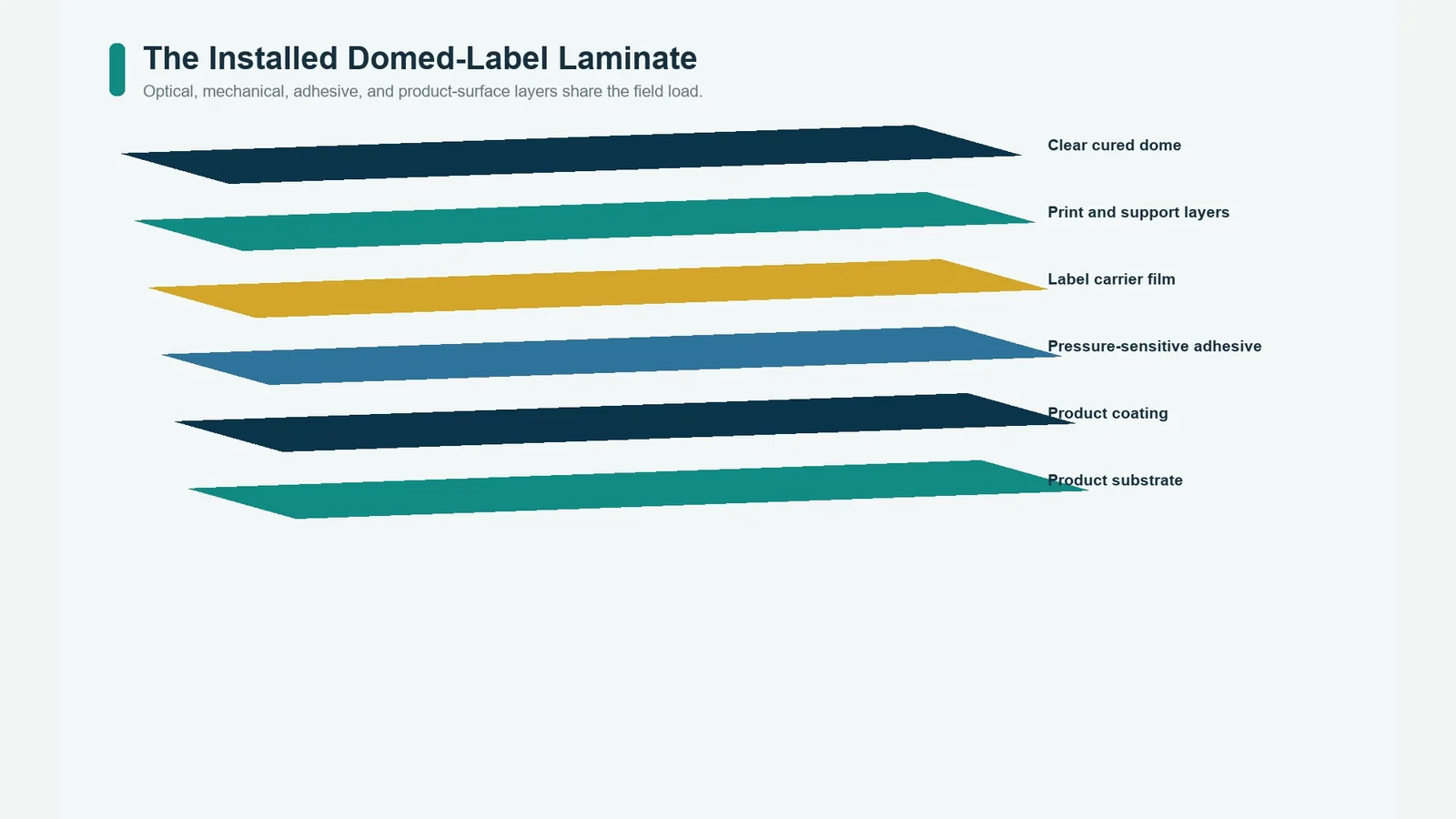
A domed label is a layered graphic overlay assembly. The clear resin forms a lens over printed artwork, but the finished part also depends on every interface below it.
Environment and handling
1. Clear dome resin: epoxy or polyurethane
2. Printed ink, clear coat, or doming-receptive layer
3. Face material: PET, polycarbonate, vinyl, acrylic, or metal
4. Pressure-sensitive adhesive and release liner
5. Equipment surface: paint, metal, glass, or molded polymer
The resin affects initial clarity, refractive behavior, indentation hardness, elastic recovery, rheology, cure, moisture sensitivity, and weathering response. It does not independently determine the printed color, dome-to-ink adhesion, pressure-sensitive adhesive bond, edge lift, or regulatory status.
That distinction matters. ASTM D3330/D3330M measures defined peel configurations and permits a representative application surface, but Peel values may not map directly to functional performance. UL Solutions evaluates marking and labeling systems as combinations of label stock, ink, coating or overlaminate, adhesive, application surface, and use condition. A resin TDS cannot confer ANSI/UL 969 Recognition on a newly domed construction.
Engineering Reference Data for Initial Selection
This domed label resin comparison uses a representative engineering data set to define a rigorous first-screen review. Final values must match the released resin, geometry, substrate, exposure, and test method.
| Specification field | Engineering reference value | Evidence basis | Project release input |
|---|---|---|---|
| Preferred outdoor chemistry | Two-part, light-stable aliphatic polyurethane | Covestro distinguishes light-stable aliphatic systems from yellowing-prone aromatic PU | Exact resin trade name, chemistry declaration, supplier, and revision |
| Dome center height | 1.8 mm nominal; 1.5–2.0 mm working range | 1.5–2.0 mm for its domed-label construction | Drawing nominal, tolerance, edge profile, and measurement method |
| Cured hardness | Shore A 85 | Midpoint of Polymark P592, which publishes Shore A 80–90 | Scale, target, tolerance, specimen thickness, dwell, and conditioning |
| Mixed viscosity | Approximately 1,050 mPa·s at 23°C | Electrolube UR5634 published value | Production resin viscosity range, temperature, spindle, and speed |
| Mix and cure window | 1:1 by volume; about 20-minute gel; 24 hours at 23°C | Electrolube UR5634 supplier TDS | Actual ratio, pot life, gel, tack-free, full cure, and post-cure |
| Elongation at break | At least 60% | Electrolube UR5634 publishes 62.4% | Exact method, specimen, conditioning, result, and acceptance limit |
| Reference temperature window | −40 to +80°C | Upper end aligns with a published converter range; UR5634 publishes −40 to +120°C for its geometry-dependent resin system | Finished-label operating and excursion limits after stack validation |
| Weathering target | 1,000 hours of comparative exposure under an agreed ASTM G154 or ASTM G155 cycle | A public doming TDS reports more than 1,000 hours under historical ASTM G53; current methods define the exposure apparatus | Exact method/cycle, hours, controls, replicates, ΔE/yellowness/haze/gloss limits, and report number |
The selected figures sit near the middle-to-upper end of public doming and optically clear PU examples; they are not industry-wide guarantees. Shore A and Shore D are not interchangeable under ASTM D2240, and the 1,000-hour weathering target cannot be converted into outdoor years.
Where Epoxy Wins
Epoxy wins only where a defined requirement rewards the exact epoxy system—not because every epoxy is cheaper, harder, or easier to cure.
A qualified, controlled-light indoor construction
For a flat indoor badge with little direct UV and no repeated bending, water-clear epoxy can meet the appearance goal. The a flexible Shore A 75 epoxy and supplier-claimed adhesion to pressure-sensitive labels, plated metal, glass, and plastics. The production ink and face material still require approval.
An existing validated process
An epoxy stack with production records, an approved sample, stable yield, and relevant field history can carry less risk than a chemistry change. Switching to PU changes mix control, cure, moisture sensitivity, rheology, and interfaces.
A replaceable or short-design-life indoor label
Epoxy may be sufficient for a replaceable indoor identifier with a defined short visual life. Compare actual quoted cost, scrap, cure space, rework, and validation effort; no public evidence supports one universal epoxy-versus-PU price rule.
Where a Polyurethane Dome Label Wins
A polyurethane dome label is the stronger starting point for exposed appearance and compliant movement—but only after the chemistry and data are checked.
Outdoor clarity with a light-stable formulation
For sunlight, rain, and thermal cycling in marine and outdoor equipment, request a light-stable exact formulation and finished-stack weathering data. “Polyurethane” alone is inadequate. Covestro explains that aromatic TDI/MDI coating systems tend to yellow and lose gloss under light and weathering, while HDI/IPDI/H12MDI systems are light-stable. That chemistry guidance screens candidates; it does not predict label life.
Curvature or controlled elastic recovery
PU candidates span a broad mechanical range: P584 lists Shore D 25–30, Opti-tec 4200 lists Shore A 75 and 100% elongation, and DC-2606 reaches Shore D 80. Approve the exact grade on the minimum radius and inspect cracking, separation, lift, and permanent set.
A supplier-supported weathering route
DC-2606 reports more than 1,000 hours in a QUV apparatus, while P584 states SAE J2527 testing. These are screening evidence, not project approval: ASTM G53 is withdrawn, and P584 omits duration and measured change. Define a current ASTM G154, ASTM G155, ISO 4892, or SAE J2527 cycle plus OEM limits.
UV, Chemicals, Dome Profile, and Substrate Compatibility
Epoxy dome yellowing is an exposure-and-formulation question
The practical epoxy dome yellowing risk rises when a clear epoxy remains exposed to daylight without enough formulation-specific protection. chalking, yellowing, and eventual breakdown of its prolonged-sunlight epoxy coatings. Even PRO-SET Absolute Clear Epoxies, marketed for UV stability, recommends a UV-stable topcoat for best long-term stability. These are not doming-life predictions; they justify requiring direct evidence for an exposed clear epoxy.
PU needs the same discipline. Aromatic polyurethane can yellow. A declaration that the exact dome system is light-stable or aliphatic, followed by finished-label exposure and objective color measurement, is more useful than the word “premium.”
Chemical resistance has no chemistry-only winner
ASTM D543 evaluates plastics under specified reagents, concentrations, temperatures, times, stress states, and contact modes. A five-minute wipe with diluted cleaner is not equivalent to fuel splash, saltwater cycling, or continuous immersion. Huntsman's thermoset selection guidance ties chemical response strongly to crosslink density and offers only a qualified tendency for harder materials to resist chemicals better. Test the actual fluid and record swelling, softening, haze, color, gloss, cracking, and adhesion after the stated recovery period.
Dome profile comes from rheology plus geometry
Viscosity, dispense volume, outline area, corner radius, surface energy, cure levelness, and gel time determine whether resin holds an even lens or crosses an edge. Published component viscosities range widely even in the four examples above. A supplier's viscosity is therefore a process input, not a universal dome-height equation. Approve the smallest feature, sharpest intended corner, longest narrow stroke, and largest area using production ink and face material.
Substrate compatibility includes moisture and ink
The DC-2606 TDS calls for a dehumidified workspace, dry nonporous substrates, and avoidance of hygroscopic inks—especially glycerine-containing inks—because moisture contamination can create bubbles during cure. P584 likewise describes its components as hygroscopic. Those cautions apply to the named systems, yet they expose a broader rule: test resin-to-ink or resin-to-coating adhesion and optical appearance on the production stack, after the real print and cure process.
Failure Chain and Verification Test Matrix
Most field complaints begin upstream of the visible symptom. The chain below prevents a resin swap from masking the actual cause.
| Initiating condition | Material or interface response | Visible symptom | Diagnostic check |
|---|---|---|---|
| UV, heat, and wet/dry cycling | Optical or surface change in resin, ink, or face film | Yellowing, haze, fading, gloss loss, cracking | Expose complete controls and candidates; measure color, yellowness, haze, and gloss before and after |
| Humidity contamination during mix or cure | Bubble formation or incomplete optical clarity | Microbubbles, foam, cloudy zones | Log room condition, material conditioning, open time, mix ratio, and cure; section suspect samples |
| Dome too rigid for the housing radius | Strain concentrates in resin, print interface, or PSA | Cracks, delamination, edge lift | Apply aged samples to the minimum radius and cycle the specified bend |
| Wrong chemical model | Swelling, softening, extraction, or stress cracking | Tack, whitening, haze, loss of profile | Repeat the exact fluid, concentration, temperature, dwell, rinse, and recovery sequence |
| PSA mismatched to paint or polymer | Weak or unstable label-to-housing bond | Curling, sliding, lifted corners | Test on representative molded/painted panels after cleaning and conditioning |
| Dispense volume or rheology outside the window | Overflow, thin edge, asymmetric lens, trapped air | Uneven profile, resin run-off, exposed print | Measure center/edge profile across the size family and review dispense/cure records |
Use the site's testing and validation route to turn the service environment into a controlled plan. A useful matrix separates the exposure method from the property measurement.
| Validation target | Candidate method | Production-equivalent specimen | Record and acceptance boundary |
|---|---|---|---|
| UV/weathering | ASTM G154 fluorescent UV or ASTM G155 / ISO 4892-2 xenon arc; SAE J2527 for applicable automotive exterior programs | Finished label on representative equipment panel, plus known-good and known-poor controls | Lamp/filter, irradiance, temperatures, wetting, duration, orientation, at least three replicates, failure mode, drawing-defined limit |
| Color and yellowing | ASTM D2244 color difference and ASTM E313 yellowness index where suitable | Same artwork, backing, thickness, gloss, and measurement geometry before/after exposure | Instrument, illuminant/observer, backing, baseline, ΔE or index change, visual limit |
| Haze and transmission | ASTM D1003 on suitable flat coupons, paired with finished-dome visual review | Matched cured resin plaque plus finished dome | Geometry, thickness, haze/transmission change, correlation to finished appearance |
| Gloss | ASTM D523 where specimen geometry permits | Flat companion coupon; finished dome reviewed separately | Measurement angle, baseline, retention or loss limit |
| Hardness and flex | ASTM D2240 on adequate specimens plus project radius/bend cycle | Cured plaque and complete label on minimum housing radius | Shore scale, dwell, temperature, thickness, cycle count, cracking/set/edge-lift limit |
| Chemical contact | ASTM D543 framework adapted to actual splash, wipe, patch, or immersion | Finished stack and resin coupon | Chemical, concentration, temperature, duration, rinse, recovery, appearance and adhesion limit |
| PSA adhesion | ASTM D3330/D3330M screening on representative surfaces | Complete label on actual paint, metal, or molded polymer | Cleaning, dwell, peel geometry/rate, conditioning, failure mode; supplement with edge-lift aging |
| Dome profile | Calibrated optical or contact profile method agreed on the drawing | Smallest, largest, narrowest, and sharpest production outlines | Center and edge height, overflow, bubbles, cure orientation, lot and dispense settings |
ASTM G151 advises against converting laboratory hours into outdoor years without a demonstrated material- and environment-specific correlation. ASTM G154 also requires reporting the operating conditions and recommends controls and replicates. The defensible result is “candidate A retained color and adhesion better than control B under cycle C,” not “1,000 hours equals five years everywhere.”
Project Inputs and Sample Approval
Start with the relevant application environment, then define the service condition before a resin is chosen:
- indoor, behind-glass, sheltered outdoor, or direct outdoor location;
- geography, orientation, expected sun, heat, moisture, freeze, and salt exposure;
- cleaner, fuel, oil, disinfectant, or process chemical with concentration and contact pattern;
- housing material, paint/coating, texture, surface energy, and cleaning process;
- face material, ink system, clear coat, PSA, artwork colors, and transparent areas;
- label length, width, corner radii, narrow strokes, dome-height limit, and housing curvature;
- flex frequency, impact or indentation risk, service duration, and replacement policy;
- optical acceptance for color shift, yellowness, haze, gloss, bubbles, and profile;
- adhesion, marking permanence, and regulatory requirement, including ANSI/UL 969 only when applicable.
Approve samples in four steps: freeze the bill of materials and process record; test at least one production-equivalent lot; compare measured results with written thresholds; retain a signed golden sample and change-control record. A resin substitution, ink change, new face film, PSA change, new print cure, or altered dome geometry should trigger a documented review because it changes the qualified stack.
Decision Matrix: Which Should You Pick?
| If the priority is… | Pick |
|---|---|
| Direct outdoor clarity with credible formulation and finished-stack data | Light-stable polyurethane candidate |
| Flat, controlled-light indoor service with an already qualified stack | Existing validated epoxy or PU construction |
| Curved application or repeated movement | Grade with verified low hardness/high elongation and successful stack-level bend test |
| Hard touch or indentation resistance | Exact grade that meets same-scale hardness plus separate abrasion/impact limits |
| Defined cleaner, fuel, oil, or salt exposure | Candidate that passes the exact chemical protocol; no family default |
| Safety-related permanent marking | Construction recognized or qualified for the applicable marking system and surface |
When neither conventional choice is best
A clear dome is not the best construction when the interface must remain very low profile, tolerate frequent sharp folding, meet an existing recognized-label system that the dome would invalidate, or survive abrasion that requires a hard-coated flat overlay or molded lens. Very fast production may justify evaluating a UV-curable urethane-acrylate system such as Polymark UVA535, but that is a third process with its own adhesion, cure-depth, light-safety, and weathering qualification. “Neither” is an engineering answer, not a procurement failure.
Frequently Asked Questions
Do epoxy domed labels always yellow?
No. Yellowing depends on the epoxy formulation, stabilizers, light spectrum, dose, temperature, moisture, thickness, and acceptance threshold. Exposed clear epoxies deserve formulation-specific weathering evidence because major epoxy suppliers warn about prolonged UV degradation. A controlled-light indoor epoxy can remain a valid choice after sample approval.
Is polyurethane always more flexible than epoxy?
No. Public doming data include a flexible epoxy at Shore A 75, polyurethane at Shore D 25–30, and polyurethane at Shore D 80. Shore scales are not directly interchangeable, and hardness does not equal bendability. Specify the exact grade, then test the finished label on the intended radius.
Which is better for outdoor domed labels?
A light-stable, preferably aliphatic polyurethane formulation with finished-label weathering data is the stronger default for appearance-critical outdoor use. The word polyurethane is not enough because aromatic PU can yellow. Confirm the exposure cycle, objective color or haze change, stack adhesion, controls, and project acceptance limits.
What causes epoxy dome yellowing?
UV and visible-light exposure can change susceptible epoxy chemistry, while heat, moisture, cure state, stabilizer package, and thickness influence the observed color. Printed white or transparent areas often reveal the shift first. Diagnose it with controlled exposure and instrumental color or yellowness measurements, not a resin-family assumption.
Can a polyurethane dome label wrap around a curved housing?
Some can, but the grade and complete stack must match the radius. Low-durometer or high-elongation PU candidates are available, while other PU doming systems are relatively hard. Apply aged production samples to the minimum radius and inspect cracking, permanent set, dome-to-print separation, PSA lift, and edge recovery.
Is polyurethane more chemical-resistant than epoxy?
Not as a universal rule. Chemical response depends on formulation, crosslink density, cure, reagent, concentration, temperature, contact mode, duration, stress, and recovery. Test the actual cleaner, fuel, oil, salt solution, or disinfectant on the complete label and record optical, dimensional, surface, and adhesion changes.
How many QUV hours equal one year outdoors?
There is no universal conversion. ASTM G151 and Q-Lab both caution that geography, orientation, spectrum, irradiance, temperature, wetness, and the material itself affect correlation. Use accelerated weathering to compare candidates under a fully reported cycle, then connect it to field life only through relevant outdoor correlation data.
Does UL 969 apply only to the dome resin?
No. ANSI/UL 969 applies to evaluated marking-and-labeling systems under defined conditions. The stock, print or ink, coating or overlaminate, adhesive, application surface, temperature, moisture, sunlight, and chemicals may all matter. Adding an unqualified dome can change a previously recognized construction and require review.
Review the Domed-Label Environment and Appearance
Bring the service environment, housing material, artwork, label geometry, chemical list, curvature, optical limits, and regulatory needs into the review. Then compare named candidates on production-equivalent samples. JASPER is one manufacturing option for that review; resin selection should remain tied to evidence and the drawing, not to a brand preference.
Technical References
- Source: ASTM D3330/D3330M. Accessed 2026.
- Source: UL Solutions. Accessed 2026.
- Source: Covestro. Accessed 2026.
- Source: Polymark P592. Accessed 2026.
- Source: Electrolube UR5634. Accessed 2026.
- Source: ASTM D2240. Accessed 2026.
- Source: PRO-SET Absolute Clear Epoxies. Accessed 2026.
- Source: ASTM D543. Accessed 2026.
- Source: thermoset selection guidance. Accessed 2026.
- Source: ASTM G151. Accessed 2026.
- Source: Polymark UVA535. Accessed 2026.
Review the overlay construction before release
Send the drawing, artwork, material stack, mounting surface, environment, and acceptance plan for a construction-specific engineering review.