
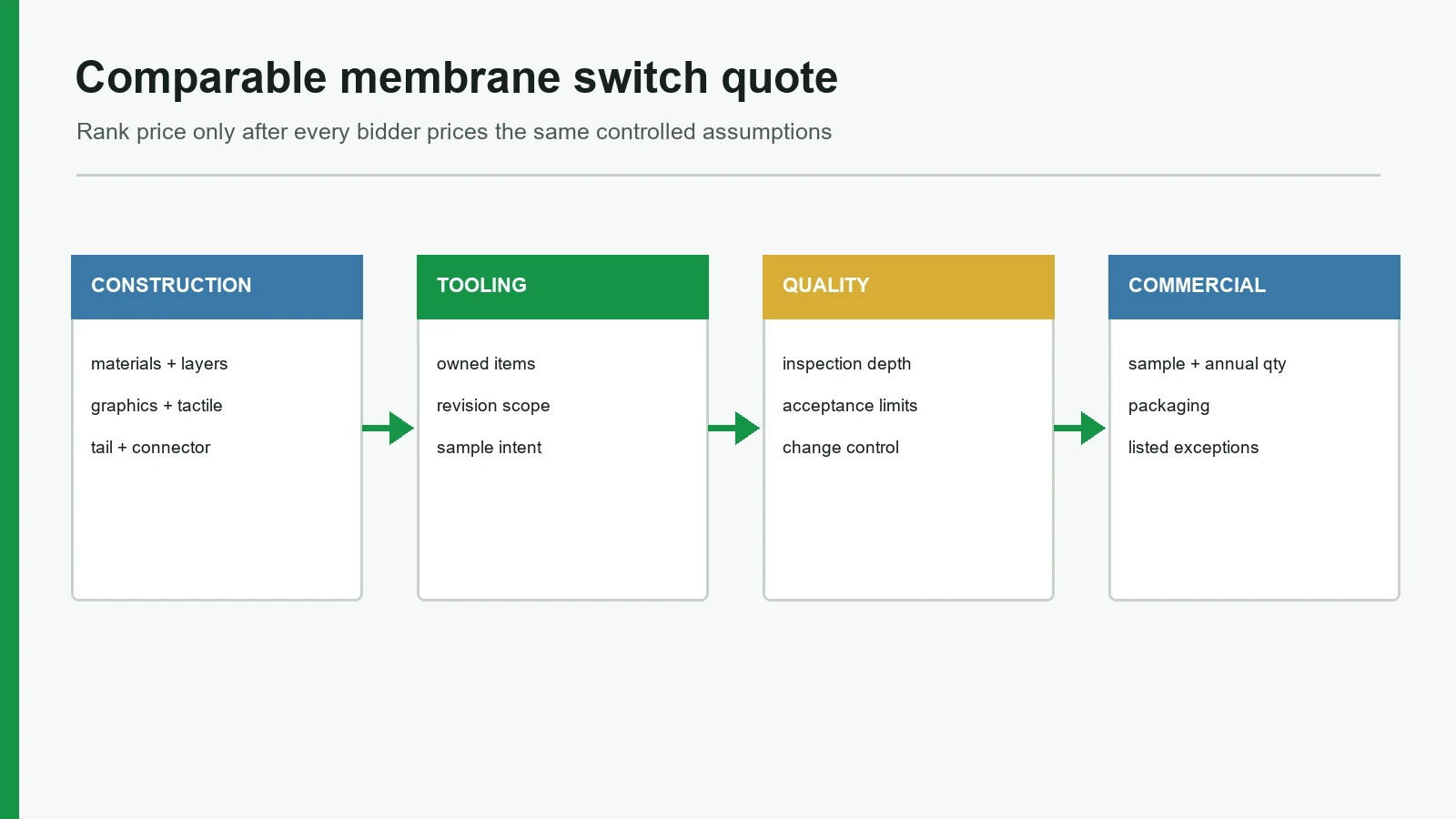
Membrane switch cost factors are not a single unit-price number. Comparable quotations move with construction stack, tooling scope, inspection depth, sample quantity, volume, packaging, and change control. Freeze those inputs before you rank suppliers on price.
1. Why Price-Only Comparisons Fail
A membrane switch looks simple on a product photo: printed face, flat panel, flexible tail. The quote is not simple. Two RFQs that share a 180 mm × 120 mm outline and a 12-key map can still diverge on printed colors, PET grade, silver versus carbon circuit work, metal domes, shielding, LEDs or light-guide film (LGF), adhesive family, connector model, steel-rule tooling, emboss tools, electrical test fixtures, sample count, packaging method, and revision rules after first article.
Those differences sit in three cost buckets:
| Bucket | What it usually covers | What buyers often miss |
|---|---|---|
| Non-recurring (NRE) | Screens/plates, cutting tools, emboss tools, fixtures, engineering setup | Whether tooling is shared, exclusive, or re-quoted on every revision |
| Unit production | Films, inks, domes, adhesives, connectors, print/lamination/assembly labor | Which options are in the base build versus “add later” |
| Quality & logistics | Inspection depth, sample loops, packaging, change control, material declarations | Whether the low bid skipped gates the higher bid included |
Circuit design, layer count and labor are only part of membrane switch cost. Inspection scope and sample quantity change landed cost. Packaging that protects embossed keys or display windows changes landed cost. A revision after steel-rule tools are cut changes landed cost more than another color on the overlay.
The failure mode is familiar. A buyer ranks three quotes by unit price. Supplier 1 priced a non-tactile PET stack with visual check only. Supplier 2 priced metal domes in an industry-typical ~250 g force planning class (verify on the project), 3M-class rear adhesive matched to powder-coated steel, 100% electrical continuity, and five first-article panels on the production housing. Supplier 3 priced discrete LEDs and a shield layer that the drawing never specified. The “winner” is not cheaper. It is a different product.
Thesis for the rest of this article: treat membrane switch cost factors as a controlled input list. Freeze construction, tooling ownership, inspection, sample plan, quantity, packaging, and change rules first. Then compare price.
When a cheaper construction is the wrong choice
| Situation | Cheaper option often offered | Why it fails the application |
|---|---|---|
| Gloved industrial panel | Non-tactile flat keys | Operators miss presses without snap feedback |
| Powder-coated steel enclosure | Generic high-surface-energy acrylic only | Edge lift risk on low-surface-energy paint |
| Washdown HMI claim | Narrow adhesive border, no gasket plan | IEC 60529 needs a defined enclosure test article |
| Multi-net matrix with LEDs | Visual inspection only | Opens/shorts escape without electrical gates |
| Embossed overlay + display window | Soft poly bag packaging | Transit crush damages emboss and windows |
| Open connector pitch at tooling | “ZIF included” comparison input | Tail/tooling re-cut after first mating trial |
2. Ten Membrane Switch Cost Factors Buyers Should Score
Use the ten criteria below as an evaluation framework. Each criterion includes a and a . Weight them for your product: a sealed outdoor industrial panel will not score like a low-duty indoor appliance keypad.
2.1 Construction stack and layer count
A typical custom membrane switch stack includes a graphic overlay, overlay adhesive, optional dome retainer, upper and lower circuit layers separated by a spacer, optional shield or stiffener, rear adhesive, flexible tail, and connector. Optional layers—printed carbon or foil EMI shield, light-guide film, foam gasket, rigid backer—add print, lamination, alignment, and inspection steps (see also the layer stack guide).
Layer count is not vanity. Each added film or adhesive interface is another process step and another place for misalignment. A six-layer sealed tactile build is not “the same part” as a four-layer flat keypad even when both fit the same cutout. The cheapest stack is the minimum that still meets tactile, sealing, and electrical requirements on the real enclosure—not the minimum that looks complete in a brochure.
The quote lists every layer by function and material family (overlay film grade class, circuit film, spacer, adhesive type class, dome presence, shield yes/no, backer yes/no).
One line item “membrane switch” with no stack breakdown, or “same as sample” with no frozen stack revision.
2.2 Overlay graphics, colors, embossing, and windows
Overlay cost tracks print complexity and finishing. Multi-color second-surface printing, dead-front legends, selective textures, hard-coat grades (including Autotex-type hard-coated PET families), transparent or translucent windows, and embossed key rims or pillows all add process steps. Polyester (PET) and polycarbonate (PC) are not interchangeable SKUs; commercial film families such as Covestro Bayfol/Makrofol-class lines ship in multiple grades and finishes. Choosing “PC for clarity” or “PET for flex life” without a named grade is incomplete.
Embossing improves finger finding. It also adds emboss tooling, process control, and packaging care so raised features survive shipping. A rim emboss on eight keys is a different NRE and scrap risk than a flat printed legend set with no raised geometry.
Artwork callouts list color count, window type, emboss type (if any), and hard-coat or finish class; artwork revision is frozen for quote.
“Full color fancy panel” with no artwork revision, or emboss height called out as a universal number without process capability notes.
2.3 Circuit design and conductor materials
The printed circuit is often the most expensive functional layer in a flex construction. Trace density, crossover dielectrics, LED branches, matrix organization, and silver versus carbon or mixed ink systems change print passes and yield risk. Industry guides commonly treat silver conductive ink on PET as the default flexible method, with carbon overprints used at contacts for wear or migration control, and copper FPC or PCB constructions when current, density, or reliability needs rise (Tapecon cost article; multi-OEM design-guide consensus).
Industry-typical RFQ electrical planning bands (verify on the project) often discuss contact resistance in the low-tens-of-ohms class when new and insulation resistance in a high-megohm class between isolated nets. Those are planning bands, not universal guarantees. Circuit complexity is also a membrane switch quality driver: more nets and tighter gaps raise the value of defined continuity, isolation, and first-article electrical checks.
Pinout, common lines, LED nets (if any), and conductor approach (printed silver/carbon vs FPC/PCB) are attached or referenced by revision.
“Standard circuit” with no pinout, or a quote that assumes copper FPC when the drawing shows a simple printed matrix.
2.4 Tactile design, metal domes, and venting
Non-tactile (flat) constructions remove dome hardware and dome placement labor. Metal snap domes add part cost, placement accuracy, and often a retainer layer. Industry-typical planning bands (verify on the project) for general-key actuation force often sit around ~180–350 g, with higher bands for gloved industrial use; metal dome life is marketed in multi-million actuation classes in vendor literature. Those figures are application-dependent planning classes, not JASPER guarantees. Force, travel, and life class belong on the drawing as targets, not as marketing adjectives.
Trapped air under the overlay or around the dome can change feel. Venting may route through the spacer, carrier, or board depending on the stack (Snaptron plating/venting guidance). A quote that ignores vent path on a sealed tactile panel is incomplete, not cheaper.
Tactile vs non-tactile is explicit; dome force class and vent approach are stated when tactile is required.
“Tactile included” without force target, or sealed construction with no vent discussion on a dome panel.
2.5 Adhesive family and enclosure substrate
Rear adhesive must match the enclosure material, surface energy, texture, temperature, moisture, and cleaning chemistry. 3M 467MP (200MP acrylic) is commonly positioned for metals and high-surface-energy plastics; 3M 9495LE (300LSE) is commonly positioned for low-surface-energy plastics and powder-coated paints (3M product data sheets). Clean, dry, unified surfaces and firm application pressure improve contact (3M surface-preparation guidance).
A lower-priced adhesive line item is not a savings if the panel lifts at the corners after thermal cycling on powder coat. Substrate notes such as “ABS, as-molded,” “powder-coated steel, fine texture,” or “polycarbonate cover, wipe-down alcohol” belong in the RFQ, not only in a phone call.
Substrate material and finish are named; adhesive family is matched or listed as open with two options.
Generic “3M adhesive” with no substrate data, or adhesive selected only by unit price.
2.6 Tail exit, connector model, and assembly access
Connector choice is controlled by pitch, contact side, accepted flex thickness, orientation, actuator style, and mating cycles on the selected part drawing (TE Connectivity FPC examples; industry-typical pitches include 0.5 mm and 1.0 mm class ZIF/LIF housings—always confirm the exact series drawing). Tail exit direction, bend radius, strain relief, and access for assembly change both unit labor and field service risk.
Late changes to connector pitch or tail exit after tooling are classic cost multipliers: new circuit art, new cutting tools, new samples. A 1.0 mm pitch, 10-pin bottom-contact ZIF is not interchangeable with a 0.5 mm top-contact part that shares only the word “ZIF.”
Connector manufacturer and series (or full part number), pitch, pin count, and tail exit are frozen.
“ZIF connector” with no pitch, or tail exit marked “not yet defined” while production tooling is already quoted as final.
2.7 Environment, sealing language, and ESD framing
Environmental claims change materials, borders, gaskets, and test cost. IEC 60529 classifies degrees of protection for enclosures; an IP65 or IP67 label without a defined enclosure and test article is incomplete (see also the IP65 vs IP67 design notes). ESD immunity, when required, is an equipment-level method such as IEC 61000-4-2, not a free-floating kilovolt number on a bare keypad.
If the panel faces outdoor UV, isopropyl alcohol wipe-downs, quaternary disinfectants, or continuous moisture, film grade, hard coat, adhesive, and edge design carry real cost. If the panel is indoor, dry, and low-clean, paying for marine-grade assumptions is waste. Shield layers and ground tabs add cost only when the EMI/ESD plan actually needs them.
Environment is described in plain conditions (indoor dry, wipe-down chemicals, outdoor UV, washdown, etc.); IP/ESD targets reference assembly-level methods.
Loose “IP67 membrane switch” as a bare-part claim, or ESD kV stamped on the switch without equipment test context.
2.8 Membrane switch tooling cost and ownership
Membrane switch tooling cost is usually non-recurring. Typical elements include printing screens or plates, steel-rule or other cutting tools, emboss tools, and fixtures used for assembly or inspection. Tooling is not one lump mystery fee. It is a list of tools tied to artwork revision, outline, and emboss geometry.
Ask who owns the tools, where they are stored, how long they are retained, and what happens on a revision. A low unit price with undefined tooling ownership can hide a re-tool charge on the first engineering change. Prototype laser-cut outlines can delay hard tooling; they do not erase the later steel-rule or CNC knife decision.
Text map of common NRE items
Artwork rev A · ► print screens / plates (overlay + circuit colors)
Outline rev A · ► steel-rule / knife tool (panel + windows + tail)
Emboss rev A · ► emboss male/female or heat tools (if raised keys)
QA plan · ► continuity fixture / bed-of-nails (if specified)
Quote separates NRE line items by tool type; ownership and revision policy are written.
Single “tooling” fee with no list, or “tooling free” without stating what is actually cut or who owns it.
2.9 Inspection depth and membrane switch quality gates
Membrane switch quality is not a slogan. It is a defined set of checks. Common gates include visual print inspection, dimensional checks against the drawing, tactile feel or force sampling when domes are used, electrical continuity and isolation, optical checks for windows or backlighting, and assembly fit on the enclosure. ASTM F1578 is a performance test method family often referenced when formal membrane switch testing is planned; the drawing should still name which checks apply to this part.
Inspection depth changes cost. 100% electrical test is not the same as sample-based visual only. Fixture-based testing is not the same as hand probing without records.
| Gate | Typical purpose | Cost impact if added |
|---|---|---|
| Visual / print | Color, registration, cosmetic defects | Labor + lighting standards |
| Dimensional | Outline, window, tail, hole positions | Gauge or optical measure time |
| Tactile / force sample | Dome feel vs target class | Force gauge samples, not always 100% |
| Electrical continuity / isolation | Opens, shorts, LED branches | Fixture build + cycle time |
| Optical (backlight/window) | Uniformity, bleed, dead-front hide | Dark-room or fixture check |
| Assembly fit on housing | Interference, adhesive land, connector access | Housing samples + rework risk |
| Environmental (as specified) | Seal/exposure claims per IEC 60529 article | Test article cost, not free |
Quote or quality plan lists which checks are 100%, which are sampled, and what records ship with the lot. Link this to your testing expectations.
“High quality” with no inspection list, or a price that assumes no electrical test on a multi-net circuit.
2.10 Sample quantity, volume, packaging, and change control
Sample quantity spreads NRE and engineering time. Five first-article panels for fit, tactile, and electrical work on the production housing cost more than one continuity-only lab sample—and usually save more by catching housing interference early.
Order volume amortizes setup and tooling. Industry-typical planning examples (verify on the project) such as a pilot of ~50 pieces versus an annual run of ~5,000 pieces are different amortization stories even when the stack is identical. Packaging protects embossed keys, windows, and adhesive liners; poor packaging creates scrap that never appears in the unit price. Change control decides whether an artwork tweak is a free markup or a new tool set. RoHS and REACH documentation expectations (Directive 2011/65/EU; Regulation (EC) No 1907/2006) add admin cost on regulated BOMs; they are not optional extras on regulated electronics programs.
Stack-to-cost diagram (text)
Graphic overlay: film grade + colors + emboss + windows
overlay adhesive
Dome / retainer / upper circuit ← tactile NRE + placement labor
spacer / vent path
Lower circuit: silver/carbon or FPC/PCB ← often largest flex cost
optional shield / stiffener / LGF / LEDs
Rear adhesive matched to enclosure ← substrate-driven, not “cheapest PSA”
Tail exit + connector series ← late changes re-open tools
Inspection + packaging + ECO rules ← quality and logistics cost
Sample count, annual/production quantity bands, packaging method, and revision process are all on the RFQ.
“Price valid for samples and production” with no quantity band, or open artwork after tools are cut.
Cost-driver decision table (summary)
| Driver | Moves unit price? | Moves NRE / tooling? | Freeze for like-for-like quotes? |
|---|---|---|---|
| Layer stack / options | Yes | Often | Yes — full stack list |
| Overlay colors / emboss / windows | Yes | Yes (screens, emboss tools) | Yes — artwork rev |
| Circuit density / ink system | Yes | Yes (screens, fixtures) | Yes — pinout + method |
| Domes / vent path | Yes | Sometimes | Yes if tactile required |
| Adhesive vs substrate | Yes | Rarely | Yes — substrate named |
| Connector / tail | Yes | Sometimes | Yes — part number |
| Environment / IP / ESD framing | Yes | Test fixtures possible | Yes — assembly-level wording |
| Tooling list & ownership | Indirect | Yes | Yes — line-item NRE |
| Inspection depth | Yes | Fixtures possible | Yes — written quality plan |
| Samples / volume / packaging / ECO rules | Yes | Yes | Yes — quantity + revision policy |
3. Step-by-Step Process for Comparable Quotes
This sequence turns the framework into actions a buyer can run. It pairs with the membrane switch RFQ checklist.
Step 1 — Freeze the decision, not the vendor
Write one paragraph: operator type (gloved/bare), indoor vs outdoor, cleaning chemicals, expected life class, enclosure material, and what “failure” means (lifted edge, dead key, faded legend, EMI upset). Do not start with a target unit price alone. If price sensitivity is high, state a target cost band only after the construction list exists.
Step 2 — Attach a construction package
Send outline and cut lines, key map, artwork revision, stack preferences, pinout, tail exit, connector part number, dome force class if tactile, adhesive substrate notes, and environment notes. Use the design guide and materials notes when the package is still incomplete.
Step 3 — Issue the same RFQ to every bidder
Identical drawings, identical sample count, identical inspection list, identical quantity bands. If one supplier proposes a cheaper stack, require a written delta list—not a silent substitution. Submit through a common RFQ channel so open questions are captured once.
Step 4 — Demand a like-for-like construction review
Ask each bidder to restate the stack, tooling list, inspection plan, and open items. A manufacturer such as JASPER can perform this review as part of quotation intake; other competent shops can too. The point is the restated construction, not the logo on the email. Reject any restatement that drops electrical test or changes PET grade without a marked delta.
Step 5 — Approve samples on the production-intent housing
Continuity on a bench is not enough for sealed edges, emboss interference, connector access, or backlight uniformity. Mount first articles on the real bezel or cover. Record visual, dimensional, tactile, electrical, and assembly results. Hold production tools until those records close.
Step 6 — Lock revision control before production release
Freeze artwork, pinout, BOM, tooling list, and quality plan. Define how engineering changes are priced and whether tools are re-cut. Production pricing without change rules is incomplete.
Step 7 — Scale volume and packaging deliberately
When annual quantity rises, re-quote with the same construction—not a new silent redesign. Specify packaging that protects emboss and windows if those features exist. Revisit inspection sampling only with a written quality plan change, not a handshake.
4. Release Blockers That Disqualify a Low Quote
These override an attractive unit price.
- No stack breakdown — You cannot compare constructions you cannot see.
- Connector or tail still not yet defined while tooling is “final” — Late exit changes re-open circuit and cutting tools.
- “IP67” on a loose switch with no enclosure test article — Conflicts with IEC 60529 framing.
- Adhesive chosen without substrate finish — Especially powder coat or LSE plastics.
- Tooling as one unexplained fee — Ownership and revision policy missing.
- Quality claimed without inspection list — No continuity, isolation, or sample plan.
- Sample quantity of one for a multi-feature panel — Insufficient for fit, tactile, and electrical split.
- Silent material substitution rights — PET grade, ink system, or adhesive can change after award.
- Price valid across undefined quantity bands — Setup amortization is hidden.
- Finished-device regulatory approval implied by a component quote — Component manufacturing is not device clearance.
5. Frequently Asked Questions
What are the main membrane switch cost factors?
The main membrane switch cost factors are construction stack, overlay print and emboss complexity, circuit method, tactile hardware, adhesive-to-substrate match, connector and tail design, environmental requirements, tooling scope, inspection depth, and sample/volume/packaging/change-control rules. Unit price alone is incomplete.
Which membrane switch pricing factors make two quotes non-comparable?
Different layer stacks, different inspection scopes, different sample counts, undefined tooling ownership, and open connector or adhesive choices make membrane switch pricing factors non-comparable even when outline size matches.
How does membrane switch tooling cost work?
Membrane switch tooling cost is usually non-recurring and covers items such as print screens or plates, cutting tools, emboss tools, and fixtures. Ask for a line-item list, ownership, storage, and revision policy rather than a single unexplained fee.
Does higher membrane switch quality always mean higher unit price?
Not always. Clear drawings, frozen artwork, and the right adhesive can reduce scrap and rework. Paying for unused layers or undefined premium labels does raise cost without raising membrane switch quality.
Is a non-tactile design always cheaper?
Often unit cost is lower without metal domes and dome placement. It is the wrong savings if operators need snap feedback or if the product requirement already specifies a force band.
Does skipping first-article samples cut cost?
Skipping samples can lower the first invoice and raise the project cost. Fit, emboss interference, connector access, and sealing issues show up on the production-intent housing.
Should IP65 or IP67 be on the membrane switch drawing?
State the target protection and the enclosure configuration. IEC 60529 applies to the evaluated enclosure arrangement. A bare switch labeled IP67 without a test article is incomplete.
Do RoHS and REACH affect quote cost?
They affect documentation and material selection on regulated OEM BOMs under Directive 2011/65/EU and Regulation (EC) No 1907/2006. Treat declarations as part of the deliverable, not an afterthought.
When is the cheapest construction the wrong choice?
When bidders priced different stacks, when inspection was omitted, when the enclosure substrate is unknown, or when environmental claims outrun the materials. Lowest unit price is wrong when it is not the same product.
How should a buyer request a like-for-like construction review?
Send the drawing package, stack preferences, connector data, environment notes, sample count, quantity bands, and inspection list through a request for quote. Ask each supplier to restate construction and tooling before ranking price.
6. What to Do Next
Comparable membrane switch quotations start from frozen construction, tooling scope, inspection, samples, volume, packaging, and change control—not from a target unit price in isolation. Score suppliers against the ten criteria above. Reject low bids that omit stack, quality gates, or revision rules.
If you need a production-intent review, submit the package for a like-for-like construction review via the RFQ form and include annual quantity context. JASPER reviews the proposed construction and quotation scope against the submitted drawing package. Pair the quote package with your quality and testing expectations before tools are cut.
Technical References
- Source: ISO 9001 quality management systems requirements. Accessed 2026.
- Source: IPC-D-325 documentation requirements for printed boards and assemblies. Accessed 2026.
- Source: ASTM F1578 membrane switch contact closure cycling practice. Accessed 2026.
- Source: IEC 60529 enclosure protection classification. Accessed 2026.
- Source: IEC 60068 environmental testing method series. Accessed 2026.
- Source: UL 969 marking and labeling systems scope. Accessed 2026.
- Source: RoHS Directive 2011/65/EU restricted substances scope. Accessed 2026.
- Source: REACH Regulation EC 1907/2006 chemical substance framework. Accessed 2026.
- Source: ISO 2859-1 sampling procedures for inspection by attributes. Accessed 2026.
- Source: ISO 14001 environmental management systems requirements. Accessed 2026.
- Source: IEC 60068-2-14 temperature change testing. Accessed 2026.
- Source: IEC 60068-2-78 damp heat testing. Accessed 2026.
- Source: ASTM D3330 pressure-sensitive tape peel adhesion test method. Accessed 2026.
- Source: 3M 467MP adhesive transfer tape technical data. Accessed 2026.
- Source: TE Connectivity FPC connector product drawings. Accessed 2026.
- Source: Covestro Makrofol and Bayfol Film Selector Guide. Accessed 2026.
- Source: Snaptron metal dome venting guidance. Accessed 2026.
Compare quotes on one controlled basis
Send the same construction package, quantities, tooling scope, inspection plan, packaging, and open assumptions for a like-for-like review.