
For outdoor panels that face rain, hose spray, or washdown—not submersion—an IP65 membrane switch assembly is usually the correct water target. For handheld, marine, or any product that can sit under water, specify IP67 (or dual IP65/IP67) and seal the tail, connector, and enclosure joint under a defined immersion test. IP67 does not automatically include IP65.
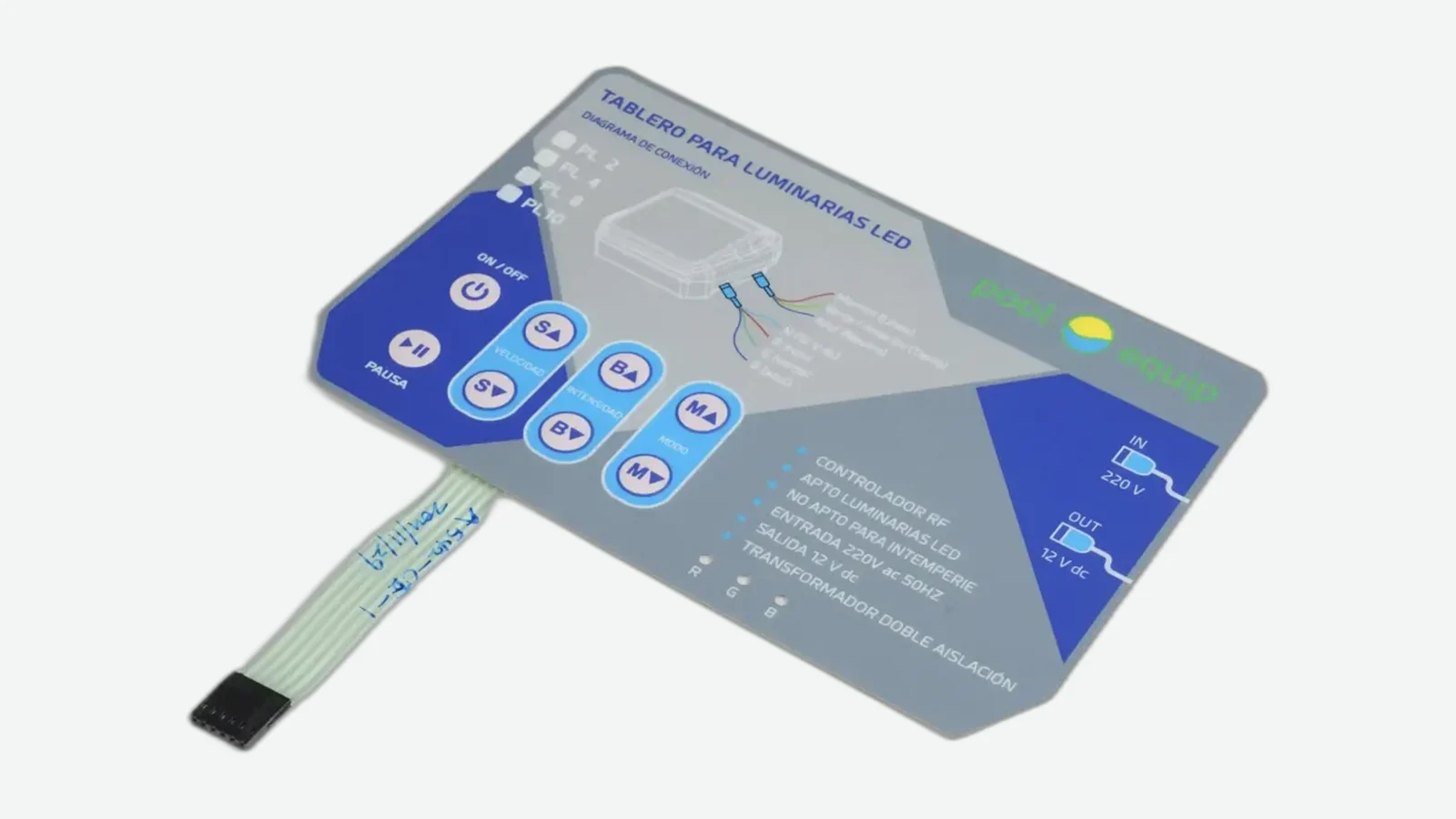
Choosing between an IP65 vs IP67 membrane switch is not a contest over which number looks safer on a datasheet. It is a decision about water failure mode, test configuration, and which joints in the finished assembly must stay closed. Short version: match the second digit to the stressor. OEM mechanical, electronics, and quality engineers at industrial, medical, automotive, marine, and equipment makers need that boundary before RFQ and first-article sample. This comparison separates component language from enclosure-level evaluation under IEC 60529, maps every common ingress path on a waterproof membrane switch build, and ends with the exposure and validation inputs that make a rating claim defensible. The same sealing rules apply whether the assembly is reviewed internally or with a manufacturing partner.
1. Quick verdict — IP65 vs IP67 at a glance
The table scores each dimension for a production-intent IP rated membrane switch assembly mounted in its enclosure—not a loose film sample on a bench.
| Dimension | IP65 wins | IP67 wins | Tie / neither alone |
|---|---|---|---|
| Dust protection (first digit 6) | ✓ | ||
| Directed water jets, rain, hose spray | ✓ | ||
| Temporary immersion (defined depth/time) | ✓ | ||
| Construction complexity for fixed outdoor panels | ✓ | ||
| Tail / connector integrity under hydrostatic load | ✓ | ||
| Dual jet + immersion programs | Dual IP65/IP67 | ||
| High-pressure hot wash (vehicle / some food lines) | IP66 or ISO 20653 “K” family |
One-line summary: Same dust digit, different water tests. Pick the second digit from the stressor the product will see, then seal every path that test can open.
2. What IEC 60529 actually tests
IEC 60529 is the international standard for degrees of protection provided by enclosures for electrical equipment—the IP Code (IEC webstore publication for IEC 60529). Short words fail here. Marketing labels such as “waterproof” are less precise than an IP code tied to a test method and a defined test article.
2.1 Two digits, two jobs
| Digit | What it covers | IP65 | IP67 |
|---|---|---|---|
| First (solids / access) | Solid objects and access to hazardous parts | 6 — dust-tight | 6 — dust-tight |
| Second (liquids) | Harmful water ingress under a defined method | 5 — water jets | 7 — temporary immersion |
The first digit 6 identifies the dust-tight enclosure class under IEC 60529.wikipedia.org/wiki/IP_code)). That is why both IP65 and IP67 membrane switch claims start from the same solids story when the enclosure is truly closed.
The second digit is where the designs diverge.
2.2 IPX5 water jets vs IPX7 immersion
| Class | Water method (public class summary) | What it stresses on a keypad |
|---|---|---|
| IPX5 | 6.3 mm nozzle; water jets from any direction; common lab schedules cite about 12.5 L/min, ~2.5–3 m standoff, and multi-minute exposure (confirm on the controlling IEC 60529 edition and lab procedure) | Perimeter edge, overlay bond, window lands, corners, exposed cutouts under dynamic spray |
| IPX7 | Temporary immersion under defined pressure and time; common class language is 1 m depth for 30 minutes (confirm orientation, water type, and acceptance on the project test plan) | Continuous boundary, tail exit, connector cavity, gasket compression set, capillary paths under static head |
Exact nozzle schedules, distances, and acceptance criteria live in the controlling edition of IEC 60529 and in the lab procedure written for the specific test article. The design point is simpler: jet energy and immersion head are not the same load case.
2.3 Ratings above IPX6 are not cumulative
This rule decides more RFQs than any gasket sketch. Water ratings above IPX6 are not cumulative under IEC 60529. A product that meets IPX7 has not automatically been shown to meet IPX5 or IPX6. Jet spray and immersion use different water delivery methods. If the field can deliver both, the assembly needs evidence for both—often marked IP65/IP67 after separate evaluations—not a single “higher” second digit.
IPX8 continuous immersion is also not a free upgrade: conditions are manufacturer-specified and must be written into the claim. Vehicle and high-pressure wash codes in the ISO 20653 / historical “K” family are a different standard track from a pure IP65 vs IP67 comparison.
3. Side-by-side specifications for an IP rated membrane switch
The numbers below restate the public class intent used in IP65 vs IP67 membrane switch RFQs. They are class labels, not a certificate for any untested part.
| Spec | IP65 membrane switch assembly | IP67 membrane switch assembly |
|---|---|---|
| Solids digit | 6 — dust-tight | 6 — dust-tight |
| Liquids digit | 5 — water jets | 7 — temporary immersion |
| Dominant water load | Dynamic spray / jet | Static hydrostatic head |
| Typical nozzle language (IPX5) | 6.3 mm nozzle; industry-typical schedule ~12.5 L/min, 2.5–3 m (verify on IEC edition + lab SOP) | Not the defining test |
| Immersion language (IPX7) | Not the defining test | Industry-typical class: 1 m / 30 min (verify orientation and acceptance) |
| Primary seal stress | Perimeter land, windows, spray-facing joints | Continuous perimeter + tail/connector volume |
| Claim ownership | Evaluated enclosure / assembly | Evaluated enclosure / assembly |
| Dual-mark option | IP65 alone, or IP65/IP67 if immersion also proven | IP67 alone, or IP65/IP67 if jets also proven |
A sealed membrane switch is only as closed as its weakest joint under the chosen test. Overlay film choice—polyester (PET) or polycarbonate (PC) grade, hard coat, second-surface ink system—matters for wear and chemistry. The film brand still does not create an IP65 or IP67 result by itself.
3.1 Construction planning bands for project review
These ranges are planning bands used in OEM RFQ conversations, not guaranteed recipes and not IEC 60529 pass criteria. Freeze numbers on the project drawing, material stack, and sample report.
| Construction item | IP65-oriented planning band | IP67-oriented planning band | Note |
|---|---|---|---|
| Perimeter seal approach | Continuous PSA land + optional thin compression gasket | Continuous land + higher-integrity gasket / bonded edge | Geometry and substrate flatness dominate |
| Compression gasket (if used) | Often ~1.0–1.5 mm starting discussion | Often ~1.5–2.5 mm starting discussion | Not a universal thickness rule |
| Rear adhesive land width (planning) | Often ≥3–5 mm continuous where space allows | Same or wider; no gaps at corners | Cutouts and keys still need selective opens |
| Tail exit | Heat-seal / PSA tail seal common on fixed panels | Boot, overmold, potting, or sealed bulkhead more common | Immersion finds the tail first |
| Connector state in test | Mated if field-mated | Mated + rear cavity sealed | Open-tail samples mislead |
| Vent strategy (tactile) | May vent to dry rear cavity | Must be intentional: sealed, filtered, or proven path | Vent vs seal conflict is real |
| Build complexity vs unsealed baseline | Industry-typical uplift often discussed as moderate | Industry-typical uplift often higher (extra tail/connector work) | Not a price quote — verify on BOM |
| Relative IP65→IP67 delta (planning talk) | — | Often discussed as a further step up when immersion hardware is added | Confirm on size, windows, backlight, connector |
Construction differences that usually matter more than film brand:
- Perimeter bond width and continuity — selective adhesive openings at keys must not open a spray or capillary path at the edge.
- Window and cutout ownership — display windows, LED apertures, and hardware holes interrupt the face and need an explicit seal owner.
- Flexible tail exit — the most common leak path on immersion programs; heat-seal boots, overmolds, gaskets, or potting are design options, not universal recipes.
- Connector cavity and housing joint — rear bulkheads, cable glands, and panel warp defeat a perfect front laminate.
- Vent vs seal conflict — tactile vent channels that open to atmosphere can fight immersion claims unless the vent strategy is intentional and tested.
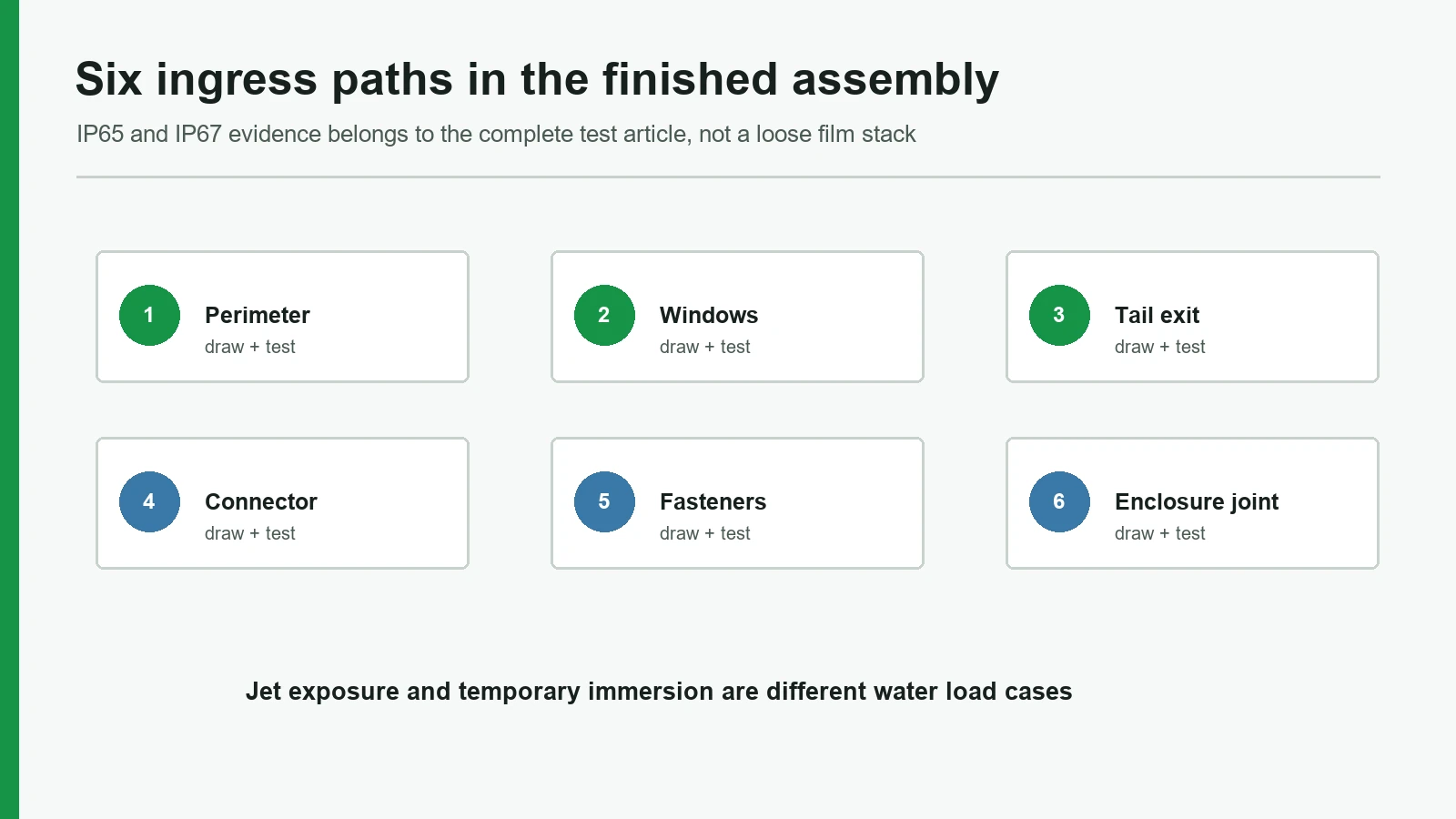
4. What the assembly must seal: six ingress paths
Waterproof membrane switch design fails when teams rate the front graphic and ignore the rest of the water map. The waterproof membrane switches product framing used on this site treats six interfaces as separate decisions. Closing one path does not prove the next.
OPERATOR / ENVIRONMENT
Path 1 Face (overlay surface, emboss, hard coat wear)
Path 2 Perimeter laminate edge (adhesive land, corners)
Path 3 Windows & cutouts (display, LED, hardware holes)
Path 4 Flexible tail exit (fold, stiffener, boot/overmold)
Path 5 Connector boundary (ZIF/LIF/crimp cavity, rear seal)
Path 6 Housing joint (gasket crush, panel flatness, fasteners)
Evaluated as ONE test article under IEC 60529 method
| Path | Water finds… | Design decision to freeze | Sample evidence that actually helps |
|---|---|---|---|
| Face | Cleaners, abrasion, standing drops | Film grade/finish, ink system, window stack | Visual + functional check after defined wipe/spray |
| Perimeter edge | Capillary wicking at laminate edge | Edge geometry, adhesive continuity, corner radius | Edge section or dye check after exposure |
| Windows / cutouts | Steps at clear windows and holes | Overlap, gasket, bezel, or sealed subassembly owner | Opening-by-opening inspection on installed unit |
| Tail exit | Flex exit under spray or head pressure | Exit direction, seal method, bend zone, strain relief | Immersion or jet on production-intent tail |
| Connector | Open cavity behind mating face | Connector family, rear seal, service access rules | Mated-state test, not open-tail fantasy |
| Housing joint | Warped panel, short gasket crush, slots | Flatness, compression, drainage, fastener map | Full enclosure test article only |
IP language belongs to the evaluated assembly. A flat switch coupon without the production enclosure, tail route, and connector state is a materials experiment, not an IP65 vs IP67 proof.
4.1 When a sealed membrane switch is the wrong mental model
- Indoor dry HMIs often need IP54-class dust/splash thinking—or better enclosure design—not an automatic jump to IP67.
- If high-pressure hot wash dominates, investigate IP66 or the ISO 20653 “K” family rather than assuming immersion IP67 solves jet energy.
- If the enclosure has an open cable slot the keypad cannot close, change the housing before buying a thicker gasket story.
5. Where IP65 wins
IP65 is the default water target for many fixed industrial panels because the field stressor is spray and cleaning, not submersion.
5.1 Outdoor cabinets, HVAC, and weather-facing fixed controls
Wall-mounted and door-mounted keypads see wind-driven rain, dust, and occasional hose cleaning. The IPX5 jet class aligns with directed water on a closed face. Do not overbuy immersion hardware for a box that never leaves a wall. Specifying IP67 for a cabinet that stays fixed adds tail-exit and connector work without matching a real failure mode. For HVAC controllers, pump stations, and industrial cabinets, invest drawing time in perimeter land, corner radii, and mounting flatness first.
5.2 Washdown and sanitizer wipe programs (when jets, not tanks, dominate)
Food, lab, and clinical surfaces often face repeated chemical wipe or moderate spray. IP65 can be the right water digit when the protocol is spray/wipe oriented. Material compatibility still sits outside the IP code: oils, solvents, acids, alkalis, and UV are not proven by a water digit. If the protocol is high-pressure close-range jetting, escalate the jet class (often toward IP66 thinking) instead of defaulting to immersion IP67 as a catch-all “more waterproof” label.
5.3 Cost- and tooling-sensitive industrial HMIs at volume
For fixed equipment with a known dry rear cavity, IP65 construction usually stays simpler at the tail exit and connector bulkhead. That is a complexity and risk statement, not a universal price table—unit economics still depend on size, window count, backlight, and connector family. Engineering teams that have actually mapped exposure direction rarely pay for immersion hardware they cannot fail in the field.
IP65 is not best when the product is pocket-carried into wet environments, deck-mounted where green water can cover the face, stored in standing water, or reprocessed by immersion disinfection.
6. Where IP67 wins
IP67 is the right second digit when temporary immersion is a credible event—even if rare.
6.1 Portable, handheld, and field instruments
Handheld meters, portable medical interfaces, and field service tools get set in puddles, rinsed in basins, or left on wet decks. Static head finds ZIF and LIF connector cavities and flex tail exits that spray tests may miss. Write the immersion configuration—depth, time, orientation, powered versus unpowered state—into the validation plan before artwork freezes. Do it early.
6.2 Marine, dockside, and outdoor deck equipment
Console and deck interfaces on small craft and shore equipment can take green water. Application pages for marine and outdoor equipment belong in the same conversation as IP67 because enclosure drainage, salt, and UV sit beside water ingress. Salt chemistry and corrosion still need material and coating decisions beyond the IP digit. IP67 addresses temporary immersion; it does not replace corrosion engineering.
6.3 Floodable enclosures and temporary submersion risk
Outdoor junction boxes, agricultural controllers that can sit in standing water, and vehicle exterior zones that see deep puddles are immersion problems first. Automotive programs often layer ISO 20653-style requirements on top of IEC language; treat those as additional, named requirements—not as “IP67 plus magic.”
IP67 is not best when the only real stressor is light rain on a fixed indoor-outdoor cabinet and the team has not budgeted for tail sealing, connector sealing, and full-enclosure samples. Over-specifying immersion can hide a better answer: fix the housing drain path and stay on IP65 with honest jet testing.
7. Dual rating, and when neither IP65 nor IP67 is the answer
7.1 Dual-marked IP65/IP67
When cleaning jets and temporary immersion both appear in the use case, the defensible mark is dual evaluation: IP65 and IP67 (or the appropriate jet class plus immersion class), each with its procedure and test article definition. Dual marking is common language on industrial-medical handhelds and outdoor instruments. It is not automatic from the larger second digit.
7.2 Choose something else when…
| Situation | Better direction than plain IP65 or IP67 alone |
|---|---|
| Only dust + light drip indoors | Lower IP class or better cabinet design |
| High-pressure hot wash dominates | IP66 and/or ISO 20653 “K” family discussion |
| Continuous submersion | IPX8 with manufacturer-specified conditions |
| Chemical attack is the real failure | Material qualification; IP is not a chemistry rating |
| Open cable gland / warped panel | Enclosure redesign before keypad “IP upgrade” |
| Unevaluated marketing claim needed fast | Stop—do not publish an IP number without a test article |
8. Decision matrix and project checklist
8.1 Choose-if matrix
| If the priority is… | Prefer |
|---|---|
| Fixed outdoor panel, rain + occasional hose, no submersion | IP65 |
| Sanitizer wipe / moderate spray on a closed face | IP65 (+ material compatibility work) |
| High-pressure wash as the main stressor | Jet-focused class (often IP66 path), not immersion-only IP67 |
| Handheld that may sit in water or rinse tanks | IP67 |
| Marine deck / green water risk | IP67 minimum, plus corrosion plan |
| Both spray cleaning and temporary immersion | Dual IP65/IP67 (or matching dual classes) |
| Continuous immersion | IPX8 with written conditions |
| No enclosure drawing yet | Do not claim any IP on the keypad alone |
8.2 Inputs to freeze before sample (exposure direction + validation target)
Use this list when requesting sealing review or quality testing planning:
- Target IP mark (IP65, IP67, dual, or other) and whether the claim is product-label or internal design goal
- Exposure direction map (which faces see jet, splash, or immersion)
- Immersion depth, time, water type, and powered state—if IPX7/IPX8 is in scope
- Cleaning chemistry, temperature, and frequency (separate from IP)
- Enclosure material, flatness, gasket, and drainage features
- Tail exit location, bend, and seal method
- Connector family, mating state during test, and rear cavity rules
- Windows, LEDs, and hardware holes with seal ownership
- Vent strategy for tactile builds (open, filtered, or sealed)
- Production-intent sample definition (not a hand-built hero unit only)
- Pass/fail inspection: visual ingress, insulation resistance, function
- Whether NEMA type language is also required for North American labels (approximate cross-reference only)
Define the exposure direction and the validation target on one page, then send the enclosure drawing, tail route, and proposed IP mark for sealing review. That package beats a datasheet argument about which second digit “sounds higher.”
9. Frequently asked questions
What is the difference between IP65 and IP67 for a membrane switch?
Both share first digit 6 when dust-tight enclosure conditions are met. IP65 is verified against water-jet conditions (IPX5 class, including the familiar 6.3 mm nozzle language). IP67 is verified against temporary immersion under defined conditions (IPX7 class). They measure different failure modes and are not interchangeable.
Does IP67 automatically include IP65?
No. Above IPX6, water ratings are not cumulative. IPX7 immersion evidence does not replace IPX5 jet evidence. If both stressors exist, evaluate both and mark dual ratings such as IP65/IP67 when both pass.
Can a flat membrane switch sample be called IP67 by itself?
Not defensibly. IEC 60529 classifies protection provided by enclosures. The claim needs a defined test article—typically the production enclosure, tail route, connector state, and mounting method. A loose coupon is a development check, not a finished IP rating.
Is IP65 enough for an outdoor membrane keypad?
Often yes for fixed, non-submerged panels that face rain and occasional hose spray. Choose IP67 when temporary immersion is credible: handheld devices, marine decks, floodable boxes, or rinse-tank reprocessing.
What construction changes usually appear when moving from IP65 to IP67?
Immersion programs put more attention on continuous perimeter sealing, tail exit sealing, connector cavity control, and housing compression. Industry-typical planning talks often move from a thinner perimeter gasket discussion (~1.0–1.5 mm) toward thicker compression or bonded-edge approaches (~1.5–2.5 mm) plus a sealed tail—verify on the project; no single thickness is IP67.
Do IP ratings cover chemicals, oil, or UV?
No. IP codes address solids and water under defined methods. Chemical wipe resistance, UV, and oil splash need separate material and application tests.
What is the NEMA relationship to IP65 and IP67?
NEMA enclosure types are a United States classification language under NEMA 250-related practice. Published cross-reference tables are approximate guidance only. An IP test does not automatically satisfy a NEMA type test, and the reverse is also true. Write the required mark set explicitly.
How should dual IP65/IP67 testing be planned?
Define one production-intent assembly, run the jet procedure and the immersion procedure as separate evaluations (order and recovery conditions agreed in advance), inspect for harmful ingress and electrical function, and only then apply dual marking. Record orientation, duration, and mating state so the report matches the product claim.
Technical References
- Source: IEC 60529 enclosure protection classification. Accessed 2026.
- Source: IEC Electropedia definition of enclosure degree of protection. Accessed 2026.
- Source: NEMA 250 enclosure classification scope. Accessed 2026.
- Source: ISO 20653 road-vehicle ingress protection test scope. Accessed 2026.
- Source: UL 50E enclosure environmental construction scope. Accessed 2026.
- Source: IEC 60068-2-18 water and guidance testing. Accessed 2026.
- Source: ASTM D3330 pressure-sensitive tape peel adhesion test method. Accessed 2026.
- Source: 3M membrane switch spacer technical data. Accessed 2026.
- Source: NEMA enclosure type and IP rating comparison guidance. Accessed 2026.
- Source: IEC 60068-2-78 damp heat steady-state testing. Accessed 2026.
- Source: IEC 60529. Accessed 2026.
- Source: IP Code overview. Accessed 2026.
Define the complete ingress test article
Send the exposure direction, enclosure section, perimeter land, tail exit, connector path, gasket construction, and required IP test method.