
A touch sensor manufacturer makes the sensing element; a touch module integrator combines that element with agreed components and validates the supplied assembly. A trader can coordinate purchasing without necessarily controlling either process. For a projected-capacitive (PCAP) purchase, choose by the last interface your organization can competently own. Before a purchase order, target 100% named accountability across seven release artifacts, with zero unassigned owners: drawings, bill of materials, controller configuration, interface definition, test plan, traceability record, and change-control procedure.
Which supplier role should receive the RFQ?
The choice is not a ranking of companies. It is a choice about physical delivery, technical custody, and the point at which a defect changes hands. A company may perform more than one role; a supplier's actual statement of work, not its website label, determines the contract boundary.
| Buying route | Typical purchased output | Ask before requesting a price | Evidence that makes the answer credible |
|---|---|---|---|
| Sensor manufacturer | Patterned PCAP sensor, flexible tail, and any explicitly included cover or sensor lamination | Does the quote stop at the sensor tail, or include the cover lens, adhesive, controller, and touch response? | Layer drawing, electrode and tail drawings, controlled material list, inspection plan, sample IDs |
| Touch module integrator | A specified combination of sensor, cover, controller, and possibly display, bond, frame, or cable | Which parts and processes are inside the delivered module, and who validates the final stack? | Assembly BOM, bond cross-section, controller revision, module-level test record, interface drawing |
| Trader or sourcing intermediary | Commercial supply and coordinated fulfillment of a separately defined article | Which legal entity manufactures, tests, approves engineering changes, and answers a failure report? | Factory identity disclosed to the OEM, factory-issued evidence, traceability path, written escalation authority |
Buy direct from a sensor factory when your own engineering team can select and tune the controller, manage display or enclosure integration, and accept the resulting system risk. Buy a module when you need one party to own a larger stack and provide its assembly-level evidence. Use a trader when sourcing reach, consolidated logistics, or commercial administration creates value—but do not mistake a single invoice for single-point engineering accountability.
Define the supplied boundary before comparing prices
“Touch panel” might mean a patterned sensor, a lens-plus-sensor stack, a sensor and controller, or a bonded display assembly. Two quotes using the same noun may purchase entirely different things. Make the exclusions as explicit as the inclusions.
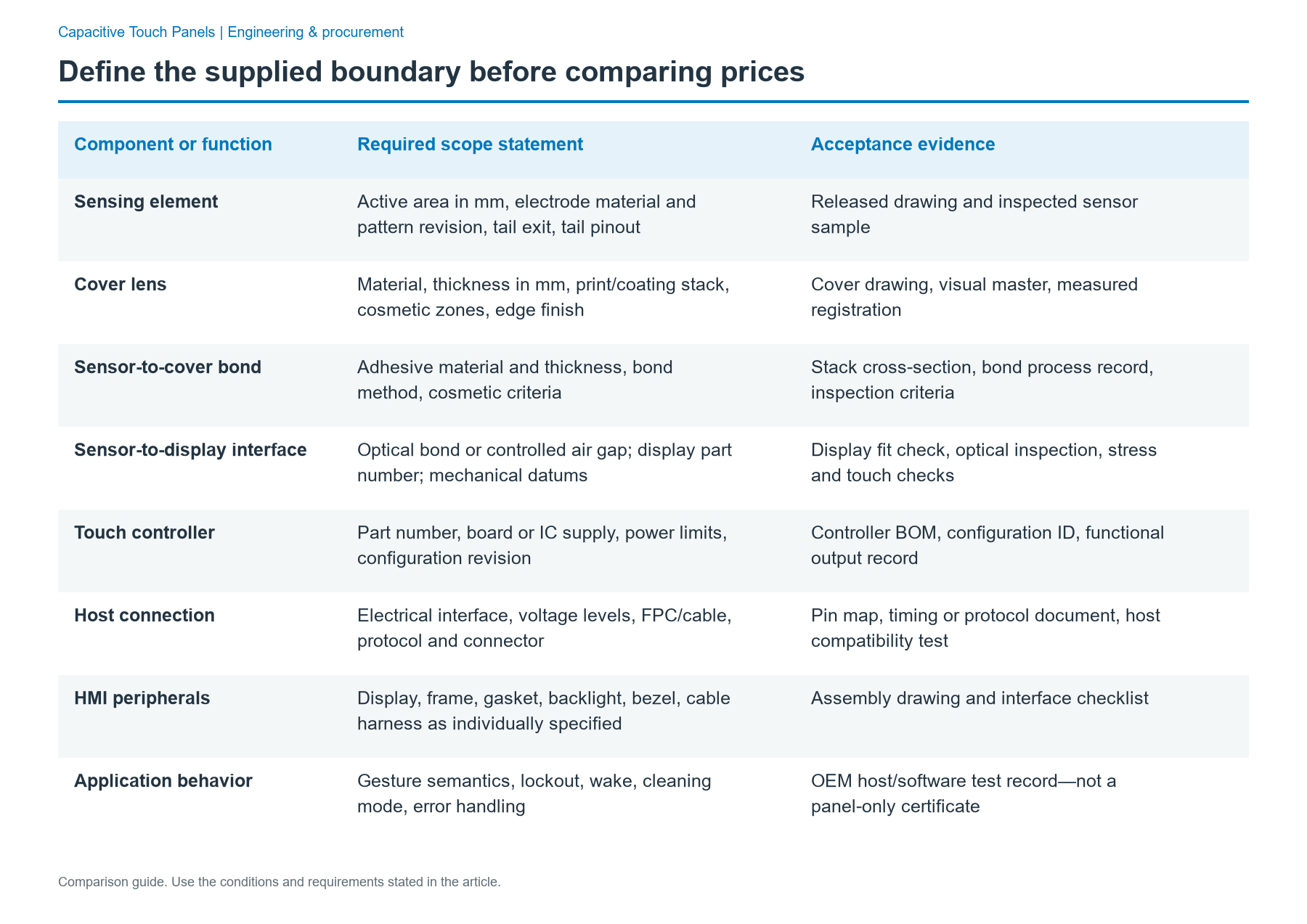
| Component or function | Required scope statement | Acceptance evidence |
|---|---|---|
| Sensing element | Active area in mm, electrode material and pattern revision, tail exit, tail pinout | Released drawing and inspected sensor sample |
| Cover lens | Material, thickness in mm, print/coating stack, cosmetic zones, edge finish | Cover drawing, visual master, measured registration |
| Sensor-to-cover bond | Adhesive material and thickness, bond method, cosmetic criteria | Stack cross-section, bond process record, inspection criteria |
| Sensor-to-display interface | Optical bond or controlled air gap; display part number; mechanical datums | Display fit check, optical inspection, stress and touch checks |
| Touch controller | Part number, board or IC supply, power limits, configuration revision | Controller BOM, configuration ID, functional output record |
| Host connection | Electrical interface, voltage levels, FPC/cable, protocol and connector | Pin map, timing or protocol document, host compatibility test |
| HMI peripherals | Display, frame, gasket, backlight, bezel, cable harness as individually specified | Assembly drawing and interface checklist |
| Application behavior | Gesture semantics, lockout, wake, cleaning mode, error handling | OEM host/software test record—not a panel-only certificate |
For an RFQ, explicitly ask whether the candidate controller offers I²C, SPI, USB HID, and UART; record an individual yes/no and electrical/protocol qualification for each. These are useful screening categories, not a claim that every controller offers all four or that they exhaust every proprietary possibility. A serial connector description alone is not a host-interface specification.
Likewise, separate the two commonly considered display attachment routes: perimeter tape/air gap and full optical bonding. The quote must name the selected route and bond area, optical criteria, serviceability trade-off, and display part number. Do not treat a loose sensor demonstration as proof of bonded display performance. A project without a display can explicitly mark both display-attachment routes outside scope.
A responsibility register for outsourced work, data, and corrective action
A purchase order needs an owner for the outsourced operation and a person authorized to change the released design. The following register is a working allocation for a typical project buying a completed touch module through an integrator; if the OEM buys a bare sensor, move the corresponding assembly and tuning duties to the OEM or its separately contracted specialist. If a trader handles the order, name the underlying accountable technical party in writing.
| Work or handoff | Process may be outsourced to | Custodian of controlled records | Who authorizes a corrective change? |
|---|---|---|---|
| Electrode pattern and sensor FPC | Sensor fabrication shop | Sensor design owner; integrator holds approved revision | Sensor design owner proposes; OEM approves affected form/fit/function |
| Cover printing, cutting, and coating | Cover processor | Specified cover owner, with integrator's incoming records | OEM approves artwork and cosmetic-zone changes |
| Cover-to-sensor lamination | Contract laminator | Integrator holding process and lot records | Integrator controls process correction; OEM approves stack/material changes |
| Display attachment, if purchased | Bonding subcontractor | Integrator holding display/BOM and bond records | Integrator controls rework; OEM approves display or bond-stack substitution |
| Controller board procurement | Electronics assembler | Named controller/BOM custodian | Controller design owner proposes substitutions; OEM approves compatibility impact |
| Parameter tuning and firmware loading | Controller specialist | Named owner of binary, parameter set, checksum, and usage rights | Named tuning authority changes parameters; OEM approves new functional baseline |
| Tail, connector, and cable assembly | Cable subcontractor | Integrator holding pin map and continuity records | Interface design owner and OEM approve pinout or length changes |
| Incoming, final, and lot tests | Sensor shop and/or integrator | Contracted release authority retains results and sample identity | Release authority contains defects; OEM decides concession or acceptance |
| Full-device electrical and operator behavior | OEM with the production display, power, enclosure, and host | OEM system verification owner | OEM controls host software, system configuration, and finished-device release |
The supplier can authorize a process adjustment inside already approved limits only where the quality agreement grants that authority. It cannot silently replace a controller, shift electrode artwork, change adhesive, alter the interface, or retune touch thresholds if those changes affect the agreed product baseline. A trader's commercial approval is not a substitute for the OEM's engineering approval.
Seven artifacts that must be assigned before the PO
Use this as a release-ownership check. “Complete” means the purchasing file identifies the accountable owner, evidence deliverable, revision, and approval route for every row; documents can follow at an agreed milestone, but responsibility cannot remain blank. The high-end procurement target is 7 of 7 assigned, or 100%, with 0 unowned items before order authorization—not a claim about a supplier's actual performance.
| Release artifact | Minimum deliverable | Accountable role in an integrator-led buy | Approval checkpoint |
|---|---|---|---|
| 1. Mechanical and stack drawings | Outline, active/view area, datums, layers, mounting interfaces | Module integrator | OEM mechanical sign-off |
| 2. Controlled BOM | Sensor, cover, adhesives, controller, display if included, cable, approved alternates | Module integrator | OEM BOM baseline |
| 3. Firmware and tuning record | Controller part, binary/parameter ID, checksum, loading and recovery process | Named controller/tuning owner | OEM installed-function sign-off |
| 4. Electrical/host interface | Pinout, power, logic levels, protocol, connector, coordinate orientation | Interface design owner | OEM hardware/software sign-off |
| 5. Validation and inspection plan | Test method, sample states, acceptance criteria, lot checks | Module integrator for its article; OEM for complete device | Joint sample-approval record |
| 6. Lot and sample genealogy | Lot IDs, critical material lots, revisions, sample IDs, retained evidence | Contracted release authority | OEM receiving-quality agreement |
| 7. Change and issue-control route | Notice triggers, disposition powers, escalation and revision authorization | Integrator or direct factory as prime | OEM change-board approval |
If the same integrator appears on several rows, verify whether it owns the record or merely forwards an upstream file. The right question is: Can your team reproduce the approved unit and diagnose the rejected one using the records you are entitled to receive?
What to ask each role, and how to read the answer
Questions for a touch sensor manufacturer
Ask for the process boundary first: Which electrode fabrication and tail operations are in-house? Which cover treatments, lamination steps, or electrical tests are bought out? Request the layer drawing with active area, visual area, electrode revision, tail-bend and connector requirements, critical tolerances, and the lot record linking incoming material to final inspected sensors. Ask what the factory can measure on a bare sensor and what requires a specified controller and assembled stack.
For a fault, ask who can remeasure the electrode matrix, inspect shorts/opens and tail continuity, approve a pattern revision, and ship revision-controlled replacement sensors. A strong answer includes raw inspection criteria and an escalation owner. “Our sensor works with any controller” without a pairing or tuning plan is a weak answer.
Questions for a touch module integrator
Ask for a complete make/buy map: Who provides the sensor and controller? Who owns lamination, display bonding, firmware loading, cleaning, optical inspection, cable fitting, and final electrical test? Ask for the exact delivered article number and whether display, frame, power board, or harness is included or excluded. Request the approved module stack, production display part number, configuration checksum, test fixtures, and rejection criteria.
Ask who can reproduce a glove or wet-surface failure using the OEM's real display, power, grounding, and bezel conditions; who can tune the controller; and who is permitted to issue the final corrected build. Look for a signed interface-control document and a requalification trigger for sensor, bond, controller, or display changes. A single assembled sample without its revision data does not close this risk.
Questions for a trader or sourcing intermediary
Ask for the actual manufacturing and test sites, the legal manufacturer of record, a direct technical escalation contact, and the contract path for audit findings, recalls, or returns. Confirm whether the trader can share original drawings and first-article reports, whether the OEM can visit or audit the manufacturing source by agreement, and how lot IDs survive relabeling or repacking.
Put dispute authority in writing: Who may grant a deviation, who pays for sorting and freight, who issues corrective-action evidence, and who authorizes a substitution? A trader can administer those activities; it should not be silently deemed the sensor designer, controller specialist, or finished-equipment certifier.
Supplier screening: evidence beats a broad capability claim
Use the same eight criteria with all candidates. The good signal and red flag test what the proposed contract actually includes, not how many services the company advertises.
| Criterion | Good signal | Red flag |
|---|---|---|
| Delivery boundary | An itemized included/excluded assembly drawing | “Complete touchscreen” with no BOM or defined acceptance point |
| Outsourced process | Named subcontract step, lot trace, inspection owner | Refusal to identify who performs or releases critical work |
| Technical data | Revision-controlled drawings, pin map, controller IDs | Only photos and marketing dimensions |
| Controller competence | Actual stack tuning method and named revision custodian | Glove or wet-use promise based on a bare finger demo |
| Quote comparability | Separate tooling, NRE, assembly, tests, freight, and yield assumptions | Low unit price that omits required bonding or validation |
| Sample authority | Written pass/fail matrix and OEM approval signature | “Approved” means shipment of any working prototype |
| Change discipline | Advance notice and requalification for listed changes | Quiet material, factory, firmware, or display substitution |
| Quality response | Lot containment, failure evidence, escalation and disposition owner | No documented path from returned unit to corrective action |
A useful first-pass rule is to hold the PO if any one of the seven release-artifact owners is unassigned, even when the quoted unit price looks attractive. Commercial terms cannot recover an unknown firmware baseline after production starts.
RFQ packet and a comparable quote worksheet
Send a single technical packet to all candidate routes, but allow each to state precisely which line items it performs. Prices become comparable only after you normalize output, one-time charges, test coverage, and delivery terms.
| RFQ field | Buyer input to freeze | Supplier must return |
|---|---|---|
| Envelope | Overall size, active area in mm, view area, thickness/flatness limits, bezel datums | Dimensional exceptions and drawing revision |
| Surface stack | Cover material/thickness, coatings, print zones, bond design, cosmetic zones | Proposed layer stack and controlled materials |
| Display | Exact display model, connector, viewing area, backlight/power conditions, or exclusion | Included/excluded display and attachment method |
| Sensing | PCAP coordinate or discrete-zone requirement, number of contacts if relevant | Sensor architecture, controller pairing, touch map evidence |
| Electrical | Host type, voltage rails, candidate interfaces, connector, EMI environment | Pinout, supported protocol, power/current conditions |
| Operator states | Dry bare finger; specified glove type/thickness; prescribed moisture and cleaning exposure | Test method and acceptance for each named state |
| Reliability and quality | Intended operating conditions, inspection level, failure classes, lot-trace needs | Test plan, sampling proposal, record-retention and defect route |
| Production | Forecast, releases, packaging, needed milestones, receiving site | Sample/tooling/production lead times with start triggers |
| Commercial | One currency, delivery location and selected Incoterm, quantity breaks | Unit price, NRE, tooling title, yield/rework treatment, freight/taxes |
As a hypothetical RFQ format, request separate price breaks at 100 units, 1,000 units, and 5,000 units, with the same revision and delivery conditions at each break. These are illustrative purchasing volumes, not standard industry tiers or a JASPER MOQ. Record sample charges and tooling separately; do not amortize them invisibly into one supplier's unit price while leaving another supplier's NRE explicit.
For a normalized comparison, calculate:
Cost per accepted unit = (lot purchase cost + allocated tooling/NRE + buyer-paid freight and duties + agreed rework costs) ÷ accepted units.
Consider an illustrative, same-destination 1,000-unit comparison. Route A buys 1,000 sensors at $19 each plus $7 per unit for separately contracted integration, $1,000 in freight/testing and $2,000 allocated NRE. If 980 units are accepted, the modeled result is ($19,000 + $7,000 + $1,000 + $2,000) / 980 = $29.59 per accepted unit. Route B buys 1,000 complete modules at $28 each, plus $1,400 freight/testing and $700 allocated NRE; if 995 are accepted, $30,100 / 995 = $30.25. Those prices and acceptance counts are assumptions, not supplier quotes or measured yields. The lower modeled cost does not settle who owns a field return, retune, or rejected bonded display.
The sensitivity is easy to test: with the same Route A cost of $29,000, 950 accepted units increase cost to $30.53 each; at 1,000 accepted units it falls to $29.00. Compare both suppliers against the same inspection definition and failure class, or the arithmetic is misleading.
Move from sample to purchase order in seven gates
- Freeze the required boundary. Publish a single cross-section, electrical interface description, OEM host/display assumptions, and included/excluded BOM. Reject quotes that silently expand or shrink the supplied article.
- Qualify the real execution chain. Check which operations are outsourced and examine the records each subcontractor passes to the prime. Assign all seven release-artifact owners before PO authorization.
- Normalize offers. Request the same 100-, 1,000-, and 5,000-unit illustrative price breaks, separate NRE, shipment term, quote validity, capacity assumptions, and lead-time triggers. Compare accepted-unit economics, not one headline price.
- Approve engineering samples in the installed stack. Use the production-intent cover, controller, display, grounding, enclosure, power and host. Include central/edge locations, the specified glove and wet conditions, inactive/cleaning states, wake, and reconnection. Save failed conditions as well as passes.
- Close design verification and release the baseline. Tie every approved sample ID to drawings, material revision, controller binary/checksum, tuning parameters, test software, deviations, and OEM signatures. Target zero unresolved critical functional failures at this gate.
- Authorize the production-intent build. Define first-article inspection, lot labels, packaging, rejection/containment rules, and retest after any controlled change. For an illustrative pilot, request 10 production-intent units, but size the actual sample and statistics to the program's risks.
- Release repeat orders by revision. Put the approved revision, destination, inspection records, response timing, notification triggers, and open issues on each order. Avoid a standing authorization for unspecified “equivalents.”
The integrator should validate what it ships; the OEM must still validate its finished HMI. Panel or module evidence cannot by itself establish equipment-level EMC compliance, ingress rating, functional safety, or host-application correctness. A system test obligation must not be disguised as a touch panel specification.
For additional detail on installed-stack sample evidence, use the PCAP prototype validation checklist before approving the gate-five baseline.
When an issue appears, who may actually fix it?
Create a shared issue log with one technical owner, one commercial coordinator, and a separate OEM disposition authority. The log should carry the serial/lot ID, full configuration, reproduction steps, photographs or measurements, containment action, root-cause evidence, and disposition. A subcontractor may investigate; only the named decision authority can release a changed design or accept a deviation.
| Observed failure | First technical investigator | Minimum evidence | Decision authority |
|---|---|---|---|
| Edge touches missing on installed HMI | Controller/tuning owner with sensor engineer | Raw touch map, stack and bezel drawing, display/power state, configuration checksum | OEM approves retune or electrode change |
| Bubble or optical blemish after bonding | Integrator and bonding process owner | Bond lot, material revision, photos against cosmetic zones, process conditions | Integrator disposes in-limit process defects; OEM approves material/stack changes |
| Host fails to enumerate or report coordinates | Interface owner plus OEM firmware engineer | Pinout, voltage/protocol log, firmware ID, host test revision | OEM approves interface or host software changes |
| Lot-level open circuit or intermittent tail | Sensor fab/assembly quality owner | Lot genealogy, continuity readings, bend/connector inspection | Prime contains lot; OEM approves deviation or return |
| Wet-condition false actuation | Controller specialist and OEM system owner | Named liquid application, glove/state definition, raw traces and host response | OEM controls operating-state acceptance and software action |
For purchasing terms, consider a requested response target of 2 business days to acknowledge a reported failure and 5 business days to provide a containment plan, both counted from receipt of adequate evidence. These are negotiable project targets, not a promised supplier service level or a substitute for an agreed final corrective-action due date.
Put the hidden handoffs into the PO
The PO and technical quality agreement should identify: legal seller and manufacturer of record; approved work sites and controlled subprocesses; article and drawing revisions; material substitutions; tooling ownership and retrieval conditions; access and license rights for source design data and controller settings; minimum records supplied with each lot; sample approval; warranty and return authorization; containment and corrective-action responsibility; and engineering-change notice/consent before shipment.
Pay special attention to tuning files. Owning physical tooling does not automatically grant source code, encrypted-controller access, or transferable configuration rights. The commercial agreement should specify whether the OEM receives binary, checksum, editable parameters, documentation, reloading rights, and continuity arrangements if the tuning specialist changes. Do not accept a promise of future “full source access” unless that entitlement is contracted.
For supply continuity, request end-of-life notice terms, last-buy process, approved alternate-controller procedure, and a definition of the retest caused by changing sensor film, cover chemistry, adhesive, firmware, or display. If any upstream factory is undisclosed, define the conditions for escrow, audit access, or a second-source qualification rather than pretending the risk is absent.
Choose the contracting boundary your team can control
| OEM situation | Better initial sourcing route | The capability the OEM must still retain |
|---|---|---|
| OEM owns controller board, tuning, enclosure and display assembly | Sensor manufacturer | Sensor acceptance, integration drawing, installed validation |
| OEM wants a tested sensor/cover/controller assembly | Touch module integrator | Host validation, configuration approval, supplier-change oversight |
| OEM wants a display bonded into an inspected module | Integrator with explicit display-bond scope | Equipment-level testing, packaging and service responsibility |
| OEM has dispersed factories and needs purchasing/logistics coordination | Trader with traceable technical origin | Direct technical escalation, access to primary evidence and OEM disposition |
| OEM cannot name who will hold firmware and interface records | Do not release a production PO yet | Assign data custodian and decision rights before selecting the route |
JASPER's capacitive touch panel product family is a starting point for defining the front-panel and sensing boundary. Select the proposed article by its sensing format and deliverables, then confirm any controller, display, bonding, or full-HMI work as a separate, explicit scope rather than treating it as included by default.
Frequently Asked Questions
Is a touch sensor manufacturer the same as a touch module integrator?
No. A sensor manufacturer primarily controls the patterned sensing element and its production evidence. A module integrator controls an agreed assembly boundary that may add cover glass, bonding, controller, display, frame, and final module testing. Some suppliers perform both roles. Evaluate the delivered drawing, controlled BOM, and test authority rather than relying on a supplier's job title.
Can a trader be the main supplier for a PCAP project?
Yes, provided the contract preserves the real manufacturing identity, engineering escalation route, lot traceability, and change-approval authority. A trader can consolidate purchasing and shipments, but invoicing authority alone does not prove control over electrode design, controller tuning, bonding, or failure analysis. The OEM should know which technical entity owns each critical handoff.
Who should own controller firmware and tuning parameters?
Name a technical custodian for the released binary, parameters, version, checksum, and recovery procedure, then define what the OEM is licensed to receive and reload. The integrator may coordinate this work with a controller specialist. The OEM should approve changes affecting touch response or host behavior. Physical ownership of the sensor does not establish firmware rights.
Should the sensor supplier also handle display bonding?
Only when the quote, drawing, and quality agreement include that operation. A sensor factory may ship a tested sensor while an integrator handles optical bonding or perimeter-tape attachment. The chosen route affects optical defects, rework, mechanical stress, and responsibility for the installed test. Require the display model, bond material, cosmetic criteria, and release authority to be named.
Which host interface should purchasing specify?
Specify the actual host connector, electrical levels, protocol, power requirements, and expected coordinate behavior. Screen candidate controller support for I²C, SPI, USB HID, and UART individually, but do not assume those alternatives exist on one product. An interface label without a pin map, controller revision, and host interoperability test does not provide a usable acceptance boundary.
What must be approved before a PCAP production order?
Assign accountable owners to all seven release artifacts, approve samples in the production-intent installed stack, and close all critical functional failures. The approval package should link sample IDs to drawings, BOM, controller configuration, interface definition, test plan, lot genealogy, and change rules. A bare-finger demonstration or a signed purchase order alone is not production validation.
Who pays when a bonded module fails after delivery?
Responsibility follows the contracted defect definition, supplied boundary, approved revisions, and agreed return and warranty terms—not merely the entity that sent the invoice. Preserve lot data, module configuration, installed test logs, and failure evidence. The prime supplier should coordinate containment; the relevant technical owner diagnoses the cause; the OEM decides whether to accept a design deviation.
Send a boundary-defined inquiry
For a sourcing review, send the panel outline and active area, cover stack, display model, host and interface, glove and wet-use conditions, expected quantities, and acceptance tasks. State whether you want a bare sensor, a controlled sensor/cover/controller assembly, or a larger module. Use the Request a Quote form to start with that defined boundary, so technical evidence and commercial pricing refer to the same article.
Bring the drawing, stack and operating conditions
JASPER engineering will review the interfaces, open risks and evidence required for a production quote.