
The membrane switch second source vs. safety stock decision starts with recovery time. Buy inventory first for bounded interruptions; qualify an independent source before longer outages exhaust that inventory. For the worked case, use a 10-week usable-coverage target: a qualified source's 6-week restart plus a 4-week allowance. This is a project planning benchmark, not a universal lead time. A second supplier without an inventory bridge can still leave production stopped.
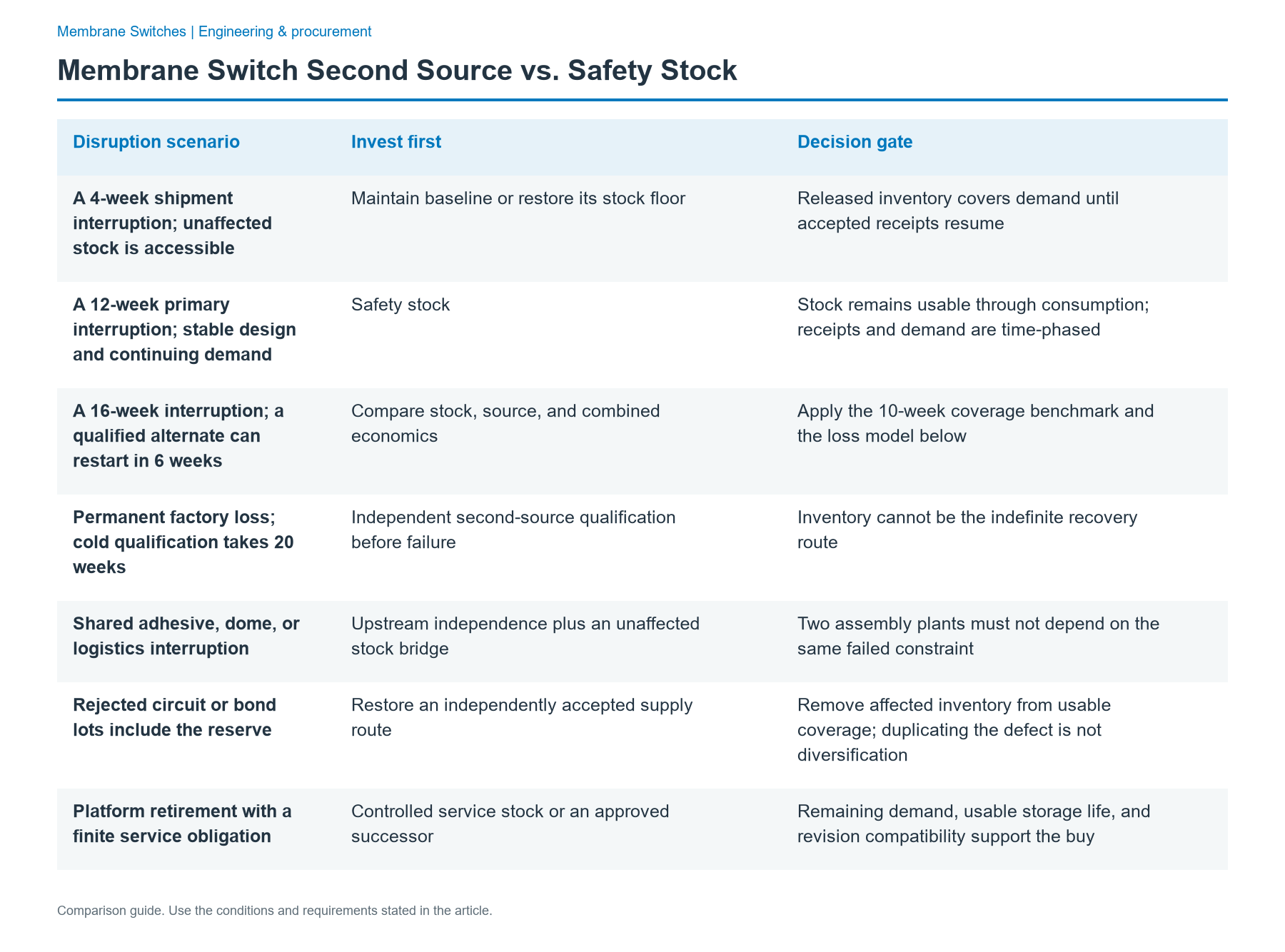
Choose against recovery time, not supplier count
Safety stock buys time, while a qualified second source provides a route back to supply. The investment question is which failure your next dollar must address.
A printed membrane switch is not interchangeable merely because its outline and legends match. The circuit pattern, key response, tail interface, spacer geometry, adhesive stack, and installed fit must still work in the OEM assembly. A second quotation therefore represents a sourcing option, not released production capacity.
Use three separate clocks. Primary recovery time ends when acceptable parts reach the consuming location, not when the original factory reopens. Cold qualification time includes the funded engineering, tooling, sample, approval, production, freight, and receiving path for an unqualified alternate. Qualified-source restart time covers the remaining activation and delivery path after approval already exists. Parallel activities count once; sequential activities accumulate.
For example, assume cold qualification takes 20 weeks end to end. A 12-week buffer cannot bridge that route if qualification begins only after supply fails. Starting the work before an outage may be necessary even when buying stock is the better immediate protection. The 20-week assumption is a scheduling scenario, not a supplier promise.
Compare all four funding policies rather than forcing a false binary:
| Policy | What receives funding | What remains exposed |
|---|---|---|
| Maintain baseline | Existing inventory and controls only | Any interruption beyond current coverage |
| Stock only | More usable, released switches | Long stoppages, obsolescence, affected lots |
| Source only | Qualified alternate; baseline stock retained | Restart gap and shared dependencies |
| Combined | Qualified alternate plus additional stock | Common-cause failures and events beyond the design case |
Set an allowable interruption before ranking costs. A policy that violates that limit is not made acceptable by a favorable expected return. When no policy passes, consider more coverage, a different upstream route, an approved redesign, or an explicitly accepted business exposure.
Use an outage-scenario investment matrix
The outage-scenario investment matrix identifies the protection to fund first and the condition that can invalidate it. Durations below are scenario inputs, not industry inventory bands.
| Disruption scenario | Invest first | Decision gate |
|---|---|---|
| A 4-week shipment interruption; unaffected stock is accessible | Maintain baseline or restore its stock floor | Released inventory covers demand until accepted receipts resume |
| A 12-week primary interruption; stable design and continuing demand | Safety stock | Stock remains usable through consumption; receipts and demand are time-phased |
| A 16-week interruption; a qualified alternate can restart in 6 weeks | Compare stock, source, and combined economics | Apply the 10-week coverage benchmark and the loss model below |
| Permanent factory loss; cold qualification takes 20 weeks | Independent second-source qualification before failure | Inventory cannot be the indefinite recovery route |
| Shared adhesive, dome, or logistics interruption | Upstream independence plus an unaffected stock bridge | Two assembly plants must not depend on the same failed constraint |
| Rejected circuit or bond lots include the reserve | Restore an independently accepted supply route | Remove affected inventory from usable coverage; duplicating the defect is not diversification |
| Platform retirement with a finite service obligation | Controlled service stock or an approved successor | Remaining demand, usable storage life, and revision compatibility support the buy |
An emergency stock purchase is useful only while supply still exists. A new alternate qualification protects future events only after its release gates are complete. Budget the interval before either investment becomes operational; do not credit protection on the date a purchase order is signed.
Count only inventory that survives release and aging
Usable inventory is the quantity that can actually support the approved platform at the time of need. Ordered units, quarantined units, inaccessible consignment stock, and superseded revisions do not automatically qualify.
For constant demand, calculate:
Usable coverage B = usable switches I / weekly switch demand d
Here, I is measured in switches and d in switches/week, so B is measured in weeks. Count service allocations consistently: either reserve those units outside I or include their demand in d, but not both. Convert equipment demand through the bill of materials rather than assuming every platform uses one panel.
For the worked case, 1,200 released switches / 100 switches per week = 12 weeks. The 10-week restart benchmark would require 1,000 usable switches under the same demand and delivery assumptions. Neither figure is a statistical service-level guarantee.
Keep routine demand-variability stock distinct from disruption stock. The example uses a protected stock floor available at the event's start, not average cycle inventory or an arbitrary addition to an existing safety-stock calculation.
| Inventory question | Good signal | Red flag |
|---|---|---|
| Is the correct assembly released? | Revision, lot status, and compatibility are recorded | A warehouse count combines old and current revisions |
| Will the bond system remain usable? | Age limits and storage conditions match the converted assembly | Raw-material shelf life is treated as finished-switch life |
| Can the tail and stack survive storage? | Packaging protects tails, liners, domes, and flatness | Bent tails, liner damage, or compressed key areas |
| Can the OEM access stock during the event? | Location, release authority, and allocation are explicit | Stock sits at the same inaccessible factory |
| Will demand consume it? | Production and service drawdown precede expiry or redesign | A last-time buy exceeds credible remaining demand |
A useful material boundary is 467MP transfer tape in the 200MP adhesive family. Its published storage guidance gives 24 months from manufacture under 70°F (21°C) and 50% relative humidity. That is a material-specific statement, not a 24-month shelf-life approval for a laminated membrane switch. Conversion, packaging, storage history, and the installed application still need their own acceptance basis.
Use first-expiring-first-out rotation where expiry governs. A continuity reserve can rotate through normal production while maintaining its floor; it need not become a forgotten carton. Recheck exposure whenever an adhesive, circuit, connector, or platform revision changes.
Model lot-wide rejection separately from a factory outage with intact inventory. If the reserve shares the rejected circuit process or bond material, those units cannot provide the bridge credited in the base financial example. The usable-stock input changes before any cost comparison is made.
Pay for second-source readiness, not spare tooling
A second source earns continuity credit only when it can deliver the released switch at the required good-unit rate. A duplicate cutting die does not establish that capability.
Track three readiness states separately: unqualified, qualified-idle, and active. An unqualified source still needs the cold qualification path. A qualified-idle source needs evidence that its approval, materials, tooling, and restart arrangements remain valid. An active source supplies recurring production, but its spare capacity must still match the outage scenario.
| Work package | Membrane-switch content | Budget treatment |
|---|---|---|
| Tooling and test equipment | Screens, cutting tools, emboss tooling where used, electrical fixtures | One-time setup plus maintenance |
| Engineering and process work | Printed circuit, spacer and vent geometry, stack tolerances, assembly method | Engineering hours and process development |
| Qualification and release | Electrical, tactile, dimensional, bonding, and application checks | Quality labor, sample builds, testing, approval time |
| Tail and mating interface | Pinout, pin 1, pitch, contact side, tail thickness, connector engagement | Interface review and representative assembly trials |
| Qualification upkeep | Revision synchronization, retained samples, repeat lots, fixture checks | Recurring quality and purchasing cost |
| Capacity and order economics | Reserved good-unit output, material access, split-order effects | Reservation charges, premiums, and inventory consequences |
A drawing package should retain mechanical dimensions, editable artwork, circuit information, and the released stack. For a ZIF tail, a matching pitch alone is insufficient: the mating connector also constrains contact orientation and cable thickness. For tactile keys, preserve the approved force response, support, spacer, and vent arrangement rather than accepting visual similarity.
Measure capacity at the constrained process and in accepted switches per week. A plant can have idle printing capacity but lack cutting, lamination, assembly, test, or material capacity. A small repeat order demonstrates current production; it does not prove the ability to replace the primary supplier's full output.
Ownership and access are different. Record rights to drawings and tooling, their physical locations, release responsibilities, and whether duplicate tools can actually run at the alternate site. OEM quality owns the required product and system release; component qualification does not replace equipment-level approval.
The investment approval should name the evidence and budget required to make the source usable. Detailed transfer execution belongs in the subsequent engineering release plan, not in a claim that sourcing has already been completed.
Calculate the business case on the same basis
A dual sourcing keypad business case should compare incremental protection costs with the same interruption losses, demand, and remaining platform life. The following illustrative example is not a quotation, customer result, or measured outage forecast.
Define the inputs
| Input | Assumed value | Meaning |
|---|---|---|
| Weekly demand, d | 100 switches/week | One switch per equipment unit in this example |
| Landed cost, c | $20/switch | Common purchase cost before any alternate premium |
| Baseline stock, B0 | 4 weeks; 400 switches | Protected, usable quantity at event onset |
| Expanded stock, B1 | 12 weeks; 1,200 switches | An additional 800 switches |
| Primary restoration, D | 16 weeks | Accepted supply restored; no earlier cold-source rescue |
| Qualified-source restart, T | 6 weeks | Full 100-switch/week accepted output thereafter |
| Alternate unavailability, q | 20% conditional probability | Given the modeled primary outage, alternate fails to help throughout it |
| Annual event probability, p | 10% | At most one modeled primary outage per year |
| Net interruption loss, V | $25,000/uncovered week | Unrecoverable contribution plus incremental disruption costs |
| One-time alternate setup, K | $30,000 | $12,000 tooling/fixtures; $8,000 engineering/process; $10,000 qualification |
| Alternate annual cost, M | $8,000/year | $6,000 upkeep plus $2,000 split-order premium |
| Inventory carrying rate, h | 25%/year | Capital opportunity cost, storage, insurance, and expected net write-off |
| Evaluation horizon, H | 3 years | Remaining economic use of this released platform |
The event model excludes independent alternate-only interruptions, multiple outages within a year, and disruptions to the OEM itself. Add those as separate, non-overlapping scenarios where relevant. The setup is assumed complete before the modeled exposure begins; a real implementation needs a separate pre-qualification bridge.
V is not gross revenue. Remove costs avoided during shutdown and account for sales recovered later. Do not add lost revenue, lost contribution, idle labor already included in that contribution, and delayed-sales losses as though they were separate damage.
Calculate uncovered demand and expected loss
For constant demand, intact starting stock, no deliveries before restart, and full demand replacement afterward:
Stock-only uncovered weeks L_stock = max(0, D − B)
Alternate-success uncovered weeks L_success = max(0, min(D, T) − B)
Conditional uncovered weeks L_source = (1 − q) × L_success + q × L_stock
Expected annual interruption loss E = p × L × V
The conditional q term retains shared failure and alternate-unavailability risk. It is not an independent annual failure probability multiplied by p without justification. These L values represent equivalent uncovered-demand weeks; a weighted value is not a literal outage duration.
The four policies produce:
| Policy | Uncovered weeks conditional on the event | Expected annual loss |
|---|---|---|
| Maintain baseline | 16 − 4 = 12 | $30,000 |
| Stock only | 16 − 12 = 4 | $10,000 |
| Source only | 0.8 × (6 − 4) + 0.2 × (16 − 4) = 4 | $10,000 |
| Combined | 0.8 × 0 + 0.2 × (16 − 12) = 0.8 | $2,000 |
Separate annual cost from cash committed
The extra inventory ties up ΔWC = (B1 − B0) × d × c = 8 × 100 × $20 = $16,000. Its annual carrying cost is h × ΔWC = 25% × $16,000 = $4,000. The stock remains an asset until consumed or written off; do not expense the same $16,000 again as an annual protection charge.
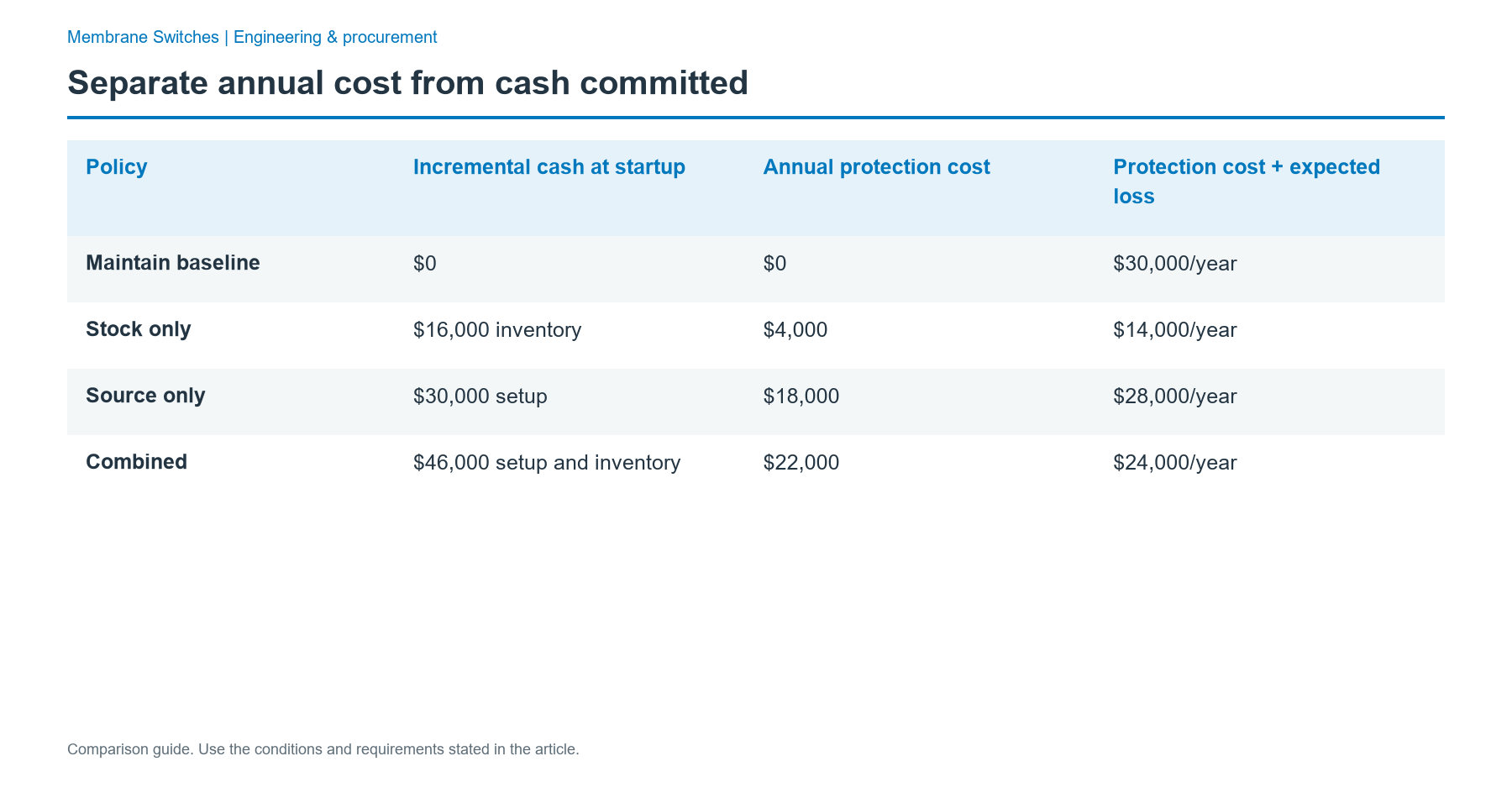
Use K/H + M = $30,000/3 + $8,000 = $18,000/year as a simple, undiscounted annualized second-source screen. Tooling/setup cash and working capital are different commitments. Ordinary unit purchases and baseline carrying costs are common to all four choices and excluded here.
| Policy | Incremental cash at startup | Annual protection cost | Protection cost + expected loss |
|---|---|---|---|
| Maintain baseline | $0 | $0 | $30,000/year |
| Stock only | $16,000 inventory | $4,000 | $14,000/year |
| Source only | $30,000 setup | $18,000 | $28,000/year |
| Combined | $46,000 setup and inventory | $22,000 | $24,000/year |
Stock only wins this expected-cost screen. The combined policy reduces expected disruption further but costs $10,000 more per year on these assumptions. That is a priced risk reduction, not automatically a bad investment.
For final capital approval, use a dated cash-flow model rather than treating K/H as discounted finance. A constant-working-capital comparison against baseline can use:
NPV = −K − ΔWC + Σ[(avoided interruption loss_t − recurring cash cost_t)/(1 + r)^t] + recoverable terminal working capital/(1 + r)^H
Here r is the annual discount rate and t runs through each year of the horizon. Use cash carrying costs rather than h's capital opportunity charge in this calculation: discounting already prices capital. Include only inventory value that can genuinely be recovered, and model changing stock commitments separately.
Stress-test the assumptions that change the answer
Event probability, alternate availability, demand, and remaining life can change the preferred investment without changing the switch's unit price.
For combined protection versus stock only, define the break-even annual primary-outage probability:
p = incremental annual protection cost / (reduction in conditional uncovered weeks × V)*
In the example, p = $18,000 / [(4 − 0.8) × $25,000] = 22.5%*. This is a decision threshold under the stated model, not a forecast. If the denominator is zero or negative, there is no positive break-even probability from this mechanism.
| Annual event probability p | Stock-only annual total | Combined annual total |
|---|---|---|
| 5% | $9,000 | $23,000 |
| 10% | $14,000 | $24,000 |
| 25% | $29,000 | $27,000 |
Test alternate unavailability separately. With q equal to 0%, 20%, and 50%, the combined-versus-stock break-even probabilities are 18%, 22.5%, and 36%, respectively. Better independence has a calculable value; an additional name on a purchase order does not.
Demand changes physical protection. At 150 switches/week, 1,200 switches cover 8 weeks, not 12. An alternate limited to 100 switches/week then leaves a 50-switch/week deficit after restart. Recalculate good-unit output and loss exposure rather than retaining the original V by habit.
For partial deliveries, use a weekly balance. Available units equal opening usable inventory plus accepted receipts. Unmet units equal max(0, demand − available units), and closing inventory equals max(0, available units − demand). Carry backorders separately when sales are delayed rather than lost; remove expired or blocked stock before counting availability.
Platform life changes setup recovery. At 1 year, 3 years, and 5 years, the annualized setup plus upkeep/premium becomes $38,000, $18,000, and $14,000, respectively. Those horizons are explicit test cases, not lifecycle categories.
Also test the worst conditional outcome. Combined protection still leaves 4 uncovered weeks when both supply routes fail for the modeled 16 weeks. It does not meet a zero-interruption requirement. A board can reject that residual exposure even when its expected annual cost appears acceptable.
Reduce concentration below the invoice level
Supplier consolidation is useful only while the administrative savings exceed the concentration it creates. Two direct suppliers can remain dependent on one ink, adhesive, dome, connector, converting site, or freight route.
Map each critical membrane-switch dependency to its production site, approved alternative, material access, and recovery path. Different legal entities or sales offices are not evidence of independent manufacturing. Different regions may reduce one shared hazard while leaving the same material bottleneck intact.
Do not approve an alternate adhesive or dome merely to make the map look diversified. A material change may alter bond behavior, electrical performance, tactile response, or the assembly's acceptance basis. Price and schedule that approval as part of the continuity investment.
Consolidation can still be rational for a stable, finite-life platform whose usable stock covers the accepted risk. The decision belongs at the affected platform and upstream-node level, not in a target such as “reduce the supplier count.” Keep service-only demand visible after new-equipment production ends.
Assign owners and release funding in stages
A membrane switch supply continuity investment needs an accountable owner for every assumption that determines whether the money buys protection.
| Owner | Decision responsibility | Evidence needed before funding credit |
|---|---|---|
| Business/platform owner | Maximum interruption, remaining production and service life | Demand horizon and accepted residual exposure |
| Procurement | Recovery commitments, material access, capacity, split-order costs | Comparable written commercial assumptions |
| Engineering | Released circuit, tail, tactile stack, tooling access | Controlled technical baseline and change boundaries |
| Quality | Qualification scope, usable age, receiving and system release | Approval criteria and records tied to the assembly |
| Operations/logistics | Stock location, allocation, rotation, restart consumption | Usable stock balance and accepted delivery schedule |
| Finance | Cash limit, loss valuation, discounting, exit economics | Incremental cash-flow model without double counting |
Release funding in three stages. First, reconcile the stock floor, outage scenario, and controlled drawing package. Second, authorize the immediate bridge and any qualification work needed before that bridge expires. Third, credit alternate capacity only after its release and restart evidence meets the approved case.
Set a review date and event triggers: a platform redesign, material change, overdue repeat lot, deteriorating usable stock, or a changed recovery commitment. Reduce or end the program when an approved successor replaces the risk, or when a documented final-service-stock plan makes ongoing qualification uneconomic. Do not end support simply because new-product sales stop.
For a final buy, calculate required purchase units = max(0, remaining production needs + remaining service needs + separately approved reserve − compatible usable stock − firm usable receipts). Time-phase every term through the last required delivery, and include repair or replacement demand only once. Check that each lot remains usable until its planned consumption date; a positive quantity calculation does not solve an aging limit. Assign ownership of excess stock, cancellation charges, final inspection, and retained technical records before ending recurring alternate orders.
Frequently asked questions
Is a second source always better than safety stock?
No. Safety stock can be the better first investment when a bounded outage fits within usable coverage and the design will remain valid. A second source becomes more valuable when recovery can outlast that coverage, but it must be qualified, available, and sufficiently independent. Compare the combined policy as well as each investment alone.
How many weeks of membrane switches should an OEM hold?
Hold enough usable switches to bridge the accepted delivery-recovery scenario and its uncertainty allowance. The worked case uses a 10-week target from a 6-week qualified-source restart plus a 4-week allowance. Demand, storage limits, affected-lot exposure, and delivery capacity can change that target; it is not a universal stocking rule.
Can safety stock replace second-source qualification near end of life?
Yes, when a finite production and service requirement can be met with usable, compatible stock and the remaining risk is accepted. Include service demand after production stops. A large last-time buy is not sufficient when parts may expire, the platform may change revision, or installed-equipment support requires a longer recovery route.
Does a qualified but idle supplier count as a second source?
It counts only to the extent that its current readiness supports the modeled restart. Check the approved revision, materials, tooling, fixtures, capacity arrangement, and release requirements. Qualification paperwork without those conditions does not establish available output. Include the recurring cost of maintaining readiness instead of treating approval as permanent insurance.
How should adhesive shelf life affect buffer stock?
Use material shelf-life information to constrain the assembly's storage and release plan, not to certify the finished switch. The 467MP guidance specifies 24 months from manufacture under its stated storage conditions. Converted-switch age limits also depend on the actual stack, packaging, storage history, and application acceptance basis. Rotate the reserve through current production where practical.
Do two suppliers eliminate concentration risk?
No. Two suppliers can share the same adhesive, dome, circuit material, subcontract process, transport route, or inaccessible stock location. Map those dependencies and include conditional alternate unavailability in the calculation. A second assembly site reduces only the failure modes it can actually avoid while maintaining the released membrane-switch requirements.
What financial result should trigger second-source funding?
Use both a risk limit and a financial threshold. In the illustrative model, combined protection beats stock only on expected annual cost above a 22.5% primary-outage probability, with all other assumptions unchanged. A stricter interruption limit can justify action earlier, while common-cause risk can still make the combined option insufficient.
Put the decision into a quotation
Turn the selected policy into a defined membrane-switch project rather than a request for a generic backup price. Start with JASPER's custom membrane switches for the panel construction and engineering handoff.
Submit the equipment platform, remaining service life, supply constraints, and decision scenario, together with the released drawing, usable stock, demand, and required recovery output. Ask for separate boundaries for tooling, qualification support, recurring production, stock ownership, and change control.
Request a Quote to review the panel approach and quotation scope. Keep OEM release, financial approval, and acceptance of residual supply risk with their named owners.
Bring the drawing, stack and operating conditions
JASPER engineering will review the interfaces, open risks and evidence required for a production quote.