
Choose a graphic overlay supplier by comparing evidence, not headline price. Send one controlled RFQ, gate each bidder on technical fit and traceability, approve a representative sample, and score the survivors on a 100-point matrix. For a risk-sensitive OEM, advance only suppliers that reach at least 80/100, pass every critical gate, and quote the same drawing revision, material stack, quantity, inspection plan, and delivery term.
Control the specification before comparing suppliers
A supplier cannot quote the same product as another bidder when the input package leaves material, printing, windows, adhesive, or acceptance criteria open. The first sourcing task is therefore not collecting prices. It is turning the overlay into a controlled purchasing specification.
A graphic overlay is both a visible user interface and a bonded component. The specification must connect artwork to the real enclosure, display, indicator, switch position, cleaning process, installation method, and expected environment. A color proof on a monitor does not confirm printed color, opacity, surface finish, window behavior, or bond performance.
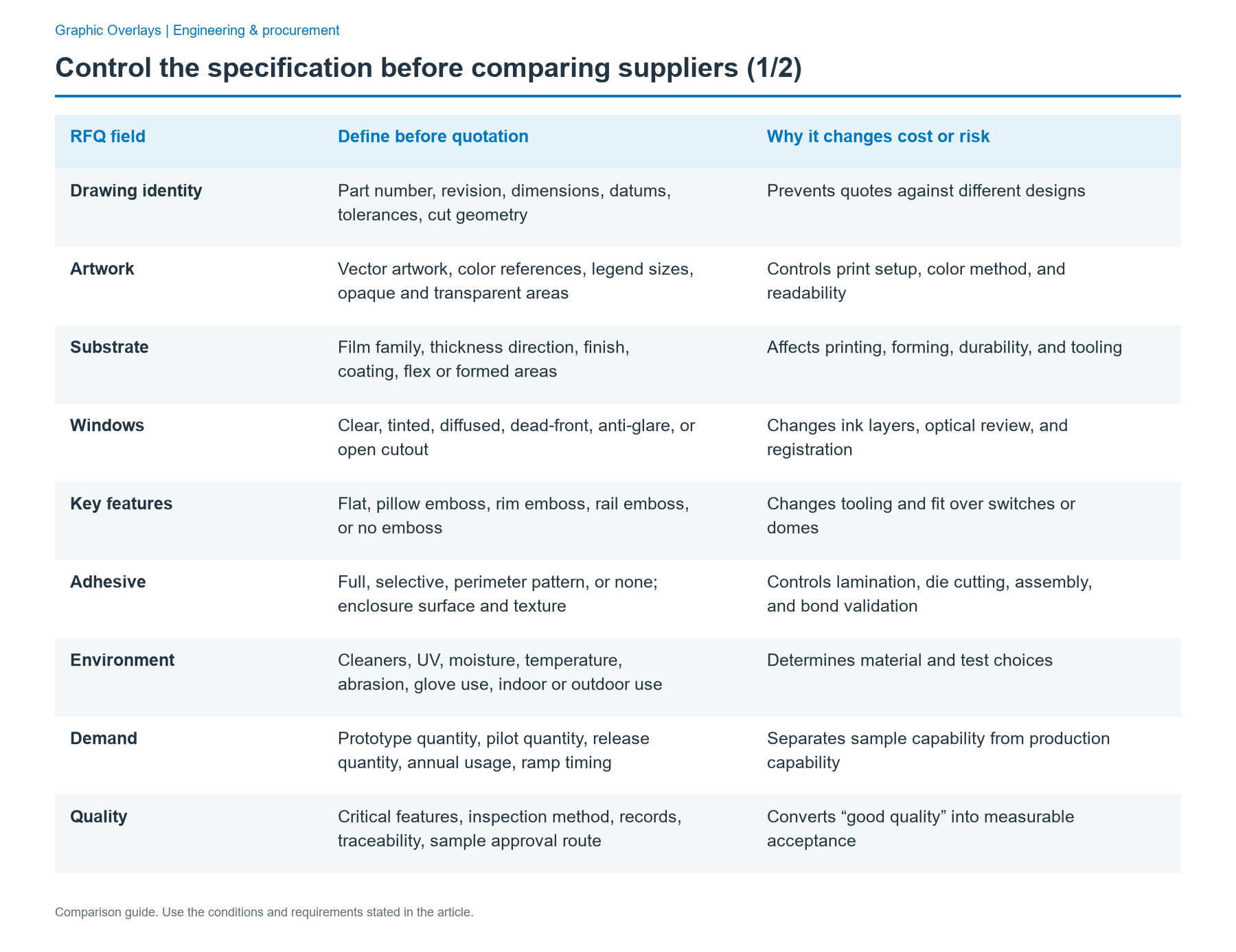
Use the same RFQ package for every supplier:
| RFQ field | Define before quotation | Why it changes cost or risk |
|---|---|---|
| Drawing identity | Part number, revision, dimensions, datums, tolerances, cut geometry | Prevents quotes against different designs |
| Artwork | Vector artwork, color references, legend sizes, opaque and transparent areas | Controls print setup, color method, and readability |
| Substrate | Film family, thickness direction, finish, coating, flex or formed areas | Affects printing, forming, durability, and tooling |
| Windows | Clear, tinted, diffused, dead-front, anti-glare, or open cutout | Changes ink layers, optical review, and registration |
| Key features | Flat, pillow emboss, rim emboss, rail emboss, or no emboss | Changes tooling and fit over switches or domes |
| Adhesive | Full, selective, perimeter pattern, or none; enclosure surface and texture | Controls lamination, die cutting, assembly, and bond validation |
| Environment | Cleaners, UV, moisture, temperature, abrasion, glove use, indoor or outdoor use | Determines material and test choices |
| Demand | Prototype quantity, pilot quantity, release quantity, annual usage, ramp timing | Separates sample capability from production capability |
| Quality | Critical features, inspection method, records, traceability, sample approval route | Converts “good quality” into measurable acceptance |
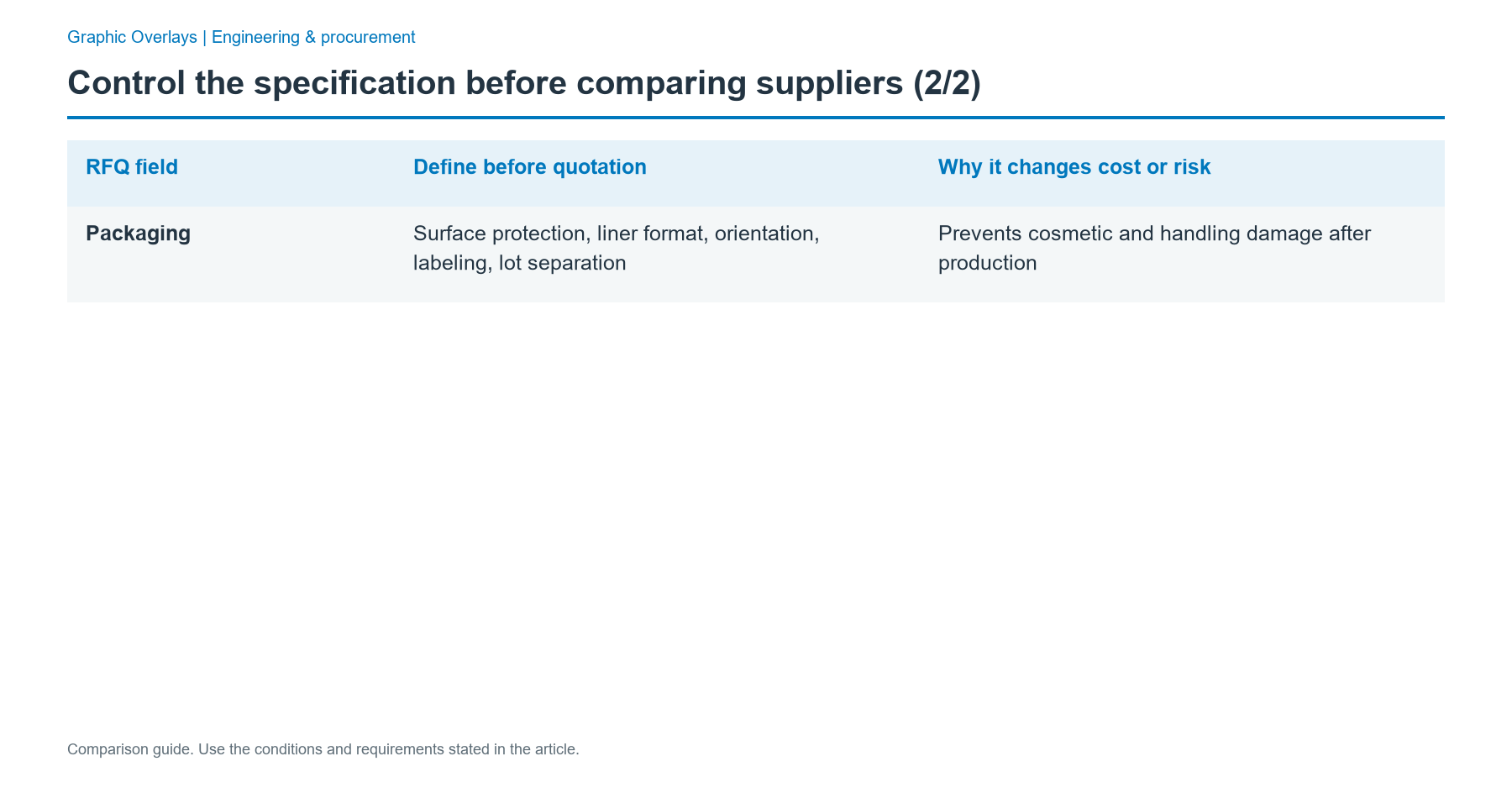
| Packaging | Surface protection, liner format, orientation, labeling, lot separation | Prevents cosmetic and handling damage after production |
Require the supplier to return a marked assumption-and-deviation list with the quote. A blank deviation list should mean the quoted construction meets the RFQ as written, not that the supplier has deferred questions until after the purchase order.
Make every quote commercially comparable
Normalize the quote before ranking it. Ask every bidder to separate recurring unit price from nonrecurring charges and to state what each price includes.
At minimum, compare:
- tooling, artwork preparation, screens, fixtures, setup, and sample charges;
- ownership, storage, maintenance, expected replacement triggers, and transfer rights for custom tools;
- prototype, pilot, and production quantities;
- minimum order quantity, price-break quantities, and scheduled-release rules;
- material substitutions, approved alternates, and the process for obtaining written approval;
- quoted lead time by milestone: drawing review, proof, tooling, sample, approval response, production, and transit;
- inspection records, material documentation, packaging, freight terms, and taxes;
- quote validity, payment terms, cancellation terms, and charges caused by buyer or supplier changes.
Do not compare a digital prototype quote with a production screen-print construction as though they are the same item. A fast sample can be useful, but the supplier must state whether the sample uses the intended production substrate, ink architecture, adhesive, tooling, and finishing route. Any difference belongs in the approval record.
Use hard gates before a weighted score
A weighted score can hide a serious failure. A low technical score should not be canceled by a low price, and a strong sales response should not offset missing traceability. Apply pass-or-fail gates first.
| Critical gate | Evidence to request | Automatic stop condition |
|---|---|---|
| Application fit | Written material and process recommendation tied to the environment | Generic quote with no construction rationale |
| Revision control | Quote and proof reference the exact part and revision | Supplier cannot identify the controlled revision |
| Quality records | Example inspection and lot-traceability formats | No method to identify or contain affected lots |
| Sample route | Defined proof, sample, first-article, and approval milestones | Production requested before representative approval |
| Change control | Written notification and approval process | Unapproved material or process substitution is allowed |
| Capacity continuity | Process capacity, key equipment, backup route, and recovery plan | No credible route for the required ramp or a single failure point left open |
| Commercial clarity | Itemized assumptions, exclusions, terms, and tooling ownership | Price depends on unstated construction or unresolved charges |
Only suppliers that pass every critical gate should enter the weighted comparison.
Score qualified suppliers on a fixed 100-point matrix
Set the weights before opening bids. Changing weights after seeing prices turns the scorecard into a justification tool instead of a decision tool.
Use the full rating set below for every criterion:
- 0 — No response: no answer or evidence.
- 1 — Claim only: a broad promise without supporting detail.
- 2 — Partial: some evidence, but important project conditions remain open.
- 3 — Acceptable: the requirement is answered with usable evidence.
- 4 — Strong: project-specific evidence, limits, and ownership are clear.
- 5 — Best supported: evidence is project-specific, risks are closed, and the control method is ready for release.
Calculate each weighted result as:
Weighted points = (rating ÷ 5) × category weight
| Category | Weight | What to score |
|---|---|---|
| Technical fit | 25 | Material stack, print route, windows, embossing, adhesive, tolerance chain, environment |
| Quality and traceability | 20 | Inspection plan, lot identity, calibration, nonconformance, corrective action, records |
| DFM and sample approval | 15 | Risk review, proof control, representative sample, first-article plan, closure quality |
| Delivery and continuity | 15 | Milestones, capacity, staffing, equipment maintenance, backup path, logistics |
| Total cost and commercial clarity | 15 | Accepted-unit cost, tooling, terms, exclusions, ownership, price-break logic |
| Communication and change control | 10 | Response quality, named owners, escalation, revision discipline, change notification |
| Total | 100 |
A useful release benchmark is 80/100 or higher, with at least 70% of available points in both Technical fit and Quality and traceability, plus zero critical gate failures. This is a procurement design target, not a universal industry certification. Raise the threshold for a safety-critical or launch-constrained project; lower it only through a documented risk acceptance.
Test overlay-specific technical judgment
A capable supplier should explain the tradeoffs in the complete construction, not simply list materials and processes. Use a controlled option menu in the RFQ, then allow a proposed alternative only when it is identified as a deviation.
| Design decision | Controlled RFQ options | What a useful supplier response explains |
|---|---|---|
| Substrate direction | Polyester, polycarbonate, or documented alternative | Why the choice fits flexing, formed detail, chemicals, appearance, and environment |
| Print architecture | Second-surface screen, second-surface digital, or hybrid | Color method, opacity, light blocking, lot consistency, and production route |
| Surface finish | Gloss, matte, anti-glare, textured, hard-coated, or selective combination | Cleaning marks, glare, abrasion, cosmetic limits, and coated-area boundaries |
| Window construction | Clear, tinted, diffused, dead-front, anti-glare, or open cutout | Powered and unpowered appearance, viewing angle, color shift, and registration |
| Key construction | Flat, pillow emboss, rim emboss, rail emboss, or no key feature | Emboss geometry, switch clearance, legend position, tooling, and inspection |
| Adhesive coverage | Full, selective, perimeter pattern, or none | Surface energy, texture, recess, edge land, keep-outs, liner split, and assembly pressure |
Material selection should be verified as a stack: film, surface treatment, inks, coatings, adhesive, release liner, and mounting surface. A certificate or data sheet for one layer does not prove the finished construction will pass the project’s cleaning, bond, optical, or dimensional requirements.
Ask the supplier to review the tolerance chain between printing, die cutting, windows, emboss features, displays, indicators, domes, and enclosure openings. A single general tolerance on the quotation is not enough when several registered features can accumulate in opposite directions.
Ask for evidence that matches the proposed process
A sales presentation shows what a company wants to sell. Supplier evidence shows how your part will be controlled. Request a compact evidence pack rather than a large set of unrelated certificates.
Useful evidence includes:
- a process flow for the quoted construction;
- a sample incoming-material and finished-lot traceability record;
- a completed inspection report for a comparable type of overlay, with customer details removed;
- calibration controls for equipment used to accept critical features;
- a nonconformance and corrective-action example;
- a change-notification form and approval route;
- tooling maintenance and storage controls;
- a training matrix for key operations;
- a capacity statement tied to the required release pattern;
- a packaging check for cosmetic surfaces, windows, liners, and lot labels.
Where an overlay carries safety-related markings, ask whether the exact label construction is covered for the intended application surface, temperature, and exposure conditions. A general reference to UL 969 or another standard does not confirm that the proposed film, ink, coating, and adhesive combination is acceptable for your end product.
Run a six-stage sourcing and approval process
The selection process should reduce uncertainty at each stage. Do not move unresolved technical questions into production.
1. Freeze the RFQ baseline
Release one RFQ revision with the drawings, artwork, product environment, controlled option selections, demand profile, acceptance plan, and commercial template. Name the buyer, engineering owner, quality owner, and final approver.
2. Hold one clarification cycle
Send the same questions and answers to all active bidders. Require each supplier to identify assumptions, exceptions, suggested changes, and information still needed. Update the RFQ revision when a clarification changes the product definition.
3. Complete gate and evidence review
Apply the critical gates, review the evidence pack, and remove suppliers that cannot control revision, materials, inspection, traceability, changes, or the required production route. Score only the qualified group.
4. Approve a representative sample
Approve the visual proof first, then a physical sample that represents the intended production construction as closely as possible. Record every known difference between sample and production. Install the sample on the real enclosure and evaluate it under the intended lighting, cleaning, handling, and operating conditions.
5. Validate the pilot and production controls
Use the pilot to confirm tooling, process settings, inspection methods, packaging, yield reporting, lot identity, and operator instructions. Close sample deviations before the first production release. If a deviation remains, assign an owner, due date, containment action, and written approval.
6. Release and monitor the supplier
The purchase order, released drawing, signed sample record, color or appearance master, inspection plan, packaging specification, and change-control agreement must identify the same revision. Track lot acceptance, on-time delivery, response time, corrective-action closure, and approved changes after launch.
Approve the sample on the real assembly
A sample is not approved because it looks correct in a bag. Fit, bond, windows, keys, and readability depend on the assembled product.
Use this sample approval record:
| Approval item | Check on the physical sample | Record |
|---|---|---|
| Identity | Part number, revision, supplier, date, material lot, tooling identity | Pass / Fail / Conditional |
| Appearance | Color reference, legends, opacity, texture, gloss, scratches, contamination | Pass / Fail / Conditional |
| Geometry | Outline, holes, cutouts, print-to-cut registration, panel alignment | Pass / Fail / Conditional |
| Windows | Clarity, tint, diffusion, dead-front effect, glare, powered appearance | Pass / Fail / Conditional |
| Keys | Emboss geometry, switch or dome location, clearance, legend position | Pass / Fail / Conditional |
| Adhesive | Coverage, keep-outs, liner split, installation, edge bond, trapped air | Pass / Fail / Conditional |
| Environment | Required cleaner, moisture, temperature, UV, abrasion, or handling checks | Pass / Fail / Conditional |
| Packaging | Surface protection, orientation, count, lot label, storage instructions | Pass / Fail / Conditional |
For every Conditional approval, state the exact condition, temporary containment, responsible owner, closure evidence, and deadline. Do not convert a failed critical feature into a verbal concession.
Compare total accepted cost, not piece price
Use the same cost model for each bidder:
Total accepted cost per usable unit = (part price × units ordered + tooling + setup + freight + incoming inspection + expected rework + expected scrap + expediting + inventory carrying cost) ÷ accepted units
Where:
Accepted units = units ordered − rejected units − units damaged or made unusable before assembly
Use your own internal costs and documented quote inputs. Do not invent reject rates or delay costs merely to favor a supplier. Run at least a base case and a stress case for yield, demand, and lead time. The result should make visible where a low unit price depends on large releases, excess inventory, unproven yield, or expensive recovery actions.
Treat communication as a production control
Response speed matters, but response quality matters more. A useful supplier answer names the revision, states the assumption, explains the effect, assigns an owner, and gives a closure date. A fast answer that omits those elements can create more work than a slower, controlled response.
Before award, identify:
- the commercial owner, engineering owner, quality owner, and escalation contact;
- the method for approving proofs, samples, deviations, and production changes;
- the expected response path for quality containment and schedule risk;
- the records that travel with each lot;
- the language, time-zone, and meeting needs for design and launch reviews.
Watch for red flags before award
Stop and investigate when a supplier:
- quotes without confirming the drawing revision;
- recommends a material without asking about the enclosure, cleaners, environment, or user interaction;
- treats a visual proof as physical sample approval;
- cannot state whether the sample and production routes differ;
- allows unapproved substitutions;
- provides certificates without scope, construction, or traceability;
- avoids discussing lot containment, corrective action, or change notification;
- gives one lead-time number with no proof, tooling, approval, production, or transit milestones;
- leaves tooling ownership and maintenance undefined;
- prices far below the qualified group but cannot explain the process or commercial difference.
One red flag may be a correctable gap. Several connected red flags usually indicate that the low quote is transferring risk to the buyer.
Complete the supplier handoff
After selection, create one controlled supplier file containing:
- the released drawing and artwork revision;
- the approved material, print, finish, window, emboss, and adhesive construction;
- the signed sample and first-article record;
- the approved color or appearance reference;
- the inspection method and acceptance criteria;
- packaging and lot-identification requirements;
- tooling ownership, storage, maintenance, and transfer terms;
- the approved-alternate and change-notification rules;
- the lead-time milestones and escalation path;
- the purchase-order clauses that control revision and deviations.
This file should be usable by purchasing, engineering, quality, incoming inspection, and the supplier without relying on private email history.
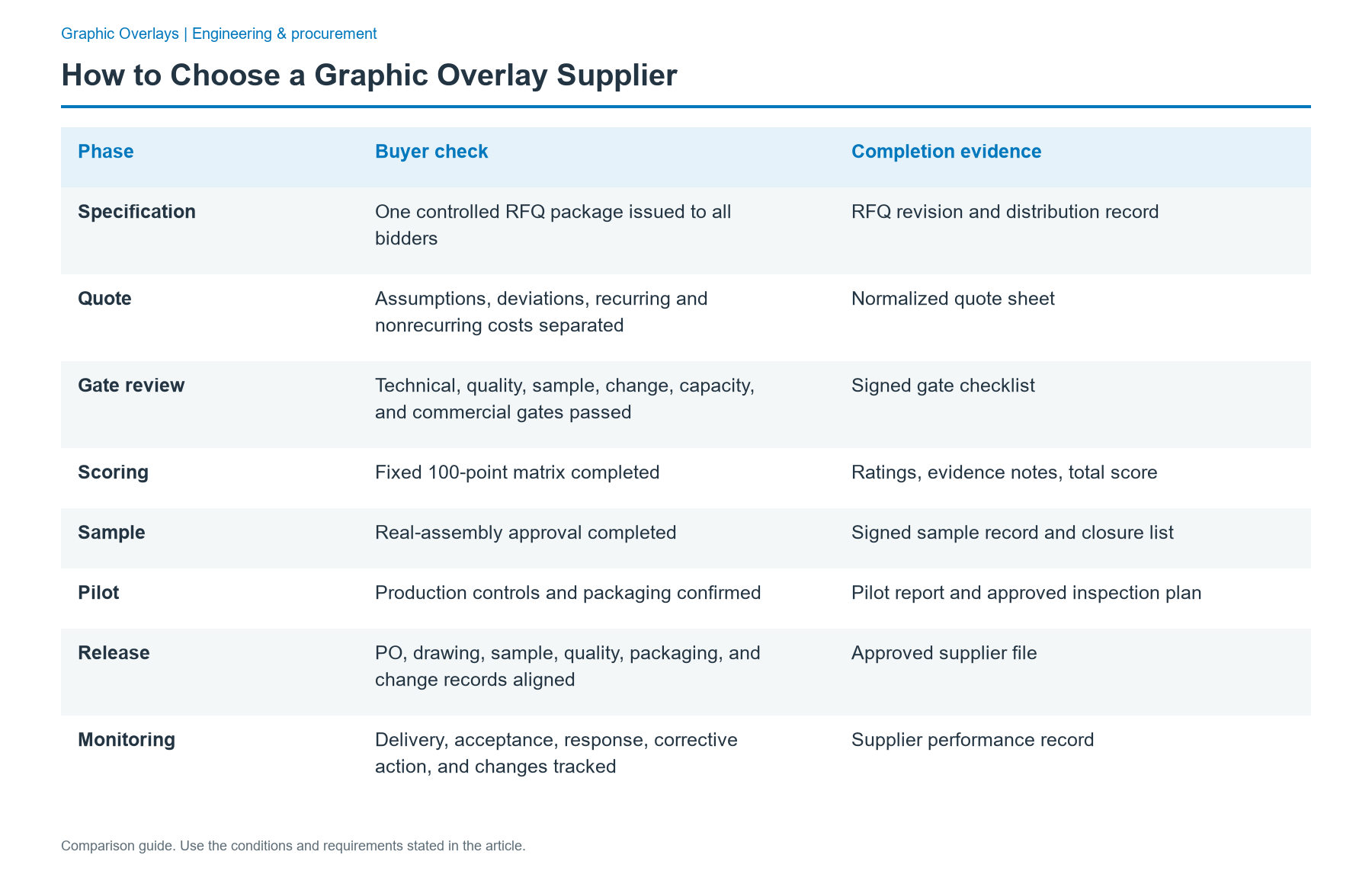
Graphic overlay supplier evaluation checklist
| Phase | Buyer check | Completion evidence |
|---|---|---|
| Specification | One controlled RFQ package issued to all bidders | RFQ revision and distribution record |
| Quote | Assumptions, deviations, recurring and nonrecurring costs separated | Normalized quote sheet |
| Gate review | Technical, quality, sample, change, capacity, and commercial gates passed | Signed gate checklist |
| Scoring | Fixed 100-point matrix completed | Ratings, evidence notes, total score |
| Sample | Real-assembly approval completed | Signed sample record and closure list |
| Pilot | Production controls and packaging confirmed | Pilot report and approved inspection plan |
| Release | PO, drawing, sample, quality, packaging, and change records aligned | Approved supplier file |
| Monitoring | Delivery, acceptance, response, corrective action, and changes tracked | Supplier performance record |
Use JASPER’s custom graphic overlays page to organize the material, printing, windows, key features, adhesive, and environment inputs before award. For a project review, request a quote with the original-size artwork, window and adhesive layers, enclosure surface, cleaning conditions, color samples, revision, and quantity.
Frequently Asked Questions
What should I send to get comparable graphic overlay quotes?
Send one controlled package to every bidder: the current drawing revision, original-size artwork, cut geometry, window and adhesive layers, enclosure material and finish, cleaning conditions, color references, required quantities, packaging, inspection needs, and delivery location. Ask each supplier to list assumptions and deviations in writing so hidden differences do not distort the price comparison.
Should I choose the lowest-priced graphic overlay supplier?
No. Compare total accepted cost, not piece price alone. Include tooling, setup, freight, incoming inspection, expected rejects, rework, inventory, expediting, and the cost of a delayed launch. A higher quoted unit price can be the lower-risk choice when the supplier provides clearer controls, a representative sample, dependable delivery, and fewer acceptance losses.
How should I score a graphic overlay supplier?
Use a weighted scorecard that is fixed before bids arrive. A practical 100-point model assigns 25 points to technical fit, 20 to quality and traceability, 15 each to sample approval, delivery continuity, and total cost, and 10 to communication and change control. Advance suppliers only after all critical gates pass.
What should be checked on the first article?
Check the first article against the released revision on the real enclosure. Verify color, legends, surface finish, cut geometry, print-to-cut registration, windows, embossing, adhesive coverage, liner removal, edge bond, glare, display or indicator alignment, cleaning response, and packaging. Record each result as Pass, Fail, or Conditional approval with an owner and closure date.
How do I verify adhesive suitability?
Identify the actual mounting surface, including resin or coating, texture, flatness, recess depth, edge land, contamination controls, temperature, moisture, chemicals, and installation pressure. Then bond a production-representative sample to the real panel and evaluate edge lift, window areas, cutouts, liner handling, and removal after the required conditioning. A material name alone is not approval evidence.
What quality evidence should a supplier provide?
Request evidence tied to the proposed process: a sample inspection report, material and lot traceability format, calibration controls, nonconformance handling, corrective-action records, change-notification procedure, tooling maintenance approach, operator training controls, and packaging checks. Certificates can support the review, but they do not replace project-specific acceptance criteria and records.
When is a supplier ready for production release?
Release the supplier only when the technical stack is fixed, all critical sample requirements pass, deviations are closed, the approved color or appearance reference is controlled, tooling and data ownership are documented, the inspection and packaging plans are accepted, production lead-time assumptions are confirmed, and the purchase order references the same released drawing and revision.
Bring the drawing, stack and operating conditions
JASPER engineering will review the interfaces, open risks and evidence required for a production quote.