
A custom nameplate RFQ checklist should contain controlled artwork, dimensions, material and finish, fixed and variable data, mounting surface, service exposure, acceptance criteria, quantity breaks, packaging, and required dates. For a production-intent first-article review, a useful buyer-set starting gate is five samples per artwork revision and material/mounting construction, with zero critical discrepancies. That sampling gate screens the build; it does not replace application qualification or any required product-specific marking approval.
Send One Controlled RFQ Packet
The fastest way to obtain comparable equipment-label quotations is to give every bidder the same revision-controlled packet. A product photograph explains intent, but the purchase specification must identify what will actually be manufactured, inspected, shipped, and repeated. Use the following industrial label quotation requirements as the RFQ cover sheet, with the indicated evidence attached.
| RFQ field | What the buyer must submit or decide | What a comparable quote must identify |
|---|---|---|
| Part identity | OEM part number; artwork and drawing revision; owning contact; language and market variants | Exact revision priced and any unresolved assumptions |
| Geometry and artwork | Vector artwork or controlled copy; overall size and units; cut line; radii, holes, slots, datums and dimensional tolerances | Fabrication route, tooling, critical dimensions and artwork-preparation charges |
| Visible information | Logo, model, manufacturer identity, ratings, warnings, symbols, languages, color reference and reading orientation | Printing or marking process, color/proof approach and text-size constraints |
| Variable information | Field map, sample records, serial-number rules, barcode symbology, encoded payload, human-readable data and reprint policy | Variable-data setup, validation method and whether data handling is included |
| Construction | Film or metal family, actual grade where specified, thickness, coating, print surface, finish, protection, adhesive or fasteners | Named construction and clearly identified alternate proposals |
| Installed interface | Equipment material, coating, texture, curvature, location, recess, attachment method and application process | Compatibility questions, mounting assumptions and any proposed qualification work |
| Service conditions | Indoor/outdoor location; temperature; UV, cleaner, oil, moisture, abrasion, vibration and required useful life | Evidence proposed for the declared exposures, not an unqualified durability claim |
| Approval and quality | Drawing tolerances; critical characteristics; first-article quantity; scan and visual tests; applicable marking requirements; record retention | Sample cost, tests, reporting, acceptance responsibility and production control |
| Demand and schedule | Trial quantity, annual forecast, explicit quantity price breaks, requested approval date and delivery releases | MOQ or minimum invoice, unit price at each break and separate schedule milestones |
| Packing and logistics | Individual/sheet/roll presentation, liner or peel direction, package counts, lot separation, destination and shipment terms | Packaging assumptions, freight basis, labels on cartons and shipment split charges |
| Commercial governance | Tooling ownership, artwork/data ownership, change control, quote validity, currency, payment and nonconformance disposition | Setup charges, exclusions, remedy process and who authorizes a changed revision |
If a field is not applicable, write not applicable and state why. Do not allow the supplier to convert a blank into an assumed design choice. Separate the controlled drawing, artwork master, variable-data specification, enclosure reference, sample acceptance plan, and purchasing terms by file name and revision. Keep proprietary production data in an approved secure transfer route.
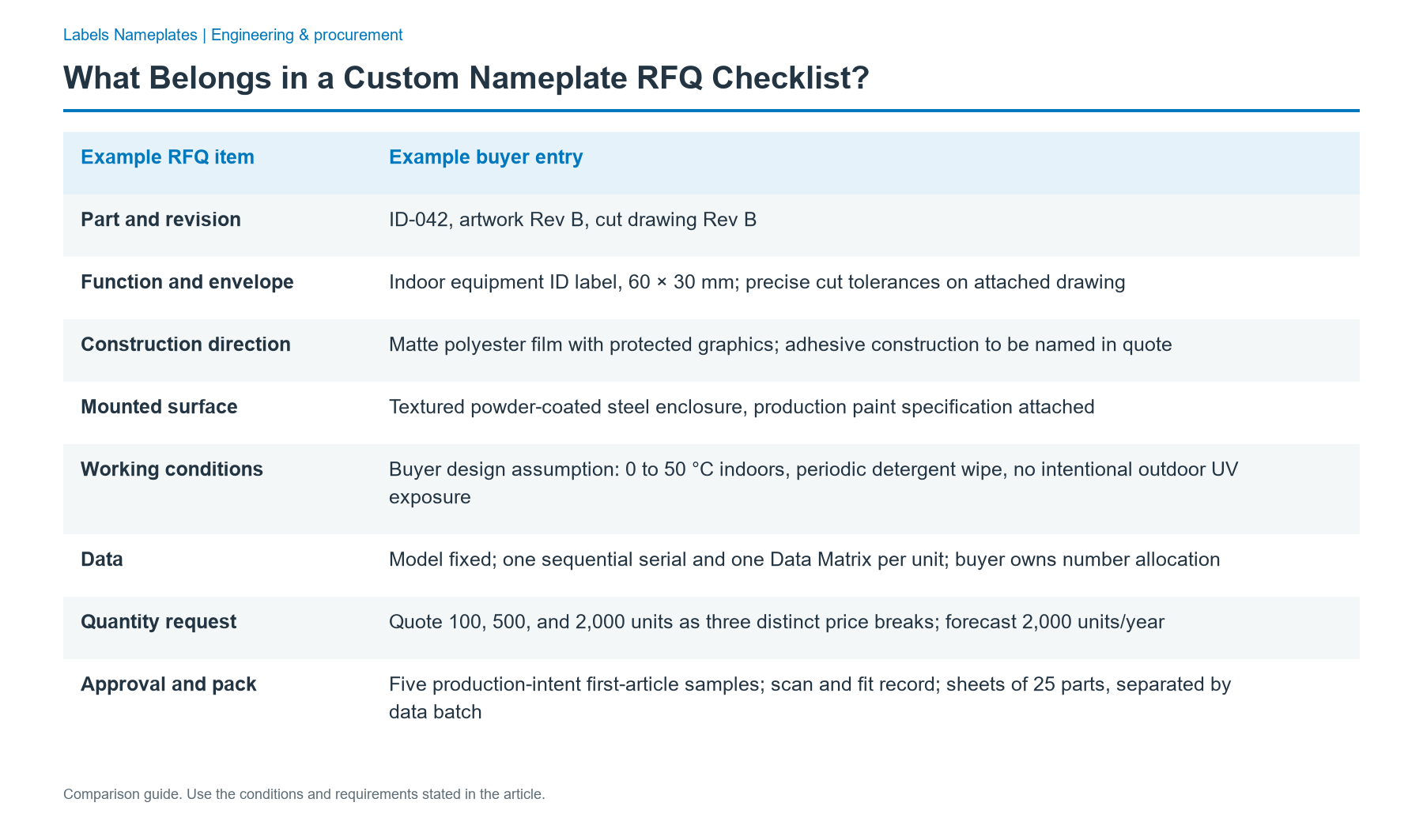
A filled example for an equipment identification label
The following is an illustrative buyer specification—not a product catalog rating, actual order, or quoted offer. It shows how a sourcing team can send a usable record rather than an open-ended request for a “durable sticker.”
| Example RFQ item | Example buyer entry |
|---|---|
| Part and revision | ID-042, artwork Rev B, cut drawing Rev B |
| Function and envelope | Indoor equipment ID label, 60 × 30 mm; precise cut tolerances on attached drawing |
| Construction direction | Matte polyester film with protected graphics; adhesive construction to be named in quote |
| Mounted surface | Textured powder-coated steel enclosure, production paint specification attached |
| Working conditions | Buyer design assumption: 0 to 50 °C indoors, periodic detergent wipe, no intentional outdoor UV exposure |
| Data | Model fixed; one sequential serial and one Data Matrix per unit; buyer owns number allocation |
| Quantity request | Quote 100, 500, and 2,000 units as three distinct price breaks; forecast 2,000 units/year |
| Approval and pack | Five production-intent first-article samples; scan and fit record; sheets of 25 parts, separated by data batch |
The proposed film, temperatures, sample count, pack count, and quantities in this example are project selections, not universal industry values. An actual equipment label sourcing specification must carry the end product's approved ratings and its acceptance method.
Choose the Identification Construction Before You Compare Prices
An RFQ needs a functional route, not just a request for the cheapest printing method. The following are five explicit quotation routes, not an exhaustive list of industry materials. Ask for a primary route and show alternatives as priced exceptions. These are different constructions, so an apparent price saving matters only if the proposed part meets the same use conditions.
| Route | Typical reason to request it | Critical item to resolve in the RFQ |
|---|---|---|
| Protected second-surface film label | Fixed graphics viewed through clear polyester or polycarbonate film | Viewing side, white backing, separate serial printing and adhesive compatibility |
| Protected surface-printed film label | Opaque stock or late-stage variable printing | Print protection, code contrast, wipe resistance and liner construction |
| Aluminum nameplate | Lightweight rigid equipment identification | Alloy/temper, thickness, anodizing or other finish, cut edge and attachment |
| Stainless steel nameplate | Rigid identification where the exposure or maintenance regime favors steel | Grade, corrosion environment, marking method, burrs, galvanic interfaces and hardware |
| Domed branding label | Raised branding badge with a resin lens | Dome profile, cure, edge durability and suitability for required text or scans |
A flexible label can be economical and space-saving, but adhesion on the actual enclosure remains a design decision. A rigid metal nameplate changes the quote through material, cutting, marking and fastening requirements. A raised dome may serve appearance rather than dense ratings or machine-readable identification; do not assume one route is functionally interchangeable with another.
For construction selection, start with JASPER's graphic overlays and nameplates product family. The custom label nameplates route fits controlled printed identification and variable data, while metal nameplates fit specified rigid and mechanically installed plates. If the face also locates keys or display windows for an operator interface, classify that requirement as a graphic overlay rather than quietly expanding a nameplate RFQ.
Treat Serial Numbers and Barcodes as Controlled Manufacturing Data
Artwork approval is not data approval. For equipment identification, the OEM should specify who creates, transmits, checks, consumes, and retains each variable field. The manufacturing instruction must distinguish fixed copy from records that change part by part.
A practical data-control register contains these seven separate decisions:
- Field ownership: which team owns the serial, model, lot, rating or asset identifier, and who can authorize corrections.
- Data form: CSV or other agreed format, encoding, separator, header names and file revision; provide representative records with dummy values.
- Sequence rule: prefix, length, start/stop allocation, skipped numbers, uniqueness across plants and rules for scrapped or reprinted pieces.
- Symbol choice: state a specific symbology, such as Code 128, QR Code or Data Matrix, rather than saying “barcode.” Confirm payload, module size, quiet zone, placement and human-readable fallback.
- Scanner condition: scanner type, read distance, lighting, installed curvature and the acceptance method. A successful phone scan does not establish verifier quality.
- Quality record: for linear symbols consider the applicable ISO/IEC 15416:2025 method; for 2D symbols consider ISO/IEC 15415:2024. Specify a required grade only if the OEM has chosen it for the application and documented the verification setup.
- Exception handling: rejected records, duplicate detection, reconciliation of issued versus printed IDs, rework authority and record retention.
For the illustrative ID-042 label, a data trial could explicitly enumerate ID042001, ID042002, and ID042003 as three dummy records. These are examples of distinct values, not an implied or authorized serial range. The quote should say whether variable-data verification, reject replacements and separate data batches carry additional fees.
A plate with safety-related electrical ratings deserves a stricter information-ownership review than an asset logo. The end-product owner must specify the actual required text, the governing product or market rules, and the approved marking route. UL 969 addresses marking and labeling systems, but a generic claim of “UL material” does not establish that a particular printed construction, substrate and application meet the end product's requirements.
Specify the Mounting Surface and Exposure, Not Just the Adhesive
Adhesive is chosen against an installed surface. Powder-coat chemistry, paint texture, plastic surface energy, mold release, curvature, contamination and application temperature all affect contact. A quote that lists a high-tack adhesive without naming the enclosure is not technically equivalent to one that qualifies the actual interface.
Provide a production enclosure coupon or the closest controlled sample. Record cleaner, drying method, assembly pressure, temperature, adhesive dwell and whether the label must be removable. Ask the supplier to identify the proposed stock and adhesive construction and to define the coupon and exposure checks. For a rigid plate, give hole locations, fastening torque specification if applicable, stand-off, washer choice and isolation needs instead.
Peel adhesion can be specified using an agreed ASTM D3330/D3330M method and substrate, but the measured number is conditional on specimen, surface, angle, dwell and test setup. Do not compare generic peel figures from different constructions as proof of equal installed service life. For critical marking, pair bond tests with installed appearance, readability and the relevant aging or chemical-exposure evaluation.
Good signal: a named construction, a stated substrate and documented sample method. Red flag: an adhesive substitution offered solely because a supplier's steel-panel peel number is higher.
Compare Quotations at the Same Revision and Quantity Breaks
Ask every bidder to price the same 100, 500 and 2,000 units with the same drawing revision, data requirements, packaging basis and requested dates. The exact values are buyer-selected quantity breaks for this example, not standardized commercial tiers. Normalize the response into one quote comparison sheet before comparing unit prices.
| Price or delivery line | Record from each quote | Why the distinction matters |
|---|---|---|
| Unit price at 100 / 500 / 2,000 pieces | Currency per good, accepted part; validity and revision | Stops volume mix from distorting comparison |
| One-time tooling and setup | Die, fixture, artwork conversion, sample and file preparation; owner | Exposes charges hidden outside unit price |
| Variable-data charges | Setup, per-record handling, scanning, scrap/reprint and reports | Prevents “printed label” from excluding actual serialization |
| Packaging and logistics | Sheets, rolls, protection, counts, freight term and split deliveries | Compares the part as received by assembly |
| Delivery milestones | Technical review, proof, tooling, first article, approval, production, dispatch | Separates elapsed lead time from buyer approval waiting |
| Evidence and deviations | Named materials, traceability, inspection results, qualifications and exception log | Identifies technically unapproved cheap bids |
For a defined quantity Q, calculate the evaluated lot cost = (accepted-part unit price × Q) + one-time charges + (packaging per part × Q) + data charges + freight + applicable duties. Separate nonrecurring costs from repeat-order costs; do not bury reusable tooling in every future lot. If a quote excludes freight or duties, add them only from documented amounts or mark the evaluation incomplete.
Consider a purely illustrative 500-piece exercise, with identical qualification already assumed for comparison: Film route F costs $0.75 per part, $180 tooling, $40 data setup and $0.08 per part for packing, totaling $635 before freight and duties. Metal route M costs $1.10 per part, $90 setup, $50 data setup and $0.12 per part for packing, totaling $750 before freight and duties. Those are hypothetical inputs, not actual market prices or JASPER quotes. If only metal passes the required service qualification, the lower film total cannot win on price.
Control Every “Equivalent Material” as a Quotation Deviation
“Equivalent” is not a purchasable specification. Material substitutions can change adhesion, appearance, marking durability, scan contrast, lead time, tooling and future repeatability. Require a signed deviation register before quote acceptance; a later purchasing email is not an adequate substitute for revision control.
| Proposed change | Minimum evidence to submit | Approval condition |
|---|---|---|
| Film or metal grade | Named old/new specification, thickness, finish and construction drawing | Engineering accepts function and appearance on the same revision |
| Adhesive or liner | Exact construction, actual substrate test plan, install method and liner/peel behavior | Applied first article and assembly process both pass |
| Ink, protective coating or marking method | Color/contrast master, cleaner/abrasion plan, scan evidence if coded | Required text and codes remain readable after agreed exposures |
| Cut, holes, data method or packaging | Dimensional comparison, reprint/scan controls, pack trial and handling impact | Relevant drawing/data/pack owners approve the changed characteristic |
Write approved only for part ID-042 Rev B and the stated application if that is the actual approval scope. An exception accepted on a clean flat coupon cannot automatically be reused on a textured, curved enclosure. Record who owns any extra test cost, whether the quote is conditional, and which sample revision becomes the new control reference.
Good signal: each alternative is separately priced and traceable. Red flag: “or equivalent” appears next to material, adhesive or finish with no part number, evidence or written approval path.
Price Legacy Samples and Photos at the Correct Maturity Level
An old part and a photograph can support an initial nameplate estimate, but they do not prove hidden material, rear adhesive, critical dimensions, original artwork rights or the necessary marking performance. Classify the request so sourcing can distinguish a budget number from a production-release quote.
| RFQ maturity | What is available | Quote status and required next step |
|---|---|---|
| A — Release-ready | Controlled drawing, artwork/data, construction, surface and acceptance criteria | Firm technical basis subject to supplier's written exceptions and commercial terms |
| B — Conditional | Dimensioned legacy sample and known function; some materials or data controls missing | Quote stated assumptions; obtain measurements, material definition and buyer sign-off before tooling |
| C — Budgetary | Photographs, approximate size and expected quantity only | Range or nonbinding estimate for feasibility; rebuild a controlled specification before PO or production |
If reverse engineering is proposed, confirm that the buyer has authority to reproduce the text, brand artwork, label design and any protected content. Photograph front, edge, back and installed location; record a scale reference and any identifiable marking. Destructive examination, adhesive removal or copying proprietary graphics requires specific authorization. Do not turn measurements from one worn sample into unqualified manufacturing tolerances.
Release a First Article with a Signed Acceptance Record
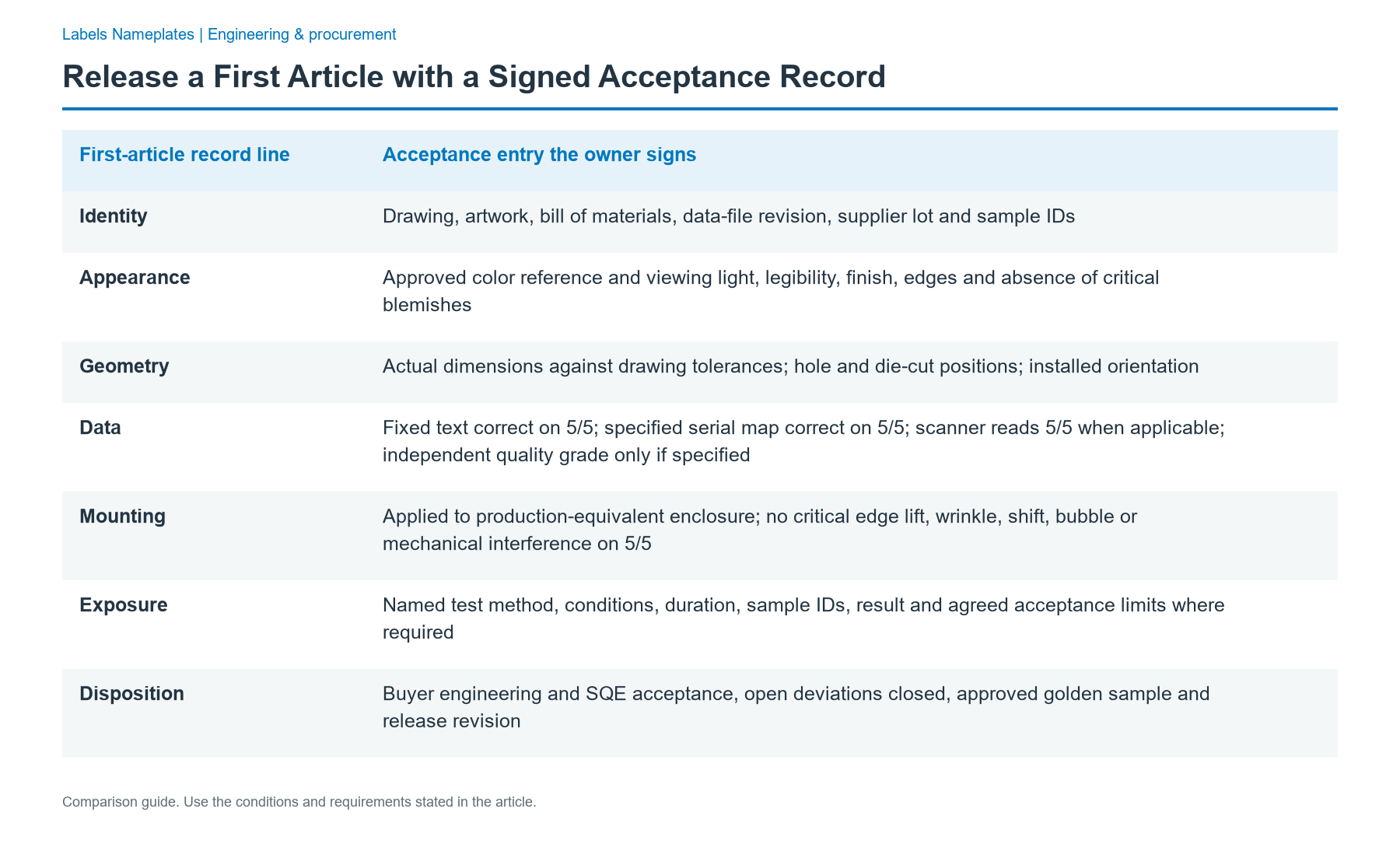
A first article should prove the production-intent construction on the actual equipment, not merely make the printed surface look attractive on a desk. For an ordinary identification-label RFQ, the buyer may begin with five parts per artwork revision and construction and require zero critical discrepancies among those five. Inspect all five for correct fixed fields, dimensions and obvious defects; scan all five when codes are present. Then add project-specific mechanical, chemical, environmental and marking-system qualification as applicable. The sample count is a planning gate, not a statistically valid guarantee of lot quality or lifetime permanence.
| First-article record line | Acceptance entry the owner signs |
|---|---|
| Identity | Drawing, artwork, bill of materials, data-file revision, supplier lot and sample IDs |
| Appearance | Approved color reference and viewing light, legibility, finish, edges and absence of critical blemishes |
| Geometry | Actual dimensions against drawing tolerances; hole and die-cut positions; installed orientation |
| Data | Fixed text correct on 5/5; specified serial map correct on 5/5; scanner reads 5/5 when applicable; independent quality grade only if specified |
| Mounting | Applied to production-equivalent enclosure; no critical edge lift, wrinkle, shift, bubble or mechanical interference on 5/5 |
| Exposure | Named test method, conditions, duration, sample IDs, result and agreed acceptance limits where required |
| Disposition | Buyer engineering and SQE acceptance, open deviations closed, approved golden sample and release revision |
Treat artwork proof, loose physical sample, applied first article and volume inspection as different evidence stages. Define what is critical: missing rating text, a duplicate or unreadable serial, the wrong material and unsafe loss of required marking are not cosmetic issues. A rejected first article triggers corrective action and a new approved reference before repeat production.
For product-specific permanent safety marking, the OEM's certification or compliance owner must confirm the applicable UL 969 system and end-product requirements. A five-piece visual and scan record alone cannot establish that compliance.
Put Quality Responsibility, Milestones and Packing on the Purchase Order
Use a seven-step release path to prevent the expected ship date from silently moving when artwork or data is disputed:
- RFQ issue: purchasing distributes the same indexed files and quantity tiers; engineering owns technical completeness.
- Clarification closure: supplier returns the deviation register; engineering and SQE decide all changes before price comparison.
- Commercial award: purchasing records included costs, tooling/data ownership, payment, incoterm or freight basis and quote validity.
- Proof and tooling: engineering approves the corrected artwork and supplier confirms the tool build or setup milestone.
- First-article approval: SQE and engineering sign the production-intent inspection, scan and installed-condition results.
- Production release: supplier locks approved construction and revision, controls variable data, and declares lot acceptance/traceability.
- Shipment and receipt: cartons carry part, revision, lot, quantity, sequence or data range when applicable; receiving verifies pack and nonconformance handling.
Name proof turn, first-article target, approval turn, production start and dock date separately. Ask which milestones stop the lead-time clock and which require buyer action. For repeating demand, define reorder triggers and whether tooling, artwork, approved material and serial allocations can be reused without another setup fee.
Packaging affects assembly yield. State whether parts arrive individually, on sheets, or on rolls; count per unit of pack; liner slit and peel direction; barcode/data sequence separation; scratch protection; humidity precautions if required; and carton marking. Sample approval must include the supplied format, because a perfect loose part can still be unusable on an automated line.
Check Supplier Evidence Before Releasing the Order
A shortlist is useful only when documentation can be matched to the quoted part. Request evidence proportionate to the risk rather than treating a generic marketing claim as proof.
| Evaluation point | Good signal | Red flag |
|---|---|---|
| Revision and exceptions | Quote and proof cite the same controlled files; deviations itemized | Price references a photograph but not a revision |
| Material and installation | Named construction with real enclosure coupon plan | Unspecified “industrial grade” adhesive |
| Data integrity | Explicit duplicate, skip, reprint and reconciliation controls | No owner for damaged or repeated serials |
| First article | Installed sample, dimensions, scan and disposition record | Only an attractive screen proof is offered |
| Compliance and exposure | Scope-specific evidence tied to the complete system | Broad certification claim without matching construction |
| Schedule and costs | Separate tooling, sample, production and freight assumptions | Lead time starts at an undefined “order accepted” event |
| Change and defects | Written notice/approval triggers, traceability and remedy responsibilities | Unilateral material change or no lot identification |
The decisive question is not who promises the fastest delivery. It is whether the buyer can release, receive, scan, mount and reorder the same approved identification part without rebuilding the specification or accepting a silent change.
Frequently Asked Questions
What is the minimum information needed for a custom nameplate quote?
Provide a part identifier, size or dimensioned drawing, artwork or required text, intended material route, installed surface, exposure, trial and annual quantities, and requested timing. State whether the identification is fixed or serialized. A supplier can discuss feasibility with fewer inputs, but a comparable, production-ready quote also needs acceptance criteria, packaging, revision control and stated exceptions.
Can I request a nameplate quotation from an old sample or photograph?
Yes, for a preliminary estimate. A photograph can show appearance and approximate geometry, while an authorized physical sample can help identify construction and mounting features. Neither alone defines hidden adhesive, exact material, tolerances or machine-readable data. Mark the quote conditional or budgetary, confirm reproduction rights, and create controlled drawings and acceptance tests before production release.
How should purchasing handle an “equivalent adhesive” proposal?
Require the alternate to be named, separately priced and recorded as a deviation. Compare it on the actual enclosure material, coating, texture and application process, not just generic adhesive data. Engineering must approve bond, installation, service exposure and any requalification before the substitution is released. Approval should identify the exact part revision and application rather than becoming blanket permission.
How many first-article nameplates should we approve?
A practical buyer-set starting gate is five production-intent pieces for each artwork revision and material/mounting construction, with zero critical discrepancies. Check fixed text and dimensions on all five; if coded, verify data and scanner readability on all five. Increase sampling and perform separate exposure or marking qualification when risk requires it. Five samples do not prove lifetime durability or statistical lot quality.
Do equipment-label RFQs need a barcode print-quality grade?
Only when the application requires a defined verifier result. Identify the symbology, encoded data, module size, quiet zone, scan conditions and inspection owner first. ISO/IEC 15416:2025 concerns linear symbol quality; ISO/IEC 15415:2024 concerns two-dimensional symbol quality. Choose any numeric grade and verification parameters from the actual OEM requirement; a successful phone scan is not a substitute.
How can two quotes with different tooling charges be compared?
Use the same approved construction, drawing revision and quantity, then calculate accepted-part unit price multiplied by quantity plus tooling, setup, data preparation, packaging, freight and applicable duties. Compare first-lot cost separately from repeat-lot cost, and record who owns reusable tools and artwork. A lower unit price is not the lower evaluated cost if it excludes required inspection, serialization or packing.
Which packaging details should appear in the RFQ and purchase order?
Specify individual, sheet or roll format; quantity per pack; liner and peel direction; protective interleaves or sleeves; lot and revision identification; and separation of serial ranges or language variants. Include carton marking, destination and split-shipment rules. Approval should use samples in the intended delivery format, since packaging can affect picking, scanning, installation speed and cosmetic damage.
Send the RFQ for a Controlled Quote
Combine the drawing, approved text and artwork, variable-data map, material/size direction, enclosure surface, exposure, packaging, version and 100, 500 and 2,000-unit example quantity breaks into one indexed inquiry. State the sample acceptance gate and ask for separate tooling, exceptions and milestones. For a specific project, request a quote from JASPER with those files and your actual release quantities and dates.
Bring the drawing, stack and operating conditions
JASPER engineering will review the interfaces, open risks and evidence required for a production quote.