
Silicone keypad legend durability depends on the complete marking system: molded color or ink, any laser-opened coating, the protective layer, key geometry, contact path, cleaning fluid, and test endpoint. This guide helps HMI, quality, reliability, and sourcing engineers choose among molded-color, printed, laser-etched, clear-coated, and hard-cap constructions. The boundary is important: no legend method is universally best, and a coating-family name or bare cycle count cannot predict field life without representative keys, actual chemicals, and an agreed failure definition.
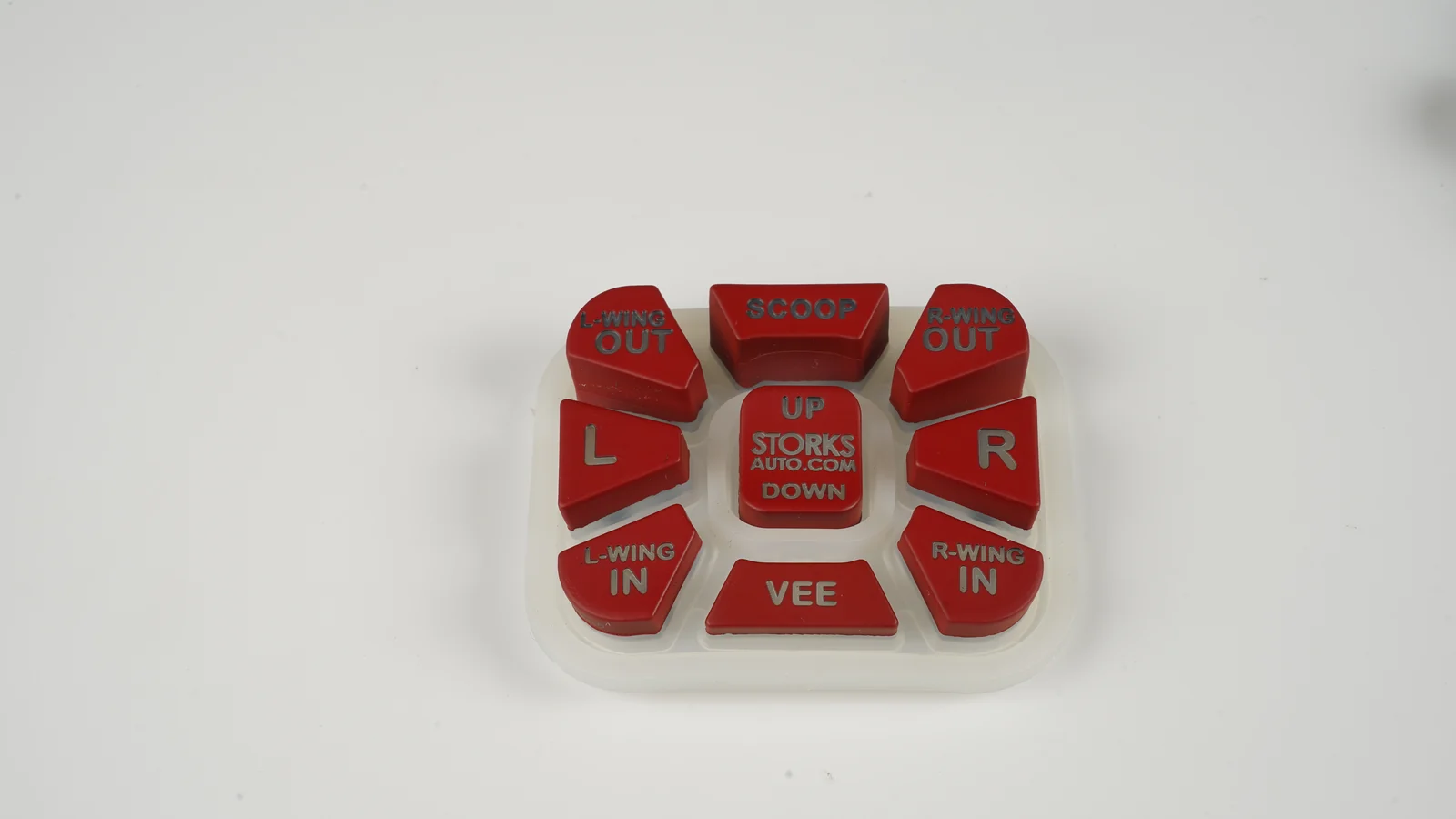
1. Define Durable Before Choosing a Legend Process
A durable legend remains readable and functionally acceptable after the product’s specified contact, cleaning, fluid, temperature, light, and actuation exposures. That definition is narrower than “the ink is still present.” A key can fail because a symbol becomes ambiguous, a clearcoat turns tacky, gloss changes make the artwork unreadable, a laser-opened edge erodes, a coating cracks around a curved keytop, or transmitted light becomes uneven. The drawing and test plan must define which change ends approval.
The surface is a stack, not a label:
Finger, glove, stylus, cleaning cloth, grit, oil, disinfectant
Optional clear protective layer — formulation, preparation, cure, flexibility
Printed ink or opaque color coat — visible artwork and/or light blocking
laser-opened area · when used
Molded silicone key — solid color, translucent base, or molded color feature
Key geometry + web + support + PCB/light engine + enclosure
In a coated day/night construction, the laser selectively removes a color layer to expose a contrasting or transmissive layer. TRUMPF identifies wavelength absorption, contrast, and coating-thickness consistency as process inputs; Laser ablation is selective, non-contact layer removal. Three-axis systems can address curved surfaces. Those sources explain the process. They do not establish one line width, power, coating thickness, or durability result for every keypad. (TRUMPF, pp. 51–52; KEYENCE)
Shin-Etsu Polymer America publishes a representative construction with transparent silicone, a transmissive color layer, a dark surface coat, selective laser removal, and a protective overcoat. It demonstrates one valid architecture, not JASPER’s undisclosed stack or a universal layer order. (Shin-Etsu Polymer America)
Four failure chains to keep open
| Starting condition | Exposure or process effect | Observable result | Evidence needed before assigning cause |
|---|---|---|---|
| Abrasive particles trapped under a glove or cloth | Local cutting and polishing at a repeated contact path | Gloss patch, thinning, edge erosion, color transfer, coating breakthrough | Wear medium, path, force, debris condition, microscopy/photographs and matched controls |
| Fluid softens or swells one layer | Wiping adds shear before full recovery | Tack, smearing, transfer, blistering, edge lift or sudden wear acceleration | Exact fluid, concentration, dwell, temperature, wipe sequence, recovery and interface examination |
| Preparation, primer or cure is unstable | Key flex or temperature exposes a weak interface | Cracking or delamination at silicone/coat or coat/clearcoat boundary | Process revision, cure record, representative flexed keys and identified failure interface |
| Flat coupon passes but curved key differs | Coat build, laser focus and strain vary over geometry | Halo, thin edge, crack, uneven wear or backlight shift | Contoured production keys, geometry classes, actual support and powered assembly checks |
A photograph can document where damage occurred. It cannot, by itself, distinguish abrasive wear from chemical softening, weak adhesion, incomplete cure, coating-build variation, substrate damage, or a combination.
Protection is not always the right answer. If the legend can be expressed as coarse molded geometry or a molded color boundary, adding a surface film may create an unnecessary interface. If a hard tool, sharp fingernail, aggressive solvent, or severe light-isolation requirement dominates, a plastic cap, insert, recessed feature, or different HMI architecture may be easier to validate than a soft coated key. The broader silicone rubber keypad design family includes choices that should be made before the test plan is frozen.
2. Compare the Legend Construction Before Specifying Protection
Legend method and protective layer must be chosen together. “Molded color,” “printed,” “laser etched,” “PU coated,” and “hard coat” describe different functions; some can coexist in one key. A laser-opened legend, for example, may use molded translucent silicone, one or more opaque color coats, and a final clear protective coat.
| Construction | What creates the visible legend | Strong fit | Main durability questions | When it is not the best choice |
|---|---|---|---|---|
| Molded color or molded geometry | Different silicone color/insert, recessed shape, raised symbol, or integral boundary | Coarse symbols, stable artwork, no need for a surface ink at the mark | Tool detail, color boundary, contamination retention, readability after surface polishing | Fine text, frequent artwork/language changes, crisp multicolor graphics, or controlled illuminated windows |
| Printed legend on silicone | Surface ink deposited through pad or screen printing, often with preparation and optional clearcoat | Unlit multicolor symbols, logos, variable artwork | Ink-to-silicone adhesion, cure, print registration, edge coverage, dry/wet wear, actual cleaners | Tight day/night transmission through an opaque field or a wear path that cannot be protected adequately |
| Laser-opened color coat | Laser removes selected opaque coating to reveal a lower color or translucent silicone | Backlit legends, high contrast, precise day/night symbols | Coat-build consistency, ablation window, edge quality, exposed lower layer, surrounding coating wear, powered appearance | Simple unlit graphics, unstable coating interface, or optical isolation better solved with inserts/barriers |
| Printed or laser-opened stack plus clear/PU protection | Clear film covers part or all of the graphic stack | Repeated rubbing or cleaning where a qualified flexible barrier improves the actual stack | Preparation, formulation, intercoat adhesion, cure, thickness variation, flex cracking, gloss/tack, chemical compatibility | The added interface cracks, changes feel/optics, traps defects, or lacks compatibility with the named fluids |
| Epoxy keytop, plastic cap, insert, or other hard exposed surface | Legend sits under or within a harder discrete feature | Concentrated wear, hard-tool contact, localized high-touch zones, premium key feel | Cap/insert retention, edge impact, scratch, stress, cleanability, stack height, sealing and optical path | One-piece soft-touch surface, low profile, large compliant area, low tooling complexity or tight tactile consistency is essential |
A protective coating does not make a weak base process strong. If preparation or cure is unstable, the extra coat can become another delamination plane. If the coating is too stiff for the local keytop strain, it can crack while a thinner uncoated printed system might remain intact. If gloss rises, the legend can become harder to read under oblique light even when no material is lost.
Why “PU coating” and “hard coat” are incomplete specifications
Covestro describes several polyurethane coating architectures, including one- and two-component systems with different binders and crosslinkers. The word PU therefore identifies a chemistry family, not a fixed hardness, elongation, solvent resistance, coefficient of friction, cure state, or adhesion to silicone. (Covestro)
“Hard coat” is equally incomplete. Hardness measured on a rigid panel does not tell an engineer whether the film can follow a flexing silicone key, survive a curved edge, maintain intercoat adhesion, or resist the actual cleaner. A harder film can improve one scratch mode and worsen flex cracking. The correct purchase description is the controlled stack and revision plus the evidence from representative specimens.
Exposed legend versus protected legend
A molded-color boundary has no printed film to erase, but its topography and contrast can still polish, soil, stain, or become hard to read. A printed legend exposes ink unless a topcoat covers it. A laser-opened legend removes the opaque coat within the artwork; the exposed lower layer and the edge around the opening remain part of the wear system. A clearcoat applied after laser opening may cover that edge, while a clear layer applied before ablation may itself be opened. The drawing must state the sequence.
For backlit designs, protection also affects optics. A clear layer can change gloss, diffusion, off-state contrast, on-state luminance, color and light scatter. The related backlit silicone rubber keypad guide addresses the production LED, diffuser, PCB and enclosure as one optical assembly. Legend durability approval must recheck both daylight and powered states after wear and chemical exposure.
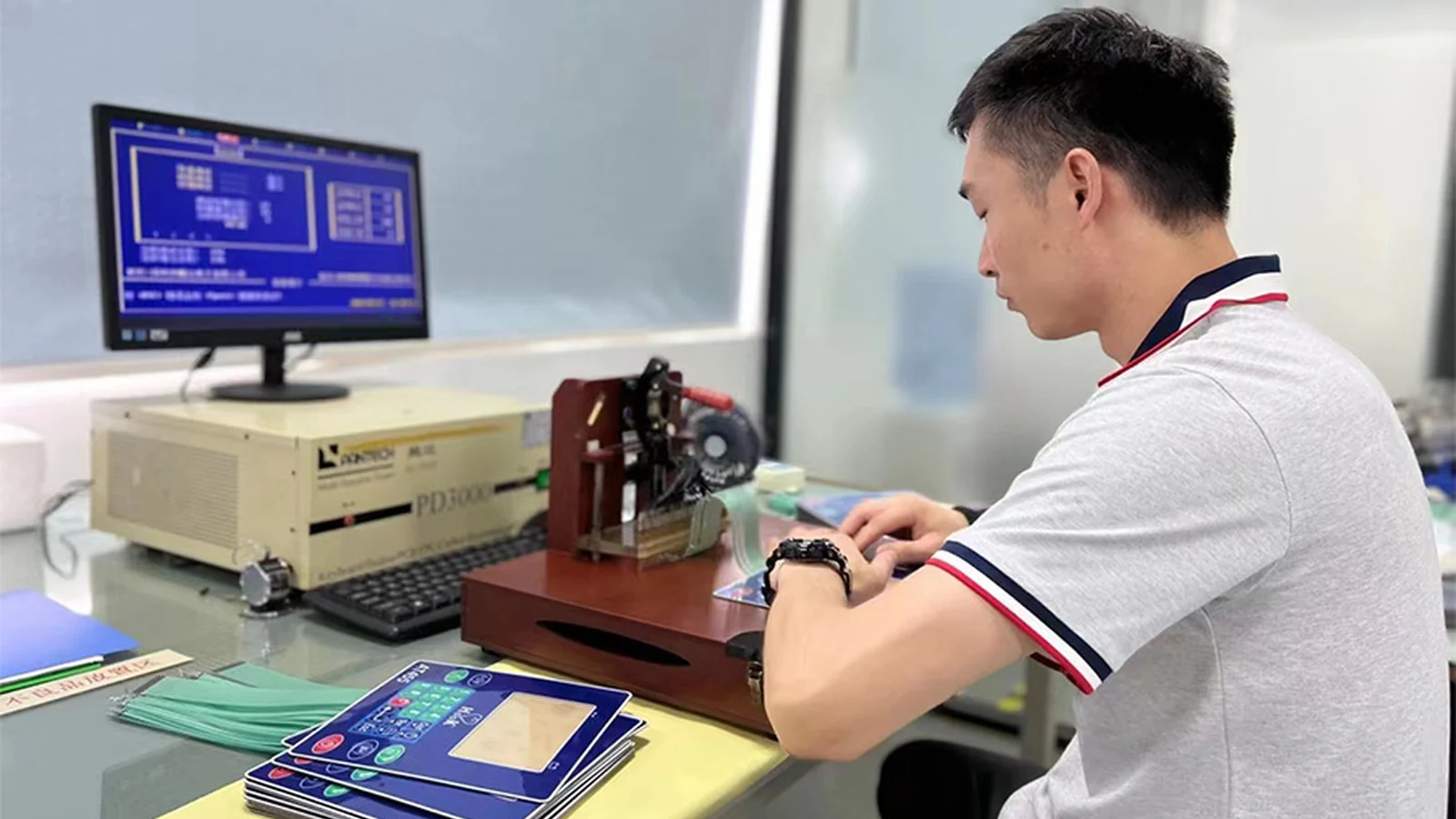
3. An 8-Point Silicone Keypad Legend Durability Framework
Use eight gates: wear map, controlled stack, adhesion plus flex, geometry-matched abrasion, actual chemical panel, sequential exposure, functional appearance, and change control. Each gate removes a different ambiguity. A high cycle result cannot compensate for the wrong fluid; a broad chemical list cannot compensate for an undefined coating; a flat coupon cannot compensate for missing contoured-key evidence.
3.1 Map the contact path and define failure
Start with what touches the key. Bare fingers often polish a different path from gloved thumbs. A stylus may concentrate load. A cleaning cloth can carry grit across several legends. Sunscreen, machining oil, skin soil, hand sanitizer, saltwater, disinfectant residue, or laboratory reagent can remain on the surface before the next actuation.
Record the contact tool, approximate path, repeated high-use keys, cleaning sequence and unacceptable endpoint. Endpoints may include first visible wear, loss of a critical stroke, color transfer, exposed base, edge erosion, tack, swelling, cracking, delamination, loss of daylight contrast, or a powered optical change. Safety-related labels may need a stricter endpoint than decorative icons.
the wear map identifies high-touch zones and gives visual, dimensional, optical or functional failure criteria.
every key receives the same arbitrary test even though field contact and cleaning are concentrated elsewhere.
3.2 Lock the full legend and coating stack
Specify each functional layer without requiring the supplier to disclose proprietary formulation details on the customer drawing. The record should still identify controlled material or process revisions for molded silicone and pigment, surface preparation, primer status, ink or color coat, clear protective layer, cure, laser sequence, and inspection plan.
WACKER’s silicone-processing guide emphasizes control of contamination, preparation, process timing and cure. Adhesion to cured silicone is system-specific and may require an evaluated primer depending on the adherend. These are process boundaries, not claims that every supplier must use one treatment. (WACKER; Shin-Etsu)
Ask five direct questions:
- What layer touches the cured silicone?
- What creates the visible off-state legend?
- What does the laser remove, if used?
- What surface contacts the operator and cleaner?
- Which controlled change forces reapproval?
a stack drawing, process revision and representative sample ladder answer all five.
“printed and PU coated” or “laser etched with hard coat” is the complete construction description.
3.3 Check adhesion on silicone and flexibility on the key
Coating adhesion and coating flexibility are related but different. A film may remain attached to a flat witness yet crack where a key curves or bends. It may also flex without cracking but separate at the silicone-to-coat or coat-to-clearcoat interface after fluid exposure.
ASTM D3359-23 is a qualitative tape-rating method developed for relatively ductile coatings on metallic substrates. ASTM notes operator sensitivity and a lack of precision/bias data for nonmetal substrates. ISO 2409:2020 classifies resistance to separation after cross-cutting but explicitly does not measure adhesion; it excludes textured coatings and total coating thickness above 250 µm. Neither method automatically qualifies a curved silicone key. (ASTM D3359-23; ISO 2409:2020)
An adapted cut/tape screen may help process development when buyer and supplier document the silicone, surface texture, coating stack, cut, tape, cure age, conditioning, pull and rating. Pair it with representative key flex or actuation before and after chemicals and temperature. When damage occurs, identify the interface instead of reporting only “adhesion failed.”
witness and contoured-key results are linked to the same preparation/cure lot, and the report names the separation interface.
a “5B” claim on an unspecified panel replaces flexed-key evidence.
3.4 Choose a method that represents silicone keypad coating abrasion
IEC 60068-2-70:1995 directly addresses this test because it addresses abrasion of markings on flat or curved actuators and keyboards caused by fingers and hands. It can also incorporate fluid contamination. The standard supplies a method framework; the project still chooses severity, fluid, specimen, inspection and acceptance. (IEC 60068-2-70)
ASTM D4060-25 uses a Taber Abraser to compare organic coatings on plane, rigid surfaces. Wheel, load, debris, specimen and coating properties can affect the result. It can rank rigid witness panels during development, but it cannot duplicate a curved, compliant keytop or translate directly into product life. (ASTM D4060-25)
ASTM F2357 and F3152 once addressed relative abrasion of coatings on silicone rubber, including contoured specimens. F2357 was withdrawn in 2017; F3152 was withdrawn in 2023 without replacement. Both are useful only as legacy test architectures, and neither supported converting machine cycles into human touches. (ASTM F2357; ASTM F3152)
Initial RCA comparison condition: Use a 175 g load for the first supplier comparison because it is the middle published Norman Tool setting. Lock the wear paper, key support, stroke and path, speed, conditioning, inspection interval, endpoint, and acceptance limit. RCA cycles compare controlled specimens; they do not equal keypresses or service life.
A reproducible abrasion record contains at least: specimen geometry; lot and cure age; support fixture; contact tip or abrasive medium; normal load; stroke length and path; speed; cycle count and inspection intervals; dry or contaminated state; ambient conditioning; photographs at fixed locations; and the exact failure endpoint.
a flat screen is followed by a documented test on contoured production keys along the service-relevant path.
a bare RCA or Taber cycle number appears beside “years,” “keypresses,” or “permanent.”
3.5 Define rubber keypad chemical resistance with actual fluids
Rubber keypad chemical resistance is conditional. It depends on the complete stack, named chemical, concentration, contact route, amount, dwell, temperature, stress, wipe material, mechanical action, rinse, drying and recovery. “Alcohol resistant” is incomplete because alcohol type, concentration, additives and exposure sequence can differ.
ISO 2812-4:2017 provides spot methods for assessing liquids or pastes on single- or multi-layer coating systems. ASTM D1308-20(2025) evaluates effects such as discoloration, gloss change, blistering, softening, swelling and adhesion loss in continuous organic finishes after household-chemical exposure. IEC 60068-2-74 supplies a fluid-contamination framework for components and materials after accidental contact; it is not proof of continuous-immersion suitability. (ISO 2812-4; ASTM D1308; IEC 60068-2-74)
Build the panel from service, not from a generic laboratory shelf. A medical-equipment interface may face a disinfectant and defined wipe protocol. An automotive interior control may contact sunscreen, skin oil and a cabin cleaner. A machine pendant may see cutting fluid or hydraulic oil. A marine control may see salt residue and detergent. Each program chooses its own identities and conditions.
the report records each commercial product or chemical identity, active concentration where relevant, lot/revision, application, dwell, wipe and recovery.
one unspecified isopropyl-alcohol rub is presented as compatibility with every disinfectant, cleaner, oil and fuel.
3.6 Sequence static exposure, wet wiping, wear and environment
Static spotting and wet rubbing answer different questions. A static fluid test can reveal discoloration, swelling, blistering or softening after a dwell and recovery. A wet-wipe test adds mechanical shear while the surface may be softened or lubricated. Dry abrasion after recovery can show whether the exposure changed the film even when the surface first looked normal.
Sequence tests around the expected service chain:
Baseline appearance / adhesion / optics
Named fluid at defined concentration, amount, temperature and dwell
Defined wipe or rub while wet (when service includes wiping)
Rinse / dry / controlled recovery
Repeat appearance, tack, transfer, adhesion and dry-wear checks
Temperature or UV conditioning when relevant
Repeat contoured-key and assembled-HMI checks
IEC 60068-2-14:2023 provides controlled change-of-temperature procedures. ISO 16474-3:2021 exposes coatings to fluorescent UV, heat and water under defined cycles. Neither source supplies a universal keypad severity or converts chamber hours into field years. (IEC 60068-2-14; ISO 16474-3)
The order should reflect reality. If operators spray cleaner, allow 30 seconds of contact, wipe five passes and use the key before full recovery, a 24-hour isolated coupon soak followed by no rubbing answers a different question. Conversely, continuous immersion can be unnecessarily severe when only brief accidental contact occurs.
the test order reproduces the service sequence and repeats the same measurements after recovery and conditioning.
unrelated certificates are combined to imply an interaction was tested when it was not.
3.7 Recheck legibility, optics, feel and cleanability
Material survival is not the only endpoint. A protective layer can alter gloss, friction, tactile feel, surface tack, soil release, symbol edges and backlight. Keypad legend wear can become functionally unacceptable before full coating breakthrough—for example, when a narrow stroke rounds off, two symbols become difficult to distinguish, or glare obscures a low-contrast mark.
For opaque daylight colors, CIE 015:2018 and ISO/CIE 11664-4:2019 define colorimetric conditions and CIE L*a*b* coordinates. ASTM D2244-25 requires an agreed procedure and correlation with visual appraisal. None defines a keypad-specific ΔE limit. The OEM and supplier must set the instrument, geometry, illuminant, specimen, tolerance and visual conditions. (CIE 015; ISO/CIE 11664-4; ASTM D2244)
For illuminated legends, inspect the production LED, drive, diffuser or light guide, PCB, housing, ambient condition, warm-up and viewing geometry. Recheck luminance, uniformity, hot spots, edge scatter and adjacent-key bleed after the wear/chemical sequence. A phone photograph on a light table is not a repeatable approval method.
Tactile checks also matter. A coating that changes friction may change how an operator’s thumb enters the key. Local cracking near the crown can progress under actuation. ASTM F1578-24 can support cycling when the complete test article falls within membrane-switch assembly scope; otherwise, define the actuator, support, force/travel profile, rate and checks as a project method. (ASTM F1578-24)
pre/post results cover legibility, appearance, tack/transfer, tactile behavior and powered optics where applicable.
approval records only whether the legend is technically still visible under ideal lighting.
3.8 Freeze traceability and reapproval triggers
A signed sample is useful only when its construction can be reproduced. Link the sample ID to silicone and pigment revisions, preparation, primer status, ink/color coat, protective layer, cure, laser recipe, fixture, artwork, production optics, test specimens, fluid lots, exposure history and raw images or readings.
Define reapproval triggers before production. A change in silicone source, pigment, mold texture, preparation, primer, ink, color coat, clearcoat, cure profile, laser machine/optics, artwork, key geometry, LED, diffuser, housing, cleaner or test method can alter durability. Proprietary formulations can remain confidential while revision identifiers and change-control obligations remain visible to the buyer.
golden samples and raw reports point to controlled revisions and named requalification triggers.
an “equivalent material” clause permits silent changes to any functional layer.
4. Run a Six-Step Sample-Approval Process
A useful approval sequence moves from service inputs to stack definition, then from low-cost screening to representative-key and assembled-HMI evidence. It prevents a polished prototype or impressive cycle count from becoming the specification by accident.
Step 1 — Record use conditions and the wear map
List the high-use keys, contact tool, soil, expected cleaning sequence, fluids, temperature/humidity/UV conditions, illuminated or daylight state, and safety significance of each legend. Include rare but credible spills separately from routine cleaning. Name the engineer who owns each acceptance decision.
The required CTA is practical: share the cleaning chemicals and wear pattern before the supplier chooses the protection system. A coating proposed without those inputs is a material guess.
Step 2 — Select the construction and freeze the drawing
Choose molded color, printed ink, laser-opened coating, protected stack, or hard exposed feature using the table in Section 2. The drawing should identify keytop geometry, texture, legend artwork and datums, color boundaries, coated zones, laser openings, clearcoat sequence, keep-outs and any cap or insert. If the keypad is backlit, tie the drawing to the production optical package.
For broader inputs beyond the legend surface, use the silicone rubber keypad design guide as the parallel drawing-preparation reference.
Step 3 — Review process controls and sample ladder
Request controlled identifiers for preparation, primer status, ink/color coat, protection layer, cure and laser process. Retain a sample ladder where available: molded unmarked base; printed or coated but unprotected sample; laser-opened intermediate; finished contoured keys; flat witness from the same run; and complete assembly.
Intermediate samples help locate a failure interface. They do not replace production-finished evidence.
Step 4 — Screen flat witnesses, then contoured keys
Use flat witnesses where an instrument or method needs a planar surface—for color, coat build, adapted adhesion screening or ASTM D4060 comparison. Then test each risk-relevant key geometry. Include high crowns, curved edges, recessed legends, narrow strokes, coated transitions and the actual high-use contact path.
Do not merge the two result types. A flat witness isolates coating variables; a contoured key introduces coat distribution, laser focus, local strain and support.
Step 5 — Apply the service-relevant sequence
Run baseline checks, static chemical exposure, wet wiping, recovery, dry wear and environmental conditioning in the order justified by use. Repeat adhesion, legibility, tack/transfer, color/gloss and powered optical checks. The testing and quality-control overview is the internal capability route for discussing a project-specific matrix; the program still owns the conditions and acceptance limits.
For medical-device interface applications, component test evidence does not validate a finished device’s cleaning instructions, biocompatibility, electrical safety, risk controls or regulatory submission. The legal manufacturer of the finished device must validate the actual disinfectant procedure and complete product under the applicable program.
Step 6 — Sign the golden sample and change-control plan
Approve the construction only after raw data, fixed-condition images, exposure logs and revision identifiers agree with the physical golden sample. State who may authorize deviations and which changes trigger partial or full requalification. Keep untested alternatives outside the approved bill of materials.
Staged test matrix
| Gate | Specimen and controlled inputs | Record and endpoint | Boundary |
|---|---|---|---|
| Construction audit | Actual silicone/pigment, legend/protection layers, preparation, cure and laser revisions | Traceable layer stack; no unapproved substitution | Process audit, not performance evidence |
| Daylight baseline | Finished keys plus witness; defined lighting, viewing and color setup | Legibility, color, gloss/texture, registration, edge defects | CIE/ASTM methods support procedure; buyer sets limits |
| Adhesion screen | Witness and finished keys from same run/cure | Separation interface and rating before/after flex | D3359/ISO 2409 only when documented and applicable |
| Dry abrasion | Contoured key; defined medium, load, path, speed and support | First wear, color transfer, breakthrough, edge erosion, legibility | IEC 60068-2-70 or agreed method; no life conversion |
| Static chemical | Finished key and named fluid/concentration/dwell/temperature | Color, gloss, tack, swelling, blistering, adhesion after recovery | ISO 2812-4, ASTM D1308 or IEC 60068-2-74 as applicable |
| Wet wiping | Same geometry; named fluid, wipe material, force/method and repetitions | Transfer, smearing, edge lift and wear acceleration | Purchaser–supplier sequence tied to use |
| Actuation/flex | Supported production-like keypad/assembly | Crack, delamination, legend change and functional checks | ASTM F1578 only within scope; otherwise project fixture |
| Temperature/UV | Representative stack and controls | Repeat appearance, adhesion, abrasion and optical checks | Exposure comparison, not years-in-service prediction |
| Powered optics | Production LED, drive, PCB, diffuser/light guide and housing | Contrast, luminance, uniformity, hot spots and bleed after exposure | Complete optical assembly; buyer sets limits |
| Ingress | Intended enclosure, compression, bezel, fasteners and exits | Complete-product IP result | IEC 60529/ISO 20653; never a loose-key claim |
Drawing and sample-approval checklist
- [ ] Vector artwork, language revision, datums, stroke/counter geometry and critical symbols
- [ ] Keytop curvature, texture, coated zones, high-use contact path and protected/unprotected boundaries
- [ ] Molded color, ink/color coat, laser-opened layer, clearcoat/hard-cap sequence and controlled revisions
- [ ] Surface preparation, primer status, cure record and sample age at testing
- [ ] Exact cleaners, disinfectants, oils, fuels, sunscreen, salt solution or process fluids
- [ ] Concentration, amount, dwell, temperature, wipe material/action, rinse, dry and recovery
- [ ] Abrasion medium, load, path, speed, support, cycles, inspections and failure endpoint
- [ ] Daylight and powered optical setup, references, limits and fixed-condition photographs
- [ ] Witness, contoured-key and assembled-HMI sample quantities and lot coverage
- [ ] Golden sample, raw report, deviations, approvers and requalification triggers
5. Eight Release Blockers That Should Stop Approval
| Stop-approval signal | Why it is disqualifying |
|---|---|
| The requirement says only “durable legend.” | Contact, chemical, environment and failure endpoint remain undefined. |
| The construction says only “PU coated” or “hard coated.” | Resin family does not identify preparation, formulation, cure, flexibility, interfaces or actual-stack performance. |
| A withdrawn ASTM keypad method is presented as current compliance. | ASTM F2357 and F3152 are legacy architectures, not active standards. |
| A cycle count has no medium, load, path, speed, geometry or endpoint. | The result cannot be reproduced, compared or transferred. |
| A flat rigid coupon is the only specimen. | It omits curvature, flex, coat distribution, laser focus and the real contact path. |
| One unnamed alcohol rub represents all chemicals. | Concentration, additives, dwell, wiping, recovery and other service fluids are missing. |
| Chemical, abrasion and environmental reports are independent one-time passes. | Interaction and sequence effects were not tested. |
| No revision-linked golden sample or change-control trigger exists. | A silent material, cure, coating, laser, artwork or cleaner change can invalidate the evidence. |
A ninth warning applies at the device boundary: do not accept a loose-keypad IP code, medical approval, biocompatibility claim or finished-device cleaning validation. Those conclusions require the complete enclosure or finished device under its applicable test and regulatory program.
6. Frequently Asked Questions
What determines silicone keypad legend durability?
The complete system determines it: legend method, silicone surface, preparation, ink or color coat, optional protective layer, cure, key geometry, contact path, fluids, environment and failure endpoint. No single label—printed, laser etched, PU coated or molded color—predicts durability without representative tests and controlled revisions.
Which silicone keypad legend method is most abrasion resistant?
There is no universal winner. Molded color removes a surface-ink failure mode but may limit fine artwork and illumination. Laser-opened coatings suit day/night legends but leave coating edges and lower layers in the wear system. Printed legends support multicolor artwork. Hard caps can suit concentrated wear. The actual contact and chemical sequence decides.
Can a laser-etched keypad legend wear off?
Yes, the legend system can become unacceptable even though the laser-removed top-coat area cannot return. The exposed lower layer, clearcoat and surrounding coating can abrade, soften, crack or delaminate. Edge erosion, gloss change and reduced backlight contrast can also impair readability before complete coating loss.
Does PU coating guarantee rubber keypad chemical resistance?
No. PU identifies a polyurethane chemistry family, not a chemical-resistance grade. The result depends on formulation, crosslinking, preparation, primer, cure, coat build, key flex and the exact chemical exposure. Approve the named stack against actual fluids, concentrations, dwell, wiping and recovery conditions.
Which test should be used for silicone keypad coating abrasion?
IEC 60068-2-70 is the most directly relevant current method reviewed here for finger/hand rubbing of markings on flat or curved actuators and keyboards. ASTM D4060 can screen plane, rigid coating witnesses. ASTM F2357 and F3152 addressed relevant silicone-keypad abrasion architectures but are withdrawn and cannot support current-compliance or field-life claims.
Can RCA or Taber cycles be converted to keypresses or years?
Not without a product- and condition-specific correlation study. Abrasive medium, load, stroke, path, speed, debris, geometry, support, environment and endpoint alter the result. RCA cycles do not directly equal finger presses. Use cycle data to compare controlled specimens, not to invent service life.
How should cleaning chemicals be specified for legend testing?
Name the commercial product or chemical, active concentration where relevant, application amount, contact mode, dwell, temperature, wipe material and action, rinse/dry step, recovery period and repetitions. Define acceptable change in legibility, color, gloss, tack, transfer, swelling, adhesion and powered appearance. Test routine cleaners separately from accidental spills.
When is a hard cap or molded legend better than a protective coating?
A hard cap or insert may be better when a hard tool, concentrated abrasion or localized premium surface dominates and the added retention/stack-height complexity is acceptable. Molded color or geometry may be better for coarse, stable symbols that do not require fine print or controlled backlight. Avoid extra coating interfaces when they add risk without solving a defined exposure.
7. Share the Cleaning Chemicals and Wear Pattern
Start sample review with two records: the exact cleaning/fluid list and a map of where operators, gloves, tools and cloths contact the keypad. Then select the legend architecture, lock the layer sequence, and test flat witnesses, contoured keys and the assembled HMI without treating those specimens as interchangeable.
Submit the cleaning chemicals, concentrations, wipe procedure, high-use keys, contact tool, environment, legend artwork, and failure limits through the project contact route. Use that package to approve the sample ladder and acceptance matrix before production release.
Technical References
- Source: IEC 60068-2-70 Abrasion of Markings and Lettering. Accessed 2026.
- Source: ASTM D4060-25 Organic Coating Abrasion. Accessed 2026.
- Source: ISO 2812-4:2017 Coating Liquid Resistance. Accessed 2026.
- Source: ASTM D1308-20(2025) Chemical Effects on Organic Finishes. Accessed 2026.
- Source: TRUMPF Laser Marking Technical Booklet. Accessed 2026.
- Source: KEYENCE Laser Ablation Guidance. Accessed 2026.
- Source: TRUMPF. Accessed 2026.
- Source: KEYENCE. Accessed 2026.
- Source: Shin-Etsu Polymer America. Accessed 2026.
- Source: Covestro. Accessed 2026.
- Source: WACKER. Accessed 2026.
- Source: Shin-Etsu. Accessed 2026.
- Source: ASTM D3359-23. Accessed 2026.
- Source: ISO 2409:2020. Accessed 2026.
- Source: IEC 60068-2-70. Accessed 2026.
- Source: ASTM D4060-25. Accessed 2026.
- Source: ASTM F2357. Accessed 2026.
- Source: ASTM F3152. Accessed 2026.
- Source: Norman Tool. Accessed 2026.
- Source: ISO 2812-4. Accessed 2026.
- Source: ASTM D1308. Accessed 2026.
- Source: IEC 60068-2-74. Accessed 2026.
- Source: IEC 60068-2-14. Accessed 2026.
- Source: ISO 16474-3. Accessed 2026.
- Source: CIE 015. Accessed 2026.
- Source: ISO/CIE 11664-4. Accessed 2026.
- Source: ASTM D2244. Accessed 2026.
- Source: ASTM F1578-24. Accessed 2026.
Review the complete keypad stack before release
Send the keypad drawing, contact geometry, PCB artwork, environment, appearance targets, and validation plan for a project-specific review.