
An outdoor graphic overlay material should be selected as part of a complete exposed stack—not by choosing PET or polycarbonate in isolation. Define the UV spectrum and orientation, moisture and chemicals, temperature range, color and optical limits, service interval, adhesive substrate, exposed edges, and enclosure shading first; then qualify the production-intent overlay under stated ASTM, ISO, IEC, or SAE conditions.
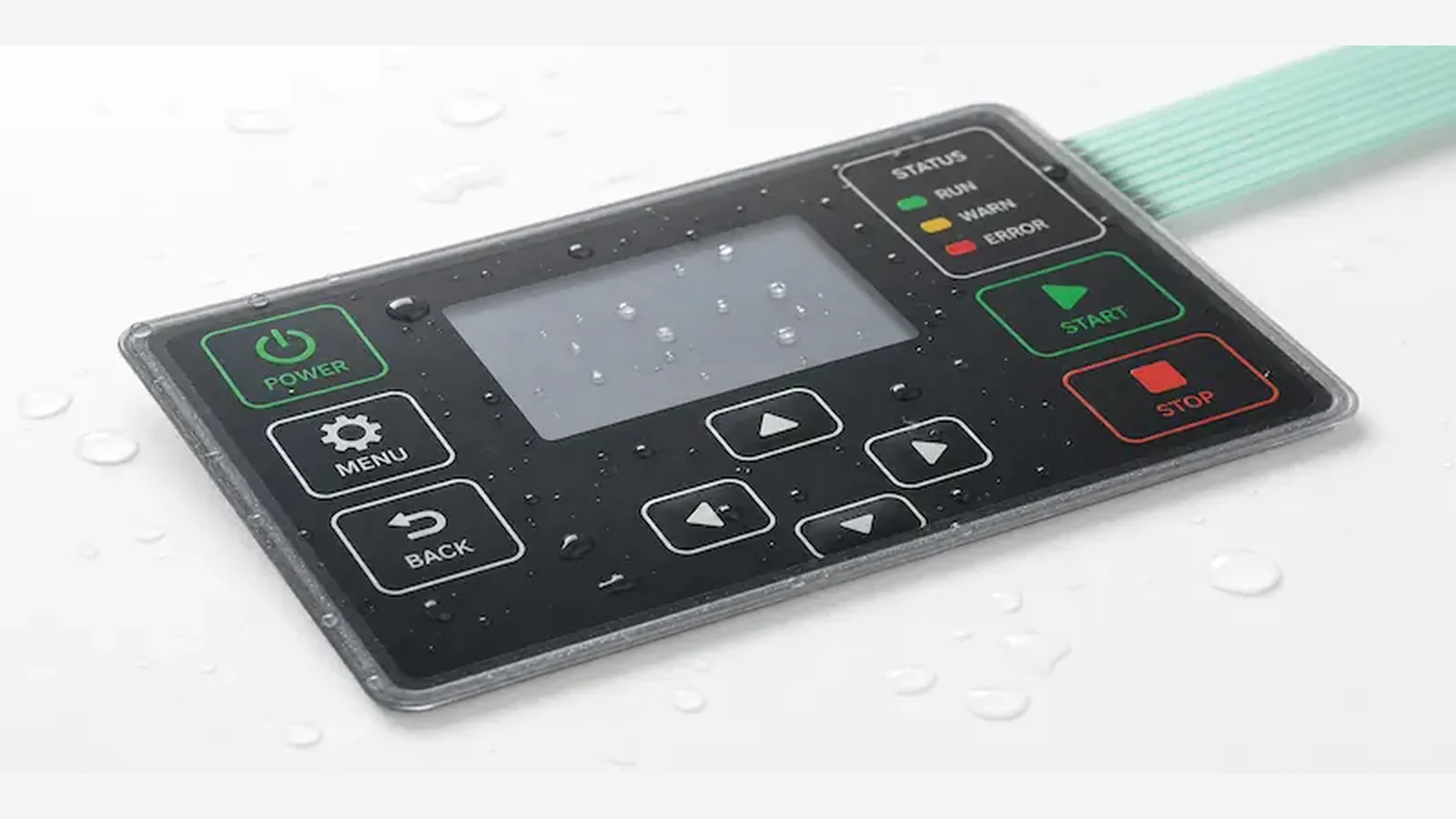
Outdoor durability is a system decision for OEM engineers and sourcing teams. A hard-coated film can retain its surface while ink fades behind it, adhesive lifts from powder coat, or water reaches a window edge. This guide explains how to specify custom graphic overlays for exposed control panels without turning an accelerated-weathering result into an unsupported field-life promise.
Decision boundary: “UV resistant,” “weatherproof,” and “outdoor rated” are not complete specifications. A useful requirement names the exposure, construction, test conditions, and acceptable change. IEC 60529 ingress classifications belong to a tested enclosure configuration—not to a loose overlay.
1. Define outdoor exposure before choosing a material
The first material-selection document should describe the environment, not the polymer. Direct sun in Phoenix, reflected sun inside an equipment cab, intermittent rain on a farm controller, and salt-laden moisture on marine and outdoor equipment interfaces impose different failure mechanisms. Even two panels at one site can age differently when one faces south and the other sits beneath a hood.
Use the table below to turn “outdoor” into purchasing and validation inputs.
| Exposure input | What to record | Why it changes the overlay |
|---|---|---|
| Location and orientation | Deployment region, elevation, compass direction, tilt, indoor/outdoor transition | Alters irradiance, temperature, rainfall, and condensation patterns |
| Shading and reflection | Bezel depth, hood, canopy, nearby glass or metal, daily shaded hours | Reduces or concentrates radiation and surface heat |
| Sunlight requirement | Direct, filtered, or incidental sun; required cosmetic service interval | Drives film, UV package, ink, and weathering route |
| Water and wet-time | Rain, splash, standing water, washdown, condensation, freeze-thaw | Drives edge geometry, cutout treatment, adhesive, drainage, and enclosure seal |
| Chemicals and deposits | Salt, diesel, hydraulic fluid, fertilizer, cleaner, sunscreen, insect repellent | Changes hard-coat, ink, film, and adhesive compatibility |
| Temperature profile | Operating/storage minima and maxima, ramp rate, dwell, enclosure surface temperature | Exposes differential expansion, embrittlement, creep, and adhesive stress |
| Mechanical contact | Finger use, gloves, grit, keys, wiping material, cleaning frequency | Sets texture, abrasion, hard-coat, and legend-protection needs |
| Visual function | Safety color, brand color, warning legend, display window, dead-front icon | Sets color, gloss, haze, transmittance, contrast, and readability limits |
| Enclosure interface | Aluminum, painted or powder-coated metal, PC/ABS, polypropylene, texture, curvature | Determines pressure-sensitive adhesive family and surface preparation |
| Acceptance horizon | Maintenance interval, cosmetic tolerance, functional life target | Determines test duration and post-exposure acceptance—not a universal film label |
The RFQ includes a one-page exposure profile, a drawing of the mounted panel, the enclosure material/coating, and measurable post-exposure requirements.
The RFQ asks for a “10-year UV-proof sticker” but gives no climate, orientation, shade, color tolerance, substrate, or validation method.
2. Read the overlay as a material stack
A weather-exposed overlay is a chain of interfaces. Failure at any one interface can make the whole panel unreadable or allow water to reach the enclosure joint. The stack should therefore be released as one construction rather than as independent catalog items.
OUTDOOR SIDE
Surface texture / hard coat
abrasion, cleaners, glare, first-contact UV
Clear face film: PET, UV-grade PC, acrylic, or qualified specialty film
dimensional support, impact/flex behavior, optical path
Subsurface print system
transparent colors, opaque backing, legends, dead-front masks
Optional barrier / cap / selective first-surface feature
added chemical or weather protection where the design needs it
Pressure-sensitive adhesive
bond to the exact enclosure finish through temperature and moisture
Edge, window, hole, and emboss geometry
controls exposed ink and adhesive paths
Enclosure / bezel / gasketed assembly
supplies stiffness, drainage, shading, compression, and the IP test boundary
EQUIPMENT SIDE
Second-surface printing protects legends from fingers and cleaning cloths, but sunlight still passes through the transparent face film. Moisture can also approach through the perimeter, holes, display windows, seams, or a damaged hard coat. Calling the print “reverse printed” does not settle outdoor life.
The controlled drawing identifies every layer, supplier grade, thickness, print sequence, adhesive, cut edge, and mating enclosure surface.
The supplier approves the film datasheet while the ink, adhesive, and enclosure coating remain “manufacturer’s standard.”
3. Choose the outdoor graphic overlay material by failure mode
The best outdoor graphic overlay material is the exact qualified film system that meets the project’s optical, mechanical, forming, chemical, and weathering requirements. Hard-coated polyester (PET) is a strong starting point for many flexible control overlays, but it is not a universal winner. UV-stabilized polycarbonate (PC), acrylic/PMMA, fluoropolymer-protected constructions, or another engineered film may be more suitable when a different failure mode dominates.
Material decision table
| Candidate construction | Useful strengths | Watch points outdoors | Often suitable when | Not the best choice when |
|---|---|---|---|---|
| Hard-coated PET film | Flex endurance, dimensional stability, chemical resistance, thin overlay construction; families such as DuPont Teijin Melinex and MacDermid Alpha Autotex are used in printed interfaces | Exact grade still needs weathering data; sharp embosses, exposed edges, and ink/adhesive compatibility remain construction-specific | Repeated key actuation, industrial cleaning, thin flexible panels, second-surface graphics | Deep forming, a rigid protective lens, or an approved requirement favors another material |
| UV-stabilized / hard-coated PC | Impact strength, forming and embossing options, clear windows, broad industrial availability | Generic PC can change color or lose properties under UV; solvent and abrasion behavior depend strongly on coat and grade | Impact or forming dominates and an exact outdoor PC grade has verified stack data | High flex cycling or chemical exposure exceeds the selected PC system’s evidence |
| Acrylic / PMMA lens or panel | Optical clarity, inherent outdoor use in many rigid glazing applications, weatherable grades | More rigid and potentially brittle than thin flexible overlay films; fabrication and impact need review | A rigid display lens or decorative faceplate carries the optical/weathering duty | Repeated membrane-key flexing or a thin conformable label is required |
| Fluoropolymer cap or protective laminate | Strong resistance to UV and many chemicals; can shield a printed construction | Lamination interfaces, forming, print adhesion, optical texture, cost, and recyclability require qualification | Long cosmetic retention or aggressive chemistry justifies another barrier layer | Tight embossing, low cost, optical clarity, or laminate-edge behavior dominates |
| Qualified specialty film system | Can target automotive exterior, marine, high-temperature, optical, or formed-part requirements | Trade names are not interchangeable; availability and processing windows may be narrow | The customer specification names an approved grade or validated construction | The evidence covers only bare film, while the production stack changes ink, coat, adhesive, or process |
A polymer family is only the start. Ask for the current grade designation and datasheet revision. “PET 0.18 mm” and “PC 0.25 mm” omit the UV stabilizer, surface treatment, texture, hard coat, optical quality, shrinkage control, and print-side treatment that may decide the result.
For a deeper polymer-only comparison, use the planned guide to polyester versus polycarbonate overlays. This article keeps the broader system boundary because an outdoor panel usually fails at an interface rather than in a neat film-property table.
When hard-coated PET is not the best choice
Two or three exact film systems are screened against the same print, adhesive, enclosure, and acceptance criteria.
A supplier substitutes a same-thickness film from another family without repeating optical, adhesion, forming, and weathering checks.
4. Specify a UV resistant graphic overlay as film, ink, and hard coat
A UV resistant graphic overlay needs three coordinated defenses: the face film manages incoming radiation and mechanical load, the ink system retains color and opacity after transmitted radiation, and the surface finish resists wear and chemicals. No single “UV ink” callout covers all three.
Outdoor overlay printing routes
| Printing route | Outdoor advantage | Main control points | Typical reason to reject it |
|---|---|---|---|
| Second-surface screen printing | Legends sit behind the film; spot colors and opaque backing layers can be controlled separately | Ink/film compatibility, mesh and deposit, cure, layer order, opacity, registration, color standard | Supplier has data only for bare ink or a different film treatment |
| Second-surface digital printing | Efficient for complex imagery, gradients, and lower-volume revisions | Color management, white backing, cure/adhesion, lot consistency, UV response of the complete ink set | Safety colors or dense backlighting masks cannot be held within the approved process window |
| Mixed screen + digital | Digital image plus screen-printed spot colors, white, blocker, or adhesive mask | Registration between processes, total ink build, intercoat adhesion, cure sequence | Process-to-process alignment or interlayer compatibility is not validated |
| Selective first-surface printing | Can add tactile marks or features unavailable beneath the film | Direct abrasion, cleaners, UV, and edge protection | Critical legends would be directly exposed without project-specific evidence |
Color approval needs an instrumented baseline. ASTM D2244 supplies calculations for color difference, but the project still has to name the color space, illuminant/observer, measurement geometry, backing, reference plaque or approved sample, and allowable change. A single ΔE number without those conditions is ambiguous. Safety warnings may need a tighter or differently defined limit than a decorative gray field.
Transparent windows need separate optical controls. ASTM D1003 can measure haze and luminous transmittance for transparent plastics, while a display assembly may also need clarity, image distortion, gloss, anti-glare texture, and contrast checks under the intended lighting. See the planned display-window design guide for that narrower optical decision.
A hard coat helps with abrasion, cleaners, gloss control, and sometimes weathering, but pencil hardness alone does not predict outdoor life. The qualification should examine cracking at embosses, gloss change, haze, color, print adhesion, and damage after the actual cleaning method. A matte texture that hides scratches can also scatter light over a display window; use selective textures when the HMI needs both anti-glare keys and a clear optical area.
The approved sample records color coordinates, gloss or texture, window haze/transmittance, print sequence, cure, and backing before exposure, then repeats the same measurements afterward.
Acceptance is “looks the same” with no viewing booth, instrument settings, master sample, or functional readability criterion.
5. Match adhesive, edge seal, and enclosure shading
A weatherproof control panel overlay depends heavily on the bond beneath the graphics. Pressure-sensitive adhesive (PSA) performance changes with substrate surface energy, roughness, powder-coat chemistry, plastic additives, curvature, cleaning residue, application pressure, dwell, temperature, and moisture. A high-temperature number in a tape brochure does not prove adhesion to the project enclosure.
3M 467MP and 468MP are examples of 200MP acrylic adhesive transfer tapes with different nominal adhesive thicknesses. 3M’s 300LSE family targets many low-surface-energy plastics and powder-coated paints. These are screening candidates, not automatic approvals. A textured powder coat may need more adhesive conformability than smooth anodized aluminum; polypropylene or a molded resin with release contamination may need a different adhesive family or surface treatment.
Use ASTM D3330/D3330M or another agreed peel method on the exact production stack. Record the enclosure lot/process, cleaning method, application pressure, dwell before test, conditioning, peel angle, peel rate, temperature, and failure mode. Compare unaged specimens with UV/moisture/temperature-conditioned specimens. A peel value is incomplete unless the test method and specimen preparation travel with it.
Edges and cutouts are design features
Water and UV reach the construction at its perimeter and every interruption. The drawing should therefore control:
- minimum adhesive land around the outer perimeter, windows, holes, and tail or cable exits;
- whether ink stops short of an exposed edge;
- drainage direction and places where water can pool;
- radii at corners and cutouts, where stress and edge lift concentrate;
- emboss geometry and distance from cuts or adhesive discontinuities;
- joints between overlay, bezel, gasket, fasteners, and enclosure;
- the application direction and roller/fixture used during assembly.
An added clear edge seal can help in a suitable geometry, but it should not hide a poor adhesive match or an uncontrolled cut edge. Some sealants can attack ink, trap moisture, discolor, or make service replacement impossible. Qualify the sealant as part of the production stack.
Reduce exposure before buying material performance
A small enclosure change can reduce risk more effectively than a premium film. A hood, recessed bezel, drip edge, north-facing orientation, drainage path, or selective opaque border can lower radiation, standing water, and edge exposure. Shading changes thermal and UV dose, so record the final geometry in the qualification configuration.
IEC 60529 applies to degrees of protection provided by enclosures. The tested assembly includes the overlay perimeter, window openings, bezel, fasteners, gaskets, cable/tail paths, joints, orientation, and mounting method. A loose overlay should not be marketed or approved as “IP67.”
Adhesive screening uses production enclosure coupons, then the selected construction is validated on the mounted enclosure with its final edges and cutouts.
The overlay supplier claims an IP rating based on adhesive coverage while the OEM enclosure, window, and cable paths have not been tested.
6. Map failure chains before qualification
Failure-chain analysis links a field symptom to the interface that created it. It also prevents the quality plan from measuring only the easiest property—usually film appearance—while missing a more serious bond or ingress path.
| Trigger | Physical path | Field symptom | Design response | Verification |
|---|---|---|---|---|
| Solar radiation + heat | Face film and transmitted radiation reach ink | Yellowing, fading, gloss loss, brittle cracking | Exact UV-grade film/hard coat; qualified ink and backing | ASTM G154 or G155 / ISO 4892 route plus ASTM D2244, gloss, crack, and readability checks |
| Rain + exposed edge | Water reaches ink/adhesive boundary | Edge lift, staining, print bleed, corrosion below | Adequate land, protected ink edge, drainage, compatible PSA/seal | Damp heat/water exposure plus peel, edge-lift, and mounted inspection |
| Hot-day/cold-night cycling | Differential expansion loads film, ink, PSA, and enclosure | Bubbles, tunneling, delamination, warped window | Match construction and substrate; reduce trapped stress | IEC 60068-2-14 with mounted specimens and post-test adhesion/optical checks |
| Condensation or high humidity | Moisture diffuses through edges or assembly joints | Haze, loss of bond, hidden corrosion, intermittent controls | Seal the complete enclosure path; review venting/condensation at system level | IEC 60068-2-78 or project cycle plus complete-assembly checks |
| Salt or field chemicals | Deposit remains wet and attacks surfaces/interfaces | Whitening, cracking, loss of adhesion, unreadable legends | Compatible hard coat, ink, adhesive; cleaning/drainage plan | ASTM B117 only when relevant, plus chemical spot/wipe tests and project acceptance |
| Grit + wiping | Abrasive particles cut or polish the face | Gloss change, scratched window, erased first-surface marks | Texture/hard coat; subsurface critical legends; specified cleaning | Project abrasion/cleaning cycle plus haze, gloss, and readability |
| Deep cutout or sharp corner | Stress concentrates near unsupported geometry | Cracks, edge lift, water path | Radius, land, support, selective texture/coat, revised emboss | Dimensional inspection and mechanical cycling before/after conditioning |
The rows can interact. UV may embrittle a coating before thermal cycling cracks it; moisture then enters the crack and weakens the adhesive. Sequence or combined-condition testing may therefore be more revealing than unrelated coupons exposed one stress at a time.
7. Build a condition-based validation matrix
A standard number is the start of a test sentence. The purchaser must still specify the specimen, exposure details, duration or cycle count, mounting, preconditioning, measurements, and pass/fail criteria. For environmental and material testing, use production-intent stacks and mounted assemblies where the risk depends on geometry.
| Decision to validate | Method/framework | Test article | Conditions the project must state | Measure before and after | Invalid inference to avoid |
|---|---|---|---|---|---|
| Fluorescent-UV/moisture weathering | ASTM G154 or ISO 4892-3 | Finished printed/adhesive stack; mounted sample when geometry matters | Lamp, irradiance, light/moisture cycle, black-panel/chamber temperature, duration, orientation, backing | ASTM D2244 color, gloss, cracking, print adhesion, peel, edge lift, readability | “1,000 hours equals five outdoor years” |
| Broad-spectrum xenon-arc exposure | ASTM G155 or ISO 4892-2 | Finished stack with representative colors/windows | Filter system, irradiance/control point, spray/dark cycle, temperatures, duration, repositioning | Color, gloss, haze/transmittance, cracks, adhesion, function | “Xenon passing proves every climate and orientation” |
| Automotive exterior exposure | SAE J2527 when the vehicle program invokes it | Program-approved production-intent construction | Current revision, apparatus and cycle, specimen mounting, program duration, vehicle-specific criteria | Program color/gloss/appearance and functional checks | “SAE method use means the material is approved by an OEM” |
| Instrumental color change | ASTM D2244 | Each critical production color on final film/backing | Color space, illuminant/observer, geometry, aperture, backing, reference, conditioning | Initial and post-exposure coordinates and difference | A universal ΔE threshold for every color/function |
| Clear-window performance | ASTM D1003 plus display checks | Final clear/texture window over representative display | Instrument method, specimen thickness, exposure, lighting, display state | Haze, transmittance, clarity/contrast/readability | “High transmittance alone means a readable outdoor display” |
| PSA bond retention | ASTM D3330/D3330M or agreed peel method | Final film/ink/PSA on production enclosure coupon | Surface preparation, pressure, dwell, conditioning, peel angle/rate/temp | Peel, edge lift, bubbles, cohesive/adhesive failure mode | Comparing values generated by different methods as if identical |
| Temperature change | IEC 60068-2-14 | Mounted overlay/enclosure assembly | Low/high temperatures, dwell, transition, cycles, powered/unpowered state | Bubbles, cracking, registration, window, peel, function | Using film temperature range as proof of assembly survival |
| Damp heat | IEC 60068-2-78 | Stack and mounted assembly | Temperature, RH, duration, mounting, recovery | Adhesion, haze, staining, edge lift, corrosion/function | Treating damp heat as an enclosure ingress classification |
| Enclosure ingress | IEC 60529 | Complete final enclosure | Target code, orientation, mounting, cable/tail paths, preconditioning, acceptance | Water/dust entry and defined functional/safety checks | Assigning IP65/IP67 to the loose overlay |
| Salt fog, when coastal/marine risk warrants it | ASTM B117 | Relevant finished stack and metal/enclosure interfaces | Solution, temperature, duration, orientation, scribe if applicable, evaluation | Corrosion, staining, adhesion, edge condition, readability | Converting salt-fog hours into coastal service years |
| Cleaner/chemical contact | Project-specific spot, wipe, or immersion method | Final face, ink edge, PSA, and sealant | Chemical concentration, temperature, dwell, wipe material/force, repetitions, rinse | Color, gloss, swelling, cracks, tack, print and bond retention | “Chemical resistant” without naming the chemical and contact pattern |
ASTM G154 explicitly functions as an apparatus practice rather than a universal product specification. ASTM G155 and ISO 4892-2 likewise require an exposure chosen for the material/application. Q-Lab’s weathering guidance reinforces the central limit: accelerated exposure can compare constructions and investigate failure mechanisms, but chamber hours do not have one universal conversion to outdoor years.
Natural exposure can be valuable when cosmetic service life is critical. Use a relevant climate, orientation, backing, and inspection schedule; keep a retained control and record weather. Accelerated and natural exposure answer related but different questions. A correlation developed for one color, construction, and climate should not be transferred casually to another.
Set acceptance criteria before exposure
A useful qualification line might require measurement of color difference under ASTM D2244, window haze/transmittance under ASTM D1003, print adhesion by an agreed method, PSA peel under ASTM D3330/D3330M, edge lift at defined inspection points, and legibility/function after the selected weathering cycle. The numerical limits must come from the product’s safety, brand, optical, assembly, and maintenance needs.
Avoid “no change.” Every instrument and material has variation. State what amount of change is acceptable, how it will be measured, and who owns the decision.
8. Run a six-step buyer process
Step 1 — Issue an exposure brief
Document location, orientation, shade, wet-time, contaminants, operating/storage temperatures, mechanical contact, cleaning, visual function, and intended service interval. Attach the installed-panel drawing and photos or renderings of the enclosure. This keeps suppliers from pricing different interpretations of “outdoor.”
Step 2 — Request two bounded constructions
Ask each manufacturer for a preferred stack and one alternative. Require exact film, hard coat/texture, print process and ink family, adhesive, exposed-edge treatment, thickness, and enclosure surface preparation. The alternative should state which risk, cost, optical, or forming tradeoff changes—not merely substitute a generic film.
Step 3 — Review evidence at the right level
A face-film datasheet supports film screening. It does not validate printed color, ink adhesion, PSA bond, cut edges, embosses, windows, or the mounted enclosure. Request source documents and prior data for closely comparable stacks, then mark differences that require new tests.
Step 4 — Approve production-intent samples
Use the intended film treatment, ink sequence, cure, cutting, embossing, adhesive, liner, enclosure coating, and assembly method. Record baseline color, gloss/texture, window optics, dimensions, adhesion/peel, edge condition, and readability. A cosmetic proof printed by another process cannot close environmental risk.
Step 5 — Test by failure mechanism
Select fluorescent UV, xenon arc, temperature change, damp heat, chemicals, abrasion, salt fog, and ingress only where the exposure brief justifies them. Define conditions and acceptance before the chamber starts. Test enough replicates and controls to distinguish a process issue from an isolated specimen defect.
Step 6 — Freeze the released construction
The released drawing and bill of materials should control trade names or qualified equivalents, revisions, layer order, thickness, color references, ink/cure process, adhesive, edge geometry, enclosure preparation, inspection method, and change-notification rules. Requalification scope should be reviewed when a critical layer or process changes.
9. Release blockers that disqualify an outdoor overlay proposal
- “Outdoor grade” without an exact film and coat — the phrase cannot be audited.
- A chamber-hour-to-year conversion with no validated correlation — accelerated weathering is being oversold.
- IP65 or IP67 assigned to the loose overlay — IEC 60529 evaluates an enclosure configuration.
- Adhesive selected without the enclosure coating/resin — the critical bond pair is unknown.
- Only the bare face film was weathered — ink, adhesive, edges, windows, and geometry remain untested.
- Color acceptance says only “no fading” — method, reference, and limit are missing.
- Ink or film substitutions need no notification — the qualified stack can change silently.
- Edges and cutouts are absent from the validation sample — common ingress and lift paths were designed out of the test.
10. Project input and sample approval checklists
Drawing/RFQ checklist
- [ ] Exact installed size, corner radii, cutouts, windows, holes, embosses, and supported/unsupported zones
- [ ] Enclosure material, resin or coating, texture, curvature, and supplier/process
- [ ] Deployment climate, elevation, orientation, shade, reflected exposure, and wet-time
- [ ] Operating/storage temperature profile and expected thermal transitions
- [ ] Rain, washdown, condensation, salt, dust, cleaners, fuels, oils, sunscreen, or other chemicals
- [ ] Key actuation, glove use, grit, wiping method, and cleaning frequency
- [ ] Critical colors, legends, safety markings, gloss/texture, display-window and dead-front requirements
- [ ] Intended maintenance/service interval and acceptable cosmetic/functional change
- [ ] Enclosure ingress target and party responsible for complete-assembly validation
- [ ] Required standards, test conditions, samples, acceptance criteria, reports, and change control
Production-intent sample approval checklist
- [ ] Film maker, grade, thickness, surface, treatment, hard coat, and lot recorded
- [ ] Ink series, layer order, cure, color references, opacity, and registration recorded
- [ ] Adhesive product, liner, enclosure coupon/part, cleaning, pressure, and dwell recorded
- [ ] Baseline color, gloss, haze/transmittance, dimensions, edge condition, print adhesion, and peel recorded
- [ ] Samples include real perimeter, corners, windows, holes, embosses, seams, and graphics near edges
- [ ] Exposure conditions, specimen orientation, controls, replicates, and interruptions recorded
- [ ] Post-exposure measurements use the same equipment, method, backing, and conditioning
- [ ] Mounted enclosure is checked separately for drainage, condensation, ingress, readability, and function
- [ ] Any film, ink, adhesive, coating, cure, tool, or enclosure change triggers documented review
These checklists prepare a technical conversation; they do not replace a product safety, regulatory, or enclosure validation plan.
11. Frequently asked questions
What is the best outdoor graphic overlay material?
There is no universal best material. Hard-coated PET is a practical starting point for many flexible control overlays, while UV-grade PC may suit impact or forming needs and PMMA may suit a rigid optical lens. Select an exact film/print/adhesive stack against the project’s sunlight, moisture, temperature, chemicals, geometry, and acceptance criteria.
How do you specify a UV resistant graphic overlay?
Name the exact face film and hard coat, print sequence and ink family, adhesive, enclosure substrate, exposed-edge design, and weathering route. For ASTM G154/G155 or ISO 4892 testing, also state apparatus conditions, duration, specimen construction, color/optical/adhesion measurements, and pass limits. Do not define UV resistance with chamber hours alone.
Is PET or polycarbonate better for an outdoor control-panel overlay?
Hard-coated PET often fits flexible, chemically exposed, frequently actuated interfaces. UV-stabilized hard-coated polycarbonate can be better where impact, forming, or a qualified PC construction dominates. Compare exact grades as finished stacks; generic PET-versus-PC property claims cannot settle a project with inks, adhesive, cutouts, and an enclosure.
Does second-surface printing make an overlay weatherproof?
No. Second-surface printing protects legends from direct touch and wiping, but UV passes through the clear film and moisture can attack exposed edges, holes, windows, or adhesive interfaces. Weather resistance still depends on the face film, hard coat, inks, backing layers, PSA, geometry, shading, and complete-enclosure design.
Which test is better for an outdoor overlay: ASTM G154 or ASTM G155?
Neither method is universally better. ASTM G154 uses fluorescent UV lamps with water exposure and is useful for selected UV/moisture mechanisms. ASTM G155 uses xenon arc for broader-spectrum simulation. Choose the method and detailed cycle by material, climate, failure mechanism, customer specification, and any existing natural-exposure correlation.
How many accelerated-weathering hours equal five outdoor years?
No universal conversion exists. Geography, orientation, shading, spectrum, irradiance, moisture, temperature, specimen mounting, color, and failure mechanism all affect correlation. Use chamber testing to compare qualified constructions under controlled conditions, then support life claims with relevant natural exposure or a validated product-specific correlation.
Can a graphic overlay itself be rated IP65 or IP67?
A loose overlay should not carry an IEC 60529 enclosure rating. The code applies to the tested enclosure configuration, including the overlay bond, perimeter, windows, bezel, fasteners, gaskets, cable or tail paths, joints, orientation, and mounting. The complete assembly needs the target ingress test and defined post-test checks.
What information should an OEM send before requesting outdoor overlay samples?
Send the installed drawing, enclosure material/coating, climate and orientation, shading, water and chemicals, temperature profile, cleaning and abrasion, critical colors/windows, service interval, ingress target, and acceptance methods. That input lets the manufacturer propose bounded constructions and production-intent samples instead of a generic "outdoor" film.
12. Define the target before selecting the stack
The next useful step is not to request a generic weatherproof sample. Define the outdoor exposure and service-life target: where the panel sits, how sunlight and water reach it, what temperature and chemicals occur, which colors or windows are critical, what enclosure receives the adhesive, and how much change is acceptable. JASPER can then review that input against graphic overlay printing options and propose a construction for project-specific validation. Use the final brief to define the outdoor exposure and service-life target.
Technical References
- Source: ASTM G154 — fluorescent UV lamp apparatus for exposure of nonmetallic materials. Accessed 2026.
- Source: ASTM G155 — xenon-arc apparatus for exposure of nonmetallic materials. Accessed 2026.
- Source: ISO 4892-3:2024 — plastics exposed to fluorescent UV lamps. Accessed 2026.
- Source: ISO 4892-2 — plastics exposed to xenon-arc sources. Accessed 2026.
- Source: ASTM D2244 — calculation of color tolerances and color differences. Accessed 2026.
- Source: ASTM D1003 — haze and luminous transmittance of transparent plastics. Accessed 2026.
- Source: ASTM D3330/D3330M — peel adhesion of pressure-sensitive tape. Accessed 2026.
- Source: IEC 60068-2-14 — change of temperature. Accessed 2026.
- Source: IEC 60068-2-78 — damp heat, steady state. Accessed 2026.
- Source: IEC 60529 — degrees of protection provided by enclosures. Accessed 2026.
- Source: ASTM B117 — operating salt spray (fog) apparatus. Accessed 2026.
- Source: SAE J2527 — accelerated exposure of automotive exterior materials using xenon arc. Accessed 2026.
- Source: 467MP adhesive transfer tape. Accessed 2026.
- Source: 468MP adhesive transfer tape. Accessed 2026.
- Source: Autotex engineered film family. Accessed 2026.
- Source: Melinex polyester film family. Accessed 2026.
- Source: weathering testing guidance. Accessed 2026.
Review the overlay construction before release
Send the drawing, artwork, material stack, mounting surface, environment, and acceptance plan for a construction-specific engineering review.