
For low volume silicone keypad manufacturing, buy the right type of batch before negotiating the minimum order quantity. An appearance model proves fit, a manufacturing-intent pilot tests the proposed process, and a saleable batch requires released specifications and acceptance evidence. A useful RFQ benchmark is 100 pilot keypads of one frozen revision, one body color, and one legend set, with separate prices for 250 and 500 pieces. Those are comparison quantities, not universal supplier minimums. Compare total qualified cost, approval gates, and variant-level constraints—not a headline piece price.
Decide What the Small Batch Must Prove
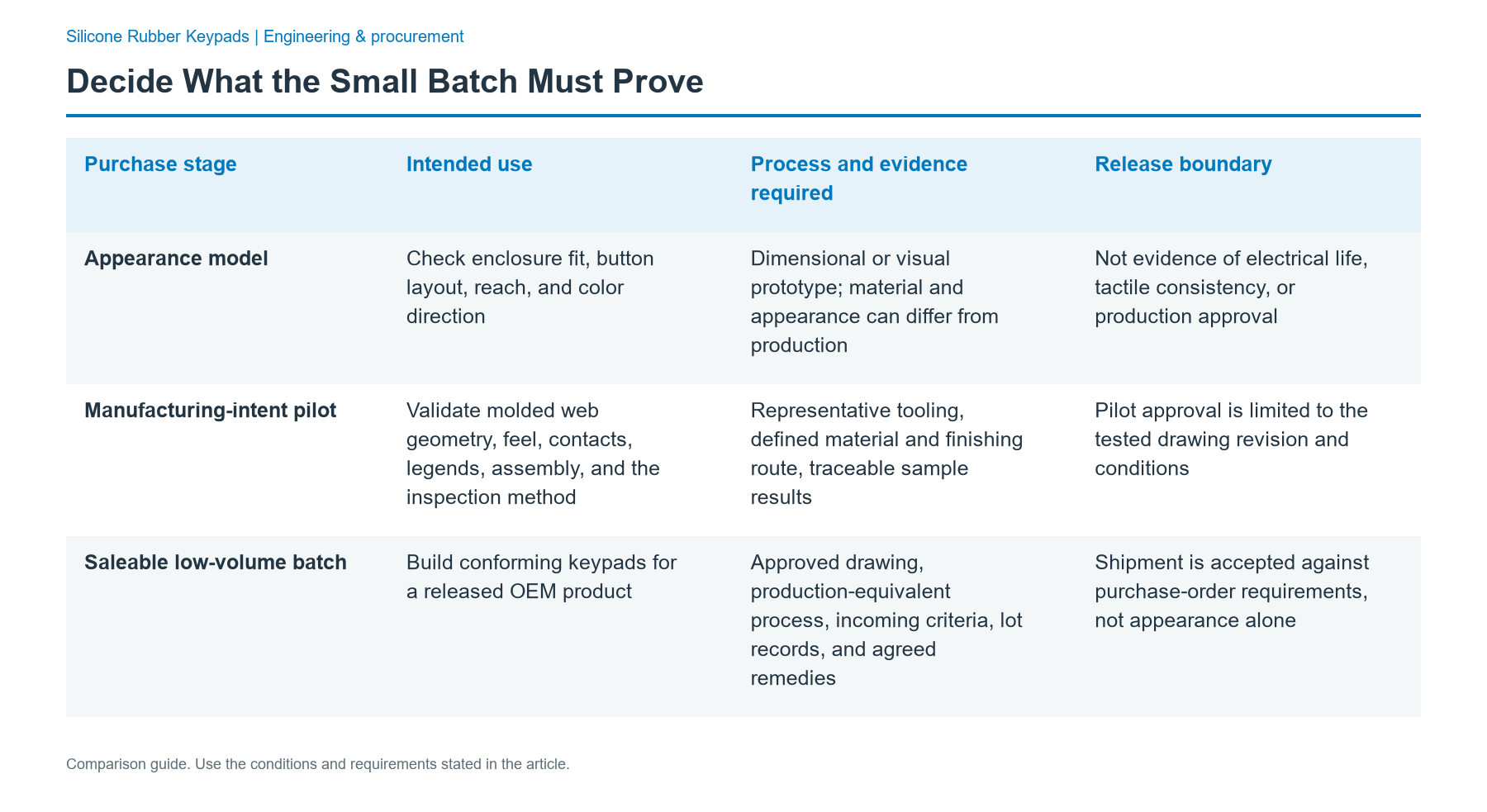
The cheapest small batch is often the wrong purchase if it cannot answer the project’s next decision. Classify the requirement by what the units will be used for, and state whether the parts may be installed in products sold to customers.
| Purchase stage | Intended use | Process and evidence required | Release boundary |
|---|---|---|---|
| Appearance model | Check enclosure fit, button layout, reach, and color direction | Dimensional or visual prototype; material and appearance can differ from production | Not evidence of electrical life, tactile consistency, or production approval |
| Manufacturing-intent pilot | Validate molded web geometry, feel, contacts, legends, assembly, and the inspection method | Representative tooling, defined material and finishing route, traceable sample results | Pilot approval is limited to the tested drawing revision and conditions |
| Saleable low-volume batch | Build conforming keypads for a released OEM product | Approved drawing, production-equivalent process, incoming criteria, lot records, and agreed remedies | Shipment is accepted against purchase-order requirements, not appearance alone |
A small batch custom rubber keypad for a display mockup may use an elastomer-like print or room-temperature-cured casting. Its texture or shape can be informative, but it cannot automatically stand in for the compression-molded part that later controls a PCB. For a functional pilot, specify the intended contact architecture and assembly stack. For saleable units, insist on the same controlled route used for qualification—or obtain documented requalification if the route changes.
A supplier should state the process, tool status, and what each sample actually represents. “Functional prototype” is not a sufficient specification when key force, return, resistance, and durability matter.
Send One Controlled RFQ Instead of Several Incomplete Drawings
A comparable request for quotation gives every bidder the same released inputs, distinguishes fixed requirements from negotiable options, and requests the same pricing breaks. The following RFQ worksheet can be copied into an inquiry or purchasing record.
| RFQ line | Information to supply or require |
|---|---|
| Design control | 2D dimensioned drawing, 3D CAD when available, drawing revision, key numbering, and target use: appearance, pilot, or saleable |
| Molded geometry | Overall length and width, base thickness, key heights, web features, mounting/retention, critical datum and tolerance, and enclosure cross-section |
| Silicone | Requested material family, Shore A hardness target and measurement condition, pigment or color reference, and any restricted substances relevant to the product |
| Tactile response | Per-key peak actuation force in cN, contact travel in mm, return-force behavior, snap-ratio target where applicable, and test fixture |
| Electrical interface | PCB contact artwork, PCB finish, pill size and position or alternative switch interface, expected contact resistance, and applied circuit/test condition |
| Decoration | Separate body colors, legend artwork/revision, print colors, coating, surface finish, and legibility or abrasion criteria |
| Lighting | No backlight, translucent area, or masked/laser-defined illuminated legend; LED positions, light-blocking regions, and optical approval method |
| Environment | Cleaning chemicals, wipe method, expected operating conditions, and any project-specific resistance or life-test requirements |
| Quantity and delivery | Quote 100, 250, and 500 pieces, each for one frozen design; state packaging, one-shipment versus split delivery, destination, and Incoterm |
| Commercial and quality | Itemized NRE/tooling, artwork fixtures, setup per variant/release, sample costs, inspection records, tool ownership, scrap allowance, and nonconformance remedies |
To avoid a vague tactile quotation, a compact instrument-keypad project might use an illustrative engineering starting point of 180 cN peak force and 1.1 mm contact travel, measured at the center of a specified key in the assembled reference fixture at 23 ± 2 °C. These numbers are a buyer-selected comparison baseline, not guaranteed properties of every silicone keypad. Confirm the permissible force and travel bands on the project drawing; large keys, gloved operation, metal domes, and different housings may call for different targets. Never turn a sample material data point into a finished-assembly acceptance limit without matching its test method.
The buyer should also provide the actual PCB layout and support condition. Contact placement, board flatness, bezel compression, and air-vent routing affect measured behavior. For long bars, rockers, or cursor keys, request an explicit anti-wobble and multi-contact review instead of assuming that a symmetric keycap produces uniform actuation.
Contact options must be quoted as distinct architectures. Common candidates are printed carbon, molded carbon pills, low-resistance carbon pills, metal-containing pills, elastomer-actuated metal domes, and a rubber actuator over a separate tactile switch. These are different bill-of-material and PCB combinations, not six interchangeable prices for a finished part. Select only those that fit the approved circuit.
When circular carbon pills are specified, check actual supplier size availability. One published keypad-design catalog documents the following 12 distinct diameter choices: Ø2.5, Ø3.0, Ø3.5, Ø4.0, Ø4.5, Ø5.0, Ø5.5, Ø6.0, Ø6.5, Ø7.0, Ø7.5, and Ø8.0 mm. This is a catalog example, not a universal industry size series or a promise of available JASPER tooling. Enter the selected diameter, tolerance, contact land, and test load in the RFQ; do not quote only a 2.5–8.0 mm range.
Choose a Manufacturing Route by Verification Risk
The route should follow the release objective, not the supplier’s smallest advertised lot. A prototype to pilot keypad order becomes expensive when a prototype saves tooling money but forces a second design, second tooling approval, or repeated electrical qualification.
| Route | Advantage at small quantity | Limitation to resolve before approval |
|---|---|---|
| Additive or machined appearance model | Quick geometry and enclosure discussion without production tooling | May not reproduce silicone-web force curves, conductive contacts, legends, or production aging |
| RTV casting with soft tooling | Useful for early geometry and material exploration with relatively low tool commitment | Curing, manual handling, shrinkage, and repeatability differ from the intended production route |
| Compression-molded silicone | Production-representative webs, integrated contacts, and defined post-processing can be qualified | Mold cavities, setup, printing, coating, and inspection costs dominate short runs |
| LSR injection molding | Attractive where precise repeatability or a future larger program justifies the process | Tooling and process economics require a separate volume and design analysis |
Do not infer that RTV is inherently inferior for every use, or that injection molding is mandatory for quality. The buyer’s test is narrower: does this supplier’s proposed route produce the required released part, with evidence under the required conditions? If the tool or compound changes after the pilot, identify which fit, force, resistance, color, coating, or life evidence must be repeated.
For backlit legends, quote the full chain—base pigment or translucent rubber, paint or masking, laser processing if specified, and optical inspection. A molded blank with a printed legend does not become a proven night-readable keypad merely because its silhouette matches the drawing. If only a soft sample is needed today, buy it for that purpose and preserve a separate manufacturing qualification budget.
Find Out What the Minimum Order Quantity Actually Limits
There is no single useful minimum order quantity across all custom silicone keypads. Ask whether an MOQ attaches to the tool/design, the compound or pigment preparation, the printing/coating route, or the shipping release. A supplier may accept 100 molded pieces while requiring a larger color-compound charge; another may mold one run but price every legend artwork as a separate printing setup.
| Constraint | Procurement question | How to put it on the quote |
|---|---|---|
| Mold/design MOQ | Does the minimum apply to each distinct geometry or to a common multi-cavity tool? | List quantity by drawing revision and cavity or tool |
| Body color MOQ | Must each pigment batch be made and priced separately? | Itemize color preparation, minimum charge, excess-material treatment |
| Legend/coating MOQ | Is each print artwork, ink color, coating, or laser program a separate setup? | Show NRE and setup charge by finishing variant |
| Delivery-release MOQ | Can accepted inventory be shipped in more than one release? Who holds it? | Quote production batch, storage conditions, ownership, release quantity, and freight separately |
A common mold is not permission to mix colors for free. The silicone body can share geometry while using different pigment batches; legends can vary while the mold stays unchanged; coating operations can demand different inspection records. Design MOQ, color MOQ, legend MOQ, and shipment MOQ are four separate negotiation lines.
Use the following variant-split sheet when asking whether mixed versions can share a 100-piece pilot. The numbers are an illustrative purchase request, not a supplier capability statement.
| SKU | Molded geometry | Body color | Legend artwork | Quantity | Price or setup question |
|---|---|---|---|---|---|
| A | Rev B shared mold | Black | Rev B-A, white | 60 | Can one molding batch support this printing run? |
| B | Rev B shared mold | Black | Rev B-B, white | 25 | Is the second stencil or program charged separately? |
| C | Rev B shared mold | Gray | Rev B-C, white | 15 | Does gray require its own pigment minimum and molding setup? |
| Total | One geometry | Two colors | Three artworks | 100 | Price every separate operation; do not assume one 100-piece MOQ |
If 60 black A units and 25 black B units share an undressed molded base, that might reduce molding setup without eliminating printing charges. The 15 gray C units may add a new color-mixing and molding minimum. Ask for a written production traveler and lot traceability that identify every SKU; a single total line on the purchase order is inadequate for variant acceptance.
Compare Total Qualified Cost at the Same Release Quantity
Unit-price comparison makes sense only after both quotations cover an equivalent, saleable part and the same commercial boundary. Normalize every quote to a total qualified landed cost rather than burying nonrecurring charges in notes.
Total program cost (USD) = tooling and development NRE + Σ(setup charge per release or variant) + Σ(accepted-order quantity × quoted unit price) + agreed test/qualification charges + freight and duties + buyer-paid scrap or rework exposure.
Then calculate cost per accepted keypad = total program cost ÷ accepted conforming units. If rejects are credited or replaced under contract, do not charge the same scrap twice. Define currency, taxes, shipping destination, and ownership of unused material before using the formula.
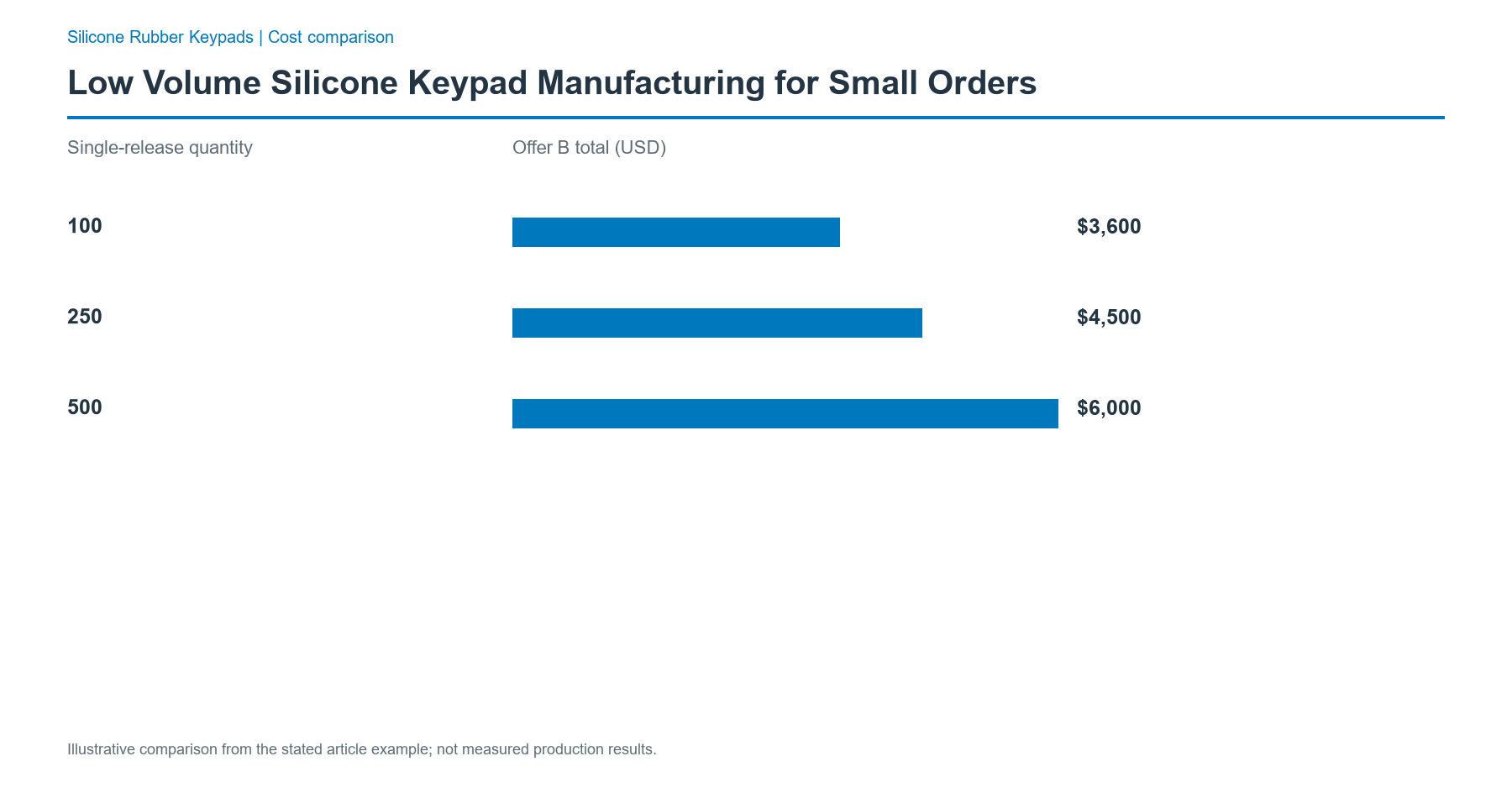
The table below is an illustrative arithmetic exercise, not current market pricing, supplier quotations, or a JASPER offer. Both hypothetical offers deliver an equally qualified part. Both include one $150 setup and $250 for common testing and logistics. Offer A has $900 NRE and $14 per keypad; Offer B has $2,600 NRE and $6 per keypad.
| Single-release quantity | Offer A total (USD) | Offer B total (USD) | Lower modeled total |
|---|---|---|---|
| 100 | $2,700 | $3,600 | A, by $900 |
| 250 | $4,800 | $4,500 | B, by $300 |
| 500 | $8,300 | $6,000 | B, by $2,300 |
With all other modeled costs equal, the break-even quantity is ($2,600 − $900) ÷ ($14 − $6) = 212.5 keypads. For whole-unit orders, Offer B first becomes cheaper at 213 pieces under these assumptions. If Offer B also adds a $500 variant setup that Offer A does not charge, the threshold moves to ($1,700 + $500) ÷ $8 = 275 pieces; at 250 units, Offer A then costs less. This sensitivity check is more useful than a claimed savings percentage based on undisclosed conditions.
Add a second scenario for a repeat order from an already approved tool. Tool amortization belongs to the program budget, but the future cash invoice may exclude previously paid NRE. Keep cash required now, lifecycle cost, and risk-adjusted cost of another design change visible as separate decisions. If the pilot and saleable run are separate, also price the second setup, packaging, storage, and inspection release.
Evaluate Supplier Evidence, Not Sales Claims
For a 100-piece pilot, request a short evidence pack before comparing the final bids. The good signal is a testable deliverable with an owner and revision, not a generic claim that a supplier can produce silicone parts.
| Decision check | Good signal | Red flag |
|---|---|---|
| DFM and thin webs | Annotated review of web geometry, demolding, key support, tolerances, and feasible cavity layout | Tooling quoted without seeing the enclosure or cross-section |
| Contact compatibility | PCB land geometry and finish reviewed against pill shape and applied-force/test conditions | Contact resistance promised with no defined mating PCB |
| Force and travel | Key-by-key force-displacement plots with test setup and revision | One unlabeled force number used for all key shapes |
| Material and color | Compound specification, sample chip or color reference, and batch identification | Color approval based only on a screen image |
| Printing and coating | Artwork revision, decoration sequence, and agreed abrasion or cleaning evaluation | “Wear resistant” without a defined test or finish |
| Backlighting | Optical sample in the actual LED and enclosure arrangement | Claims based on a detached keycap photo |
| Tooling and files | Written tool location, cavity count, ownership/access terms, repair and transfer rules | NRE billed with no statement of tooling rights |
| Quality and changes | Inspection record, traceability, nonconformance workflow, and revision-change approval | Unapproved material or print substitutions allowed |
| Schedule and shipment | Milestones tied to input freeze, first articles, pilot acceptance, and release | “Four weeks” with no start event or rework allowance |
Compare suppliers using a pass/fail gate for critical interfaces before a weighted commercial score. A quote that cannot demonstrate electrical contact on the buyer’s board should not win solely on price. For bids that pass, score total qualified cost, controlled process, documented tool rights, variant handling, and realistic milestone evidence. Record the evaluator, version of the RFQ, and each exception so the lowest compliant bid can be defended later.
Run a Seven-Gate Prototype-to-Pilot Purchase
A small-order schedule should be a chain of approvals, not a single optimistic lead-time number. The seven-gate handoff below assigns the buyer an action at every transition.
| Gate | Supplier deliverable | Buyer release decision |
|---|---|---|
| 1. RFQ baseline | Assumption log and costed options tied to one drawing revision | Procurement, engineering, and SQE freeze scope and bid comparison basis |
| 2. DFM and tooling | Mold/parting proposal, cavity strategy, tolerance risks, artwork and tool-rights terms | Authorize NRE only after technical and ownership questions close |
| 3. First articles | Identified sample pieces, measurements, tactile curves, color/legend references | Approve, reject, or issue one documented correction request |
| 4. Pilot build | Agreed quantity and production traveler, cavity and variant traceability | Authorize pilot after the corrected first article passes |
| 5. Verification | Fit, electrical, force/travel, finish, environmental and life evidence as applicable | SQE records deviations and closes critical failures |
| 6. Saleable release | Signed drawing, approved process and inspection plan, final unit price and shipment plan | Buyer issues a released purchase order with a change-control clause |
| 7. Receipt and closure | Lot identity, inspection results, count, packaging evidence, issue disposition | Accept conforming inventory and resolve credits/replacements |
Ask bidders to enter calendar dates and elapsed working days for each gate, identifying whether the clock starts on purchase order, tool design sign-off, receipt of buyer-supplied PCB, or artwork approval. Reserve an explicit decision window for OEM engineering; the supply chain cannot count an unsigned sample as approved. A manufacturing-intent pilot should be linked to its first-article approval and to a recorded inspection method, not silently combined with shipment acceptance.
Approve Samples Against a Written Record
Pilot approval should attach measurements to the actual keypad + PCB + housing combination. Use this compact sample record even when the sample count is small; set the number of samples and destructive-test specimens from the program risk and test purpose, rather than assuming one piece represents all cavities.
| Record field | What to capture | Acceptance decision |
|---|---|---|
| Identity | Part number, drawing and artwork revision, lot, color, cavity when available | Matches the approved RFQ and sample label |
| Dimensional fit | Critical datums, rim/retention dimensions, bezel clearance, contact alignment | Within released drawing tolerances in the assembled fixture |
| Tactile behavior | Peak force (cN), travel (mm), return behavior, key position, temperature, fixture | Meets the key-specific signed limits and does not stick or rock unexpectedly |
| Electrical closure | PCB revision/finish, applied load and measurement circuit, per-key contact result | Continuity and resistance meet the agreed board-level test |
| Surface and artwork | Body/legend color, location, registration, coverage, coating finish | Matches approved physical master and artwork |
| Illumination | LED/current setup, lit/unlit photos, leakage and hot spots if specified | Meets the signed optical reference in the installed stack |
| Cleaning and durability | Defined cleaning agents, wipe cycles or key-actuation method and post-test criteria | No disallowed loss of function or legend integrity |
| Disposition | Pass/fail, deviation ID, repair/replace decision, approver and date | No open critical issue at release |
For a 100-piece engineering pilot, a reasonable buyer-controlled screen is 100% identification, cosmetic, and legend inspection, with functional and endurance test sampling defined separately according to risk. This is a proposed control plan, not a standard imposed on all suppliers. Agree in advance which tests are nondestructive, which require extra test coupons, who pays for failures, and whether accepted quantity excludes consumed specimens. Store a physical master when color and tactile acceptance are sensitive to lighting or interpretation.
Put Ownership, Variants, and Remedies Into the Purchase Order
The purchase order turns a promising quote into a controllable small batch. Include the released drawing and artwork revision, SKU-level quantities, finished-part description, material/contact/finishing route, agreed sample master, acceptance criteria, and packaging identity. List NRE and recurring prices separately. Specify whether a pilot price is reusable for the next order or requires a new quotation.
Define tool ownership, maintenance, access, modification approval, and disposition at project exit; the fact that a buyer funded an NRE charge does not by itself settle every tool-rights term. If one tool supports several legend or color variants, identify which files and fixtures are buyer-owned and how revision control is applied across shared geometry.
Require a written deviation request before a change to compound, pigment, carbon pill, PCB mating condition, print artwork, coating, process, cavity, or inspection method. The agreement should say who performs requalification and bears its cost. Set rules for short shipments, cosmetic versus electrical defects, replacement lead time, return authorization, and documented corrective action. For staggered deliveries, spell out title to held inventory, storage environment, maximum release age, and freight responsibility. These clauses matter as much for 100 parts as for 10,000 because a missed pilot can stall an entire product build.
JASPER's silicone rubber keypad product page is the starting point for discussing a custom molded keypad. Keep the RFQ limited to the silicone keypad and agreed interface or assembly scope; do not assume a membrane switch, touch controller, or complete HMI system is automatically included.
Frequently Asked Questions
What is a realistic minimum order quantity for a custom silicone keypad?
There is no reliable universal MOQ for a custom silicone keypad. New geometry, production tooling, pigment batches, print setups, and delivery schedules each create different minimum economics. Ask for an itemized quotation at 100, 250, and 500 pieces for the same drawing revision, and have the supplier identify which operations trigger minimum charges. These three quantities are comparison points, not guaranteed order acceptance.
Can different body colors or legend versions share one MOQ?
They can share some work, but not automatically one MOQ or one price. Common molded geometry may permit shared tooling, while different body pigments require separate material preparation and legend variants may need independent printing programs or fixtures. List each SKU's exact quantity, body color, artwork revision, coating, and requested delivery. Require the supplier to identify every separately charged setup and the traceability method for mixed versions.
Can a cast or 3D-printed keypad be used in a saleable pilot?
Only if that exact process and material are qualified for the intended finished product. Cast and printed samples are useful for fit and appearance, but their web mechanics, contact behavior, finishing, and aging may differ from production-molded silicone. Do not approve a production process on the strength of a visually similar model. State whether the sample is appearance-only, manufacturing-intent, or saleable, and document any requalification when the route changes.
Is a 100-piece pilot enough to approve regular production?
A 100-piece pilot can be a useful planning baseline, but quantity alone proves nothing. Approval depends on representative tooling and material, cavity/variant coverage, the installed PCB and housing, predefined measurements, and closure of failures. The OEM's validation plan determines whether additional life, cleaning, or environmental work is needed. Release the production drawing and inspection criteria only after the required evidence passes; do not treat the pilot count as a certification.
Why can the cheapest unit price produce the highest total cost?
Small runs carry nonrecurring engineering, tooling, color and print setup, sample, test, freight, and potential rework charges. Compare totals at the identical quantity and acceptance scope, then divide by accepted conforming pieces. A low unit price with high tooling can be less attractive at 100 pieces but more attractive at 500. Separate already-paid tooling from cash required for a repeat release, and test how extra variant setups change the break-even point.
Which quality evidence matters most for a small-batch keypad?
Start with traceable dimensions, key-by-key force and travel, electrical closure on the intended PCB, and proof of the approved legends and surface finish. Add backlight, cleaning, or actuation-life testing when the application requires it. Each record should identify the drawing revision, test fixture, conditions, results, and disposition. A generic material data sheet or unlabelled sample photograph cannot replace assembled-part verification or an agreed receiving-inspection plan.
What should I send to request a small-batch silicone keypad quote?
Send the dimensioned keypad drawing and revision, legend artwork, mating PCB contact layout and support details, force/travel targets, body color and finish, cleaning environment, variants and quantities, and the intended approval stage. Specify whether 100 units are for a manufacturing-intent pilot and request separate 250- and 500-unit prices. Ask for tooling, setup, inspection, packaging, shipment, ownership, and milestone assumptions as itemized lines rather than one unexplained total.
Request a Comparable Small-Batch Quote
If you are ready to price a specific design, request a quote with the keypad drawing, legend artwork, PCB contact and support details, force/travel target, cleaning environment, revision, and quantity by variant. State whether the order is an appearance model, a manufacturing-intent pilot, or saleable inventory, and ask for a priced approval plan. That gives engineering and purchasing a shared basis for deciding what to make first and when to release the next batch.
Bring the drawing, stack and operating conditions
JASPER engineering will review the interfaces, open risks and evidence required for a production quote.