
A graphic overlay RFQ template should give every bidder the same controlled drawing set, stack-up, quantities, approval plan, lead-time milestones, and acceptance rules. Use the template below only after all critical fields are complete and every attachment carries one revision. As a practical release gate, require 100% of critical fields and at least 90% of all applicable fields before sending the RFQ.
Use an RFQ release gate before asking for price
A comparable quote starts with a comparable input package. If one bidder receives a dimensioned drawing, another receives only artwork, and a third fills gaps with its own preferred material, the resulting prices describe different parts. The purchasing team then spends the comparison stage discovering scope differences that should have been resolved before the RFQ.
Use two release thresholds for internal control:
- Critical-field threshold: 100%. Part identity, governing revision, outline, quantity, mounting surface, required windows, acceptance route, and commercial response format must be complete.
- Applicable-field threshold: at least 90%. Noncritical details may remain open only when the RFQ clearly asks for a recommendation and defines the performance condition that the recommendation must meet.
A field marked “supplier recommendation” is not missing information. It is a controlled decision request. The supplier must state the proposed construction, assumptions, effect on price and lead time, and the evidence needed for approval.
| Release-gate area | Critical when | Release evidence |
|---|---|---|
| Part and revision control | Always | One RFQ number, part number, revision, and dated file list |
| Geometry and artwork | Always | Dimensioned outline, editable art, visual PDF, and separated feature layers |
| Construction | Always | Exact requirement or an explicit supplier-recommendation route |
| Mounting surface | Adhesive-backed part | Housing material, coating, texture, flatness, recess, and edge land |
| Environment | Exposure affects the build | Cleaner, temperature, moisture, UV, abrasion, and handling conditions |
| Quantity and schedule | Always | Every quantity break, annual usage, release pattern, and milestone dates |
| Approval and acceptance | Always | First-article checks, acceptance record, document precedence, and change path |
Copyable graphic overlay RFQ template
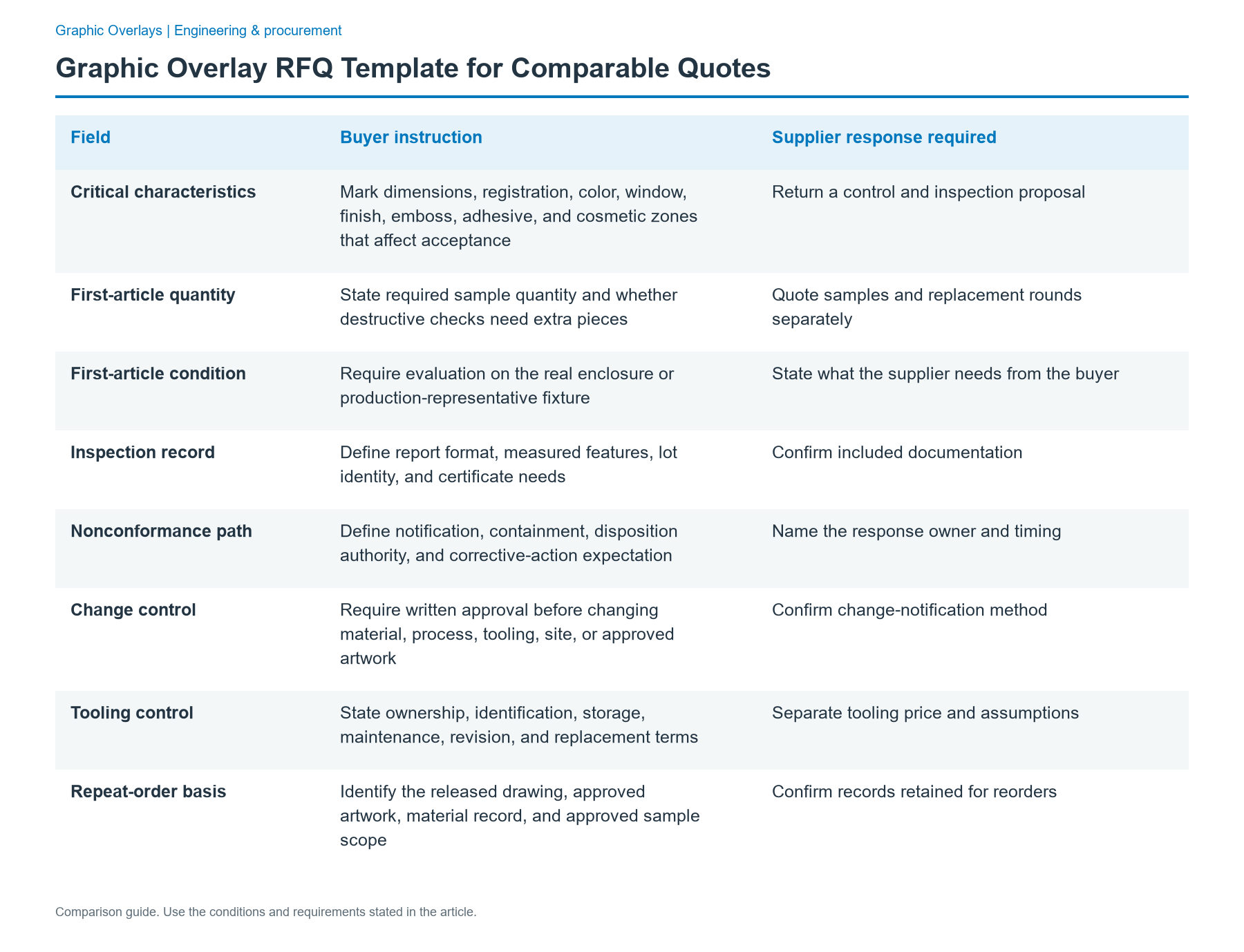
The following tables form one RFQ package. Keep the buyer instruction in the working template, enter the project value beside it, and require the supplier to repeat the same field in the quotation or exception list.
1. Project control and commercial basis
| Field | Buyer instruction | Supplier response required |
|---|---|---|
| RFQ identity | Assign one RFQ number and issue date | Repeat both on every quote revision |
| Part identity | State part name, part number, and released revision | Confirm the quoted revision |
| Product use | Describe the equipment and the overlay’s user-interface function | State any application assumptions |
| Quote due date | Give date, time zone, and contact for questions | Confirm response date |
| Quantity breaks | List each requested break; for example 25, 100, 500, 1,000, and 5,000 pieces | Quote every value separately |
| Demand profile | State annual usage, launch quantity, release frequency, and forecast status | Identify material or capacity assumptions |
| Price structure | Require unit price, setup, tooling, samples, inspection, packaging, and freight to be separated | Show every charge and exclusion |
| Quote validity | Define the minimum validity period needed for approval | State validity and material-price assumptions |
| Delivery basis | State destination, packaging unit, and required delivery term | Confirm what the quoted price includes |
| Payment and tax fields | Insert the buyer’s approved commercial terms | List exceptions without changing technical scope |
2. Drawing, artwork, and geometry
| Field | Buyer instruction | Supplier response required |
|---|---|---|
| Governing drawing | Identify file name, revision, units, scale, and release date | Confirm receipt and readability |
| Editable artwork | Provide the native vector file with live or outlined fonts as controlled by the buyer | State usable file format and any conversion risk |
| Visual reference | Provide a press-ready PDF showing the intended appearance | Return a marked proof for approval |
| Cut geometry | Separate outline, holes, slots, windows, adhesive keep-outs, and datum features | Identify tooling and registration assumptions |
| Dimensions | State overall size, key locations, radii, and tolerances | List any capability exception before quoting |
| Color control | Name the color standard or physical master, lighting condition, gloss condition, and approval method | State matching route and sample requirement |
| Print construction | Select screen, digital, hybrid, or supplier recommended | State the proposed process and opacity plan |
| Surface finish | Select gloss, matte, textured, or selective texture and identify areas | Confirm material/finish combination |
| Window type | Select clear, tinted, translucent, dead-front, or open cutout for every window | State optical and print assumptions |
| Emboss feature | Select none, pillow, rim, rail, or custom formed feature for each zone | State tooling, height-control, and registration assumptions |
Keep print, cut, window, emboss, and adhesive layers distinct. A flat visual proof can look correct while the finished part still conflicts with the display, bezel, switch dome, or enclosure datum.
3. Material, adhesive, and stack-up
| Field | Buyer instruction | Supplier response required |
|---|---|---|
| Substrate family | Select PET, polycarbonate, or other engineered film | Repeat family and proposed exact grade |
| Grade and thickness | State exact grade and nominal thickness, or request a documented recommendation | Provide data sheet identity and converted thickness |
| Print side | State first-surface, second-surface, or mixed construction | Confirm ink and protective-layer sequence |
| Protective treatment | State hard coat, chemical-resistance need, anti-glare need, or no added treatment | Describe the proposed surface construction |
| Adhesive rule | State exact grade, approved equal, or supplier recommendation | Identify exact proposed grade and thickness |
| Adhesive coverage | Select full, selective, perimeter, or none for mechanical capture | Return an adhesive die line when applicable |
| Release liner | State liner type, split location, pull-tab need, and assembly direction | Confirm liner and converting method |
| Stack-up drawing | Show film, ink, window layers, texture, adhesive, liner, and total construction | Return a quoted stack-up with revision identity |
| Packaging protection | State interleaf, bag, tray, orientation, label, and maximum pack quantity | Confirm protection against rub, curl, and contamination |
4. Enclosure, environment, and installation
| Field | Buyer instruction | Supplier response required |
|---|---|---|
| Bonding surface | Identify plastic, coated metal, painted surface, glass, or another substrate | State adhesive compatibility assumptions |
| Surface condition | Record texture, surface treatment, flatness, recess depth, edge land, ribs, and known contamination risks | Flag areas that reduce contact or pressure |
| Cleaning exposure | List cleaner names or chemistry, concentration, wipe method, dwell time, and frequency | State proposed validation route |
| Temperature | Give operating, storage, and installation ranges with units | Identify material or adhesive limitations |
| Light exposure | State indoor, indirect sunlight, or direct outdoor exposure | State UV-control assumptions |
| Moisture and sealing | State splash, condensation, washdown, immersion, or dry-use condition | Describe overlay contribution without claiming a complete assembly rating |
| Abrasion and touch | Describe glove use, fingernails, tools, public use, and cleaning wear | State finish and test assumptions |
| Installation | Describe surface preparation, alignment fixture, pressure method, dwell time, and operator sequence | Confirm liner split and installation aids |
| Verification | List project tests, sample count, conditioning, and acceptance limit | Price and schedule each required activity |
5. Quality, first article, and order controls
| Field | Buyer instruction | Supplier response required |
|---|---|---|
| Critical characteristics | Mark dimensions, registration, color, window, finish, emboss, adhesive, and cosmetic zones that affect acceptance | Return a control and inspection proposal |
| First-article quantity | State required sample quantity and whether destructive checks need extra pieces | Quote samples and replacement rounds separately |
| First-article condition | Require evaluation on the real enclosure or production-representative fixture | State what the supplier needs from the buyer |
| Inspection record | Define report format, measured features, lot identity, and certificate needs | Confirm included documentation |
| Nonconformance path | Define notification, containment, disposition authority, and corrective-action expectation | Name the response owner and timing |
| Change control | Require written approval before changing material, process, tooling, site, or approved artwork | Confirm change-notification method |
| Tooling control | State ownership, identification, storage, maintenance, revision, and replacement terms | Separate tooling price and assumptions |
| Repeat-order basis | Identify the released drawing, approved artwork, material record, and approved sample scope | Confirm records retained for reorders |
Do not write only “PET and adhesive” on the purchase order
A material family does not define a repeatable construction. PET and polycarbonate each contain many grades, thicknesses, surface treatments, coatings, optical conditions, and converting behaviors. The word “adhesive” omits chemistry, carrier or transfer construction, thickness, liner, coverage, and the surface the adhesive must bond to.
Use one of three substitution statuses and state it beside every controlled material:
- Exact grade only. No alternate may be used without a written change authorization.
- Approved equal. An alternate may be proposed, but it must be identified and approved against named comparison criteria before use.
- Supplier recommendation. The supplier selects a grade against the stated surface, environment, geometry, installation process, and validation plan.
An acceptable alternate-material response includes the exact grade, reason for the proposal, affected requirements, property comparison, sample or test plan, price effect, lead-time effect, and approval status. The word “equivalent” by itself is not an approval record.
The same rule applies to the drawing package. Put the exact revision on the RFQ, quote, purchase order, artwork proof, stack-up, first-article report, and packaging label. When the numbers differ, production should not start until the conflict is resolved in writing.
Normalize each quote before scoring suppliers
A low unit price can result from omitted tooling, a different film, fewer inspection steps, unpriced samples, or a longer material lead time. Move every quote into the same comparison sheet before evaluating it.
| Comparison field | Normalized entry |
|---|---|
| Technical compliance | Comply, comply with stated exception, or no bid for each RFQ field |
| Unit pricing | Every requested quantity break, same delivery basis, same packaging basis |
| One-time charges | Tooling, setup, artwork conversion, color work, fixtures, and inspection programming |
| Sample route | Sample quantity, construction, revision rounds, approval dependencies, and shipment basis |
| Lead-time milestones | DFM questions, proof, tooling, first article, buyer approval, production, and transit |
| Quality evidence | Inspection record, material traceability, lot identity, change control, and nonconformance path |
| Commercial exposure | Quote validity, minimum buy, material commitment, cancellation terms, and excess inventory |
| Exceptions | One numbered list tied to exact RFQ fields |
A practical 100-point evaluation model is:
- Technical compliance: 30 points
- Approval evidence and sample plan: 20 points
- Schedule and capacity fit: 15 points
- Quality, traceability, and change control: 15 points
- Total landed and accepted cost: 15 points
- Communication and exception clarity: 5 points
For each category, rate the response from 1 to 5 and calculate category points = rating ÷ 5 × category weight. A response rated 5, 4, 3, 4, 3, and 4 in the order above scores 80 points. The model does not replace a technical disqualification: a quote that fails a critical requirement should remain noncompliant even when its weighted score is high.
Ask for evidence that predicts production control
| Review area | Good signal | Red flag |
|---|---|---|
| Material identity | Exact grade, thickness, source traceability, and substitution rule | Only a generic family name |
| Drawing review | Numbered DFM questions and explicit exceptions before tooling | Price issued with silent assumptions |
| Color and finish | Defined master, lighting, gloss condition, and physical approval route | Approval based only on a monitor image |
| Windows and embossing | Registration reviewed against the real display, switch, and enclosure | Features assessed as isolated artwork |
| Adhesive | Surface, edge land, recess, contamination, and installation pressure are reviewed | Adhesive selected before the enclosure is known |
| Inspection | Measurable characteristics, method, record, lot identity, and disposition path | “Standard quality” without a record |
| Schedule | Separate proof, tooling, first-article, production, and transit milestones | One lead-time number with no dependencies |
| Change control | Written approval before material, process, tooling, site, or artwork changes | Unannounced substitutions are allowed |
Approve the first article as an installed part
The first article should be checked on the production enclosure or a production-representative fixture. A desk sample cannot prove edge bond, window alignment, glare, emboss location, liner removal, or operator installation.
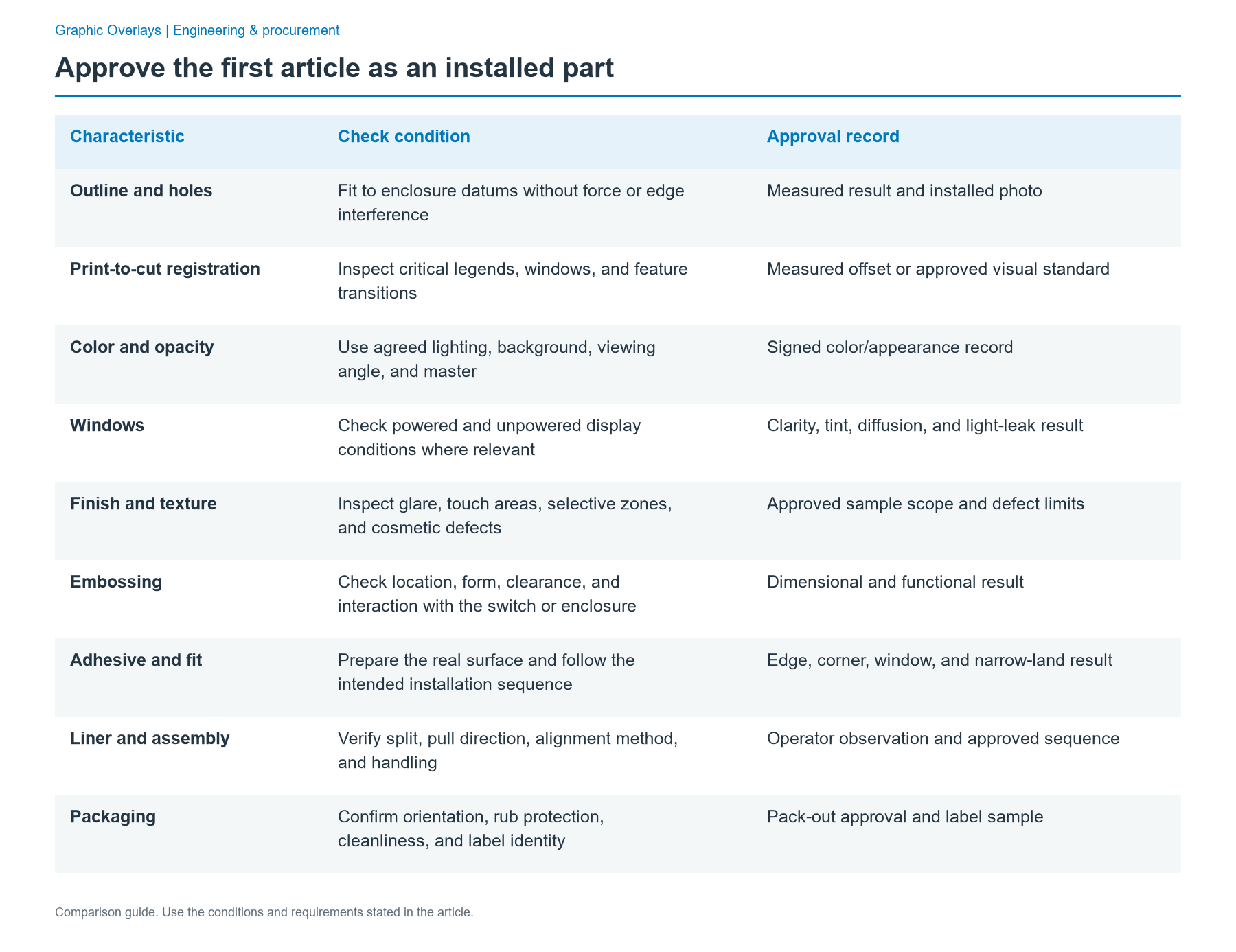
| Characteristic | Check condition | Approval record |
|---|---|---|
| Outline and holes | Fit to enclosure datums without force or edge interference | Measured result and installed photo |
| Print-to-cut registration | Inspect critical legends, windows, and feature transitions | Measured offset or approved visual standard |
| Color and opacity | Use agreed lighting, background, viewing angle, and master | Signed color/appearance record |
| Windows | Check powered and unpowered display conditions where relevant | Clarity, tint, diffusion, and light-leak result |
| Finish and texture | Inspect glare, touch areas, selective zones, and cosmetic defects | Approved sample scope and defect limits |
| Embossing | Check location, form, clearance, and interaction with the switch or enclosure | Dimensional and functional result |
| Adhesive and fit | Prepare the real surface and follow the intended installation sequence | Edge, corner, window, and narrow-land result |
| Liner and assembly | Verify split, pull direction, alignment method, and handling | Operator observation and approved sequence |
| Packaging | Confirm orientation, rub protection, cleanliness, and label identity | Pack-out approval and label sample |
Use only three disposition values: approved, approved with written deviation, or rejected and resubmit. A deviation must name the affected characteristic, quantity or date limit, and whether the next production lot must return to the original requirement.
Sample approval should not silently replace the drawing. State what the physical sample controls. A sample may control color and surface appearance while the released drawing controls dimensions, materials, and tolerances.
Set document precedence before the purchase order is released
Do not rely on an unwritten assumption that the purchase order, drawing, artwork, quotation, or sample always wins. Create a precedence table for the project and define the scope of each record.
| Example order | Document | What it controls |
|---|---|---|
| 1 | Signed change authorization or purchase-order amendment | Approved departures from the released baseline |
| 2 | Released drawing and acceptance specification | Dimensions, tolerances, materials, construction, and inspection requirements |
| 3 | Approved artwork proof | Visible content, layout, and print-layer intent |
| 4 | Approved material or color master | The named appearance or material attribute only |
| 5 | Approved first article | Fit and appearance characteristics explicitly recorded on the approval form |
| 6 | Supplier quotation and clarification log | Price, schedule, assumptions, and exceptions accepted by the buyer |
This example is an operating structure, not a universal contract rule. The final RFQ and purchase order should state the project’s actual order. When two records conflict, issue a written resolution tied to the same part number and revision before production release.
Run the RFQ in six controlled steps
- Build one package. Assemble the drawing, editable artwork, visual PDF, cut and adhesive layers, material rule, enclosure data, quantities, acceptance plan, and file index.
- Apply the release gate. Reach 100% of critical fields and at least 90% of applicable fields. Convert every legitimate open item into a supplier-recommendation request with clear conditions.
- Issue the same revision to every bidder. Use one due date and one question channel. Do not give one bidder extra technical detail outside the controlled addendum.
- Publish numbered clarifications. Record each question, buyer answer, affected file, and whether the answer changes price or schedule. Reissue changed files with a new revision.
- Normalize and score. Compare identical quantity breaks, charge categories, milestone definitions, exceptions, and evidence. Disqualify critical noncompliance before weighting price.
- Approve and release. Close DFM questions, approve the proof and installed first article, freeze the document precedence, and attach the accepted quote and exception log to the purchase order.
Common signs that the quote is not ready for an order
Pause the award when any of these conditions remains:
- The quote names a substrate family but not an exact grade or controlled recommendation route.
- The adhesive is priced without identifying the enclosure material and surface condition.
- Tooling, setup, samples, inspection, packaging, or freight are hidden inside an unexplained unit price.
- A single lead time combines proofing, tooling, sample approval, production, and transit.
- The supplier accepts the artwork without reviewing cut geometry, windows, emboss zones, or adhesive keep-outs.
- The first article will be approved as a loose sheet rather than on the real enclosure.
- The quote contains no revision identity, numbered exception list, or validity period.
- Material or process substitutions can occur without written notification and approval.
- The purchase order does not define what happens when the drawing, artwork, sample, and quote disagree.
Move from the RFQ to an engineering handoff
A complete RFQ does not force every design choice to be fixed by procurement. It creates a controlled way for engineering, quality, purchasing, and the supplier to resolve the remaining choices. Review the stack-up, windows, texture, embossing, adhesive coverage, and enclosure interface as one part before tooling. JASPER’s custom graphic overlays page provides the product handoff point for that review.
For a project-specific review, send the original-size artwork, window and adhesive-area layers, enclosure surface, cleaning conditions, color sample, governing revision, and every requested quantity break. Then request a quote with the same controlled package used for internal approval.
Frequently asked questions
What information is needed to quote custom control panel overlays?
A quote-ready package needs a controlled drawing, editable artwork and visual PDF, dimensions and tolerances, substrate and finish, window and emboss details, adhesive and mounting-surface data, operating and cleaning conditions, explicit quantity breaks, sample expectations, acceptance criteria, packaging needs, and one revision identity across every file.
Can a supplier quote before every overlay detail is fixed?
Yes, but every open item must be labeled as a supplier recommendation or a priced assumption. The quote should separate the base construction from alternatives, list the effect on tooling, samples, lead time, and unit price, and require written approval before the assumed item becomes part of the released build.
Why is “PET with adhesive” not enough for a purchase order?
PET identifies only a material family, and “adhesive” identifies only a function. A purchase order should reference the exact film grade, thickness, surface treatment, print side, adhesive grade, adhesive coverage, liner, and approved substitution rule. Those details can change color, flex behavior, bond, converting, and repeat-order consistency.
How many quantity breaks should a graphic overlay RFQ include?
Use at least three quantity breaks that match the buying plan, and list every break explicitly. A development program might request 25, 100, 500, 1,000, and 5,000 pieces. Include expected annual usage and release pattern so tooling, setup, packaging, and material purchasing are not hidden inside one unit price.
What should be approved on a graphic overlay first article?
Approve the first article on the real enclosure for outline fit, print-to-cut registration, legends, color and opacity, window clarity, finish, emboss position, adhesive coverage, edge bond, liner removal, installation sequence, packaging protection, and required inspection records. Record each result against the released revision rather than approving only by email.
Which document should control if the drawing and approved sample conflict?
The RFQ and purchase order should state the document precedence before production. Define which document controls dimensions, materials, artwork, color, finish, and appearance. If a conflict appears, stop release and resolve it in writing; do not assume that a physical sample automatically overrides a released drawing or specification.
How should alternate materials be quoted?
Quote each alternate on a separate line with its exact grade, reason for the change, affected requirements, price effect, lead-time effect, sample or test plan, and approval status. The supplier should not substitute after approval without written authorization, even when the alternate is described as equivalent or commercially available.
Bring the drawing, stack and operating conditions
JASPER engineering will review the interfaces, open risks and evidence required for a production quote.