
A custom silicone keypad quote has three cost layers: one-time development and tooling, charges repeated for each production batch, and cost per accepted keypad. Compare them at a defined purchasing volume, not by unit price alone. For a practical planning benchmark, model 10,000 accepted keypads in four releases of 2,500 and disclose whether that quantity is a forecast, a purchase commitment, or merely a quote assumption. That distinction can reverse the lowest-cost offer.
What belongs in each part of the cost breakdown?
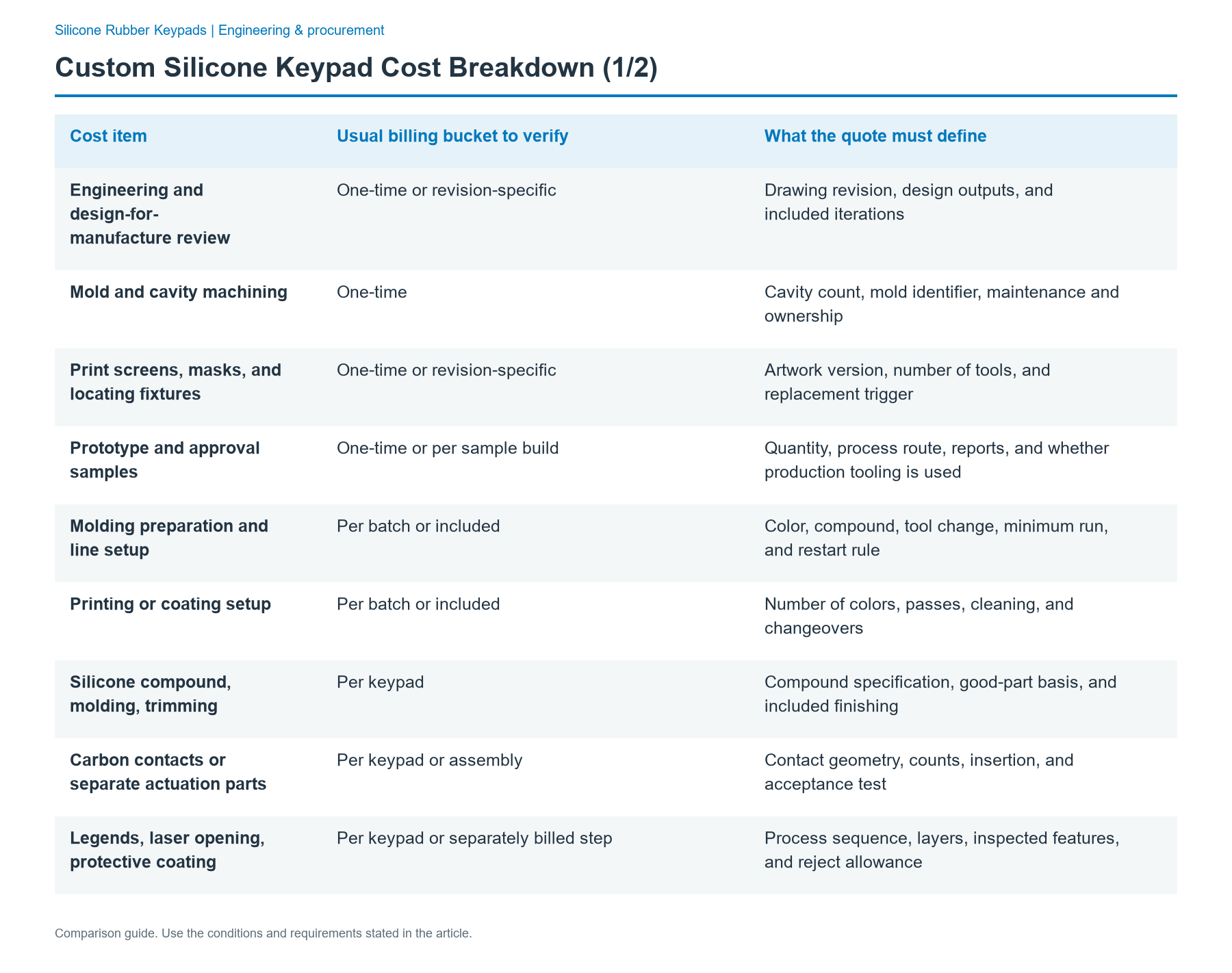
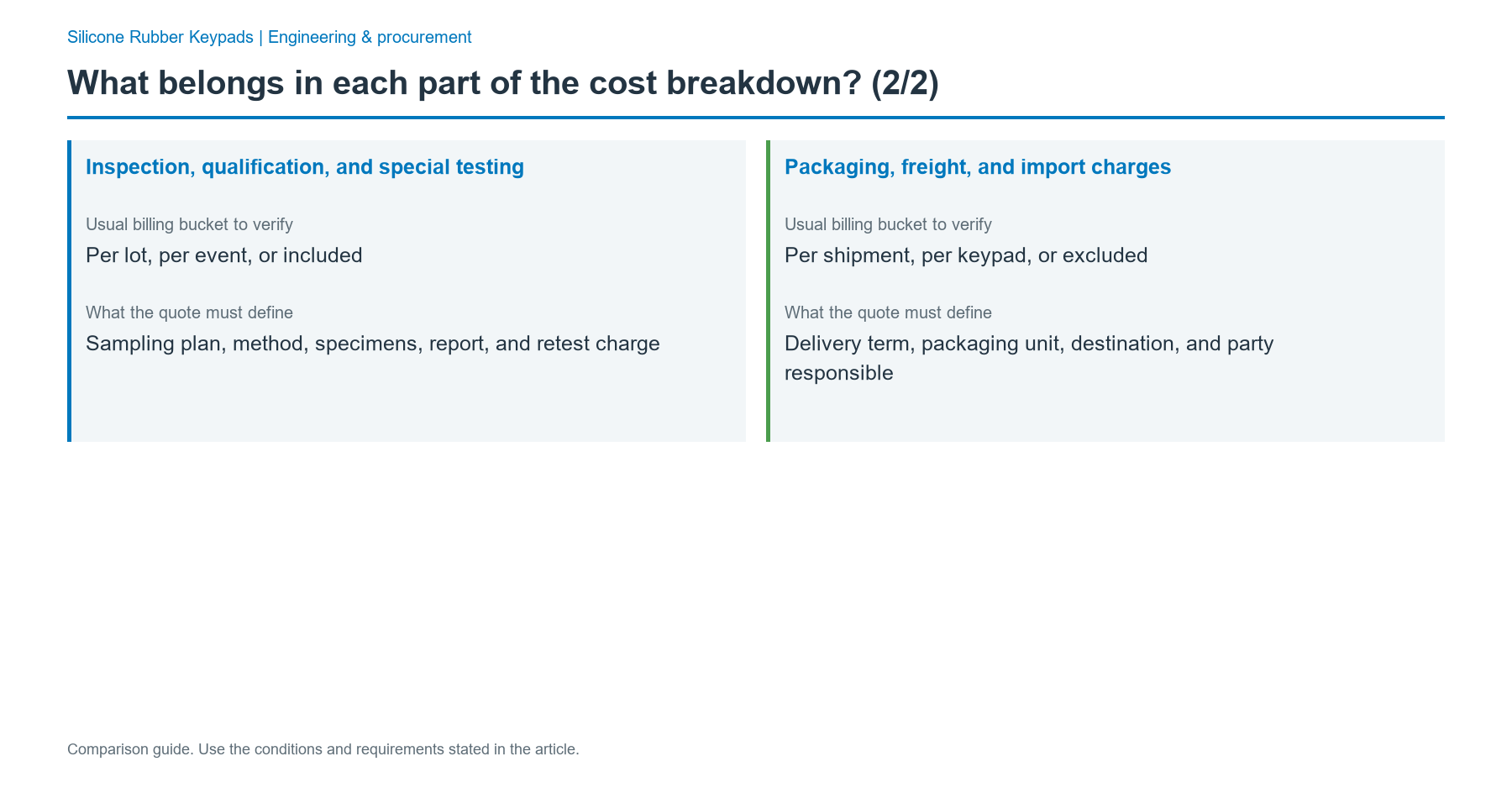
The first purchasing decision is how the supplier bills for the work. A compression mold might be paid once, a color change might trigger a setup charge every run, and a printed contact or coating might be included in the piece price. The same operation can be packaged differently across quotations; classification is about the contractual charge trigger, not the manufacturer's internal accounting.
| Cost item | Usual billing bucket to verify | What the quote must define |
|---|---|---|
| Engineering and design-for-manufacture review | One-time or revision-specific | Drawing revision, design outputs, and included iterations |
| Mold and cavity machining | One-time | Cavity count, mold identifier, maintenance and ownership |
| Print screens, masks, and locating fixtures | One-time or revision-specific | Artwork version, number of tools, and replacement trigger |
| Prototype and approval samples | One-time or per sample build | Quantity, process route, reports, and whether production tooling is used |
| Molding preparation and line setup | Per batch or included | Color, compound, tool change, minimum run, and restart rule |
| Printing or coating setup | Per batch or included | Number of colors, passes, cleaning, and changeovers |
| Silicone compound, molding, trimming | Per keypad | Compound specification, good-part basis, and included finishing |
| Carbon contacts or separate actuation parts | Per keypad or assembly | Contact geometry, counts, insertion, and acceptance test |
| Legends, laser opening, protective coating | Per keypad or separately billed step | Process sequence, layers, inspected features, and reject allowance |
| Inspection, qualification, and special testing | Per lot, per event, or included | Sampling plan, method, specimens, report, and retest charge |
| Packaging, freight, and import charges | Per shipment, per keypad, or excluded | Delivery term, packaging unit, destination, and party responsible |
Do not add an included fee twice. Label each quote line as separately charged, included in another line, or excluded from supply. In the last case, attach a buyer-side estimate rather than treating the omission as zero. Also separate the supplier's cash invoice from the buyer's internal allocation of already-paid tooling across future units.
One-time does not mean unrepeatable. An artwork change may require a new screen; a revised web profile can require a mold modification; a new test method can require another qualification event. Request the change trigger and approval authority beside the initial charge.
Which keypad design choices actually drive price?
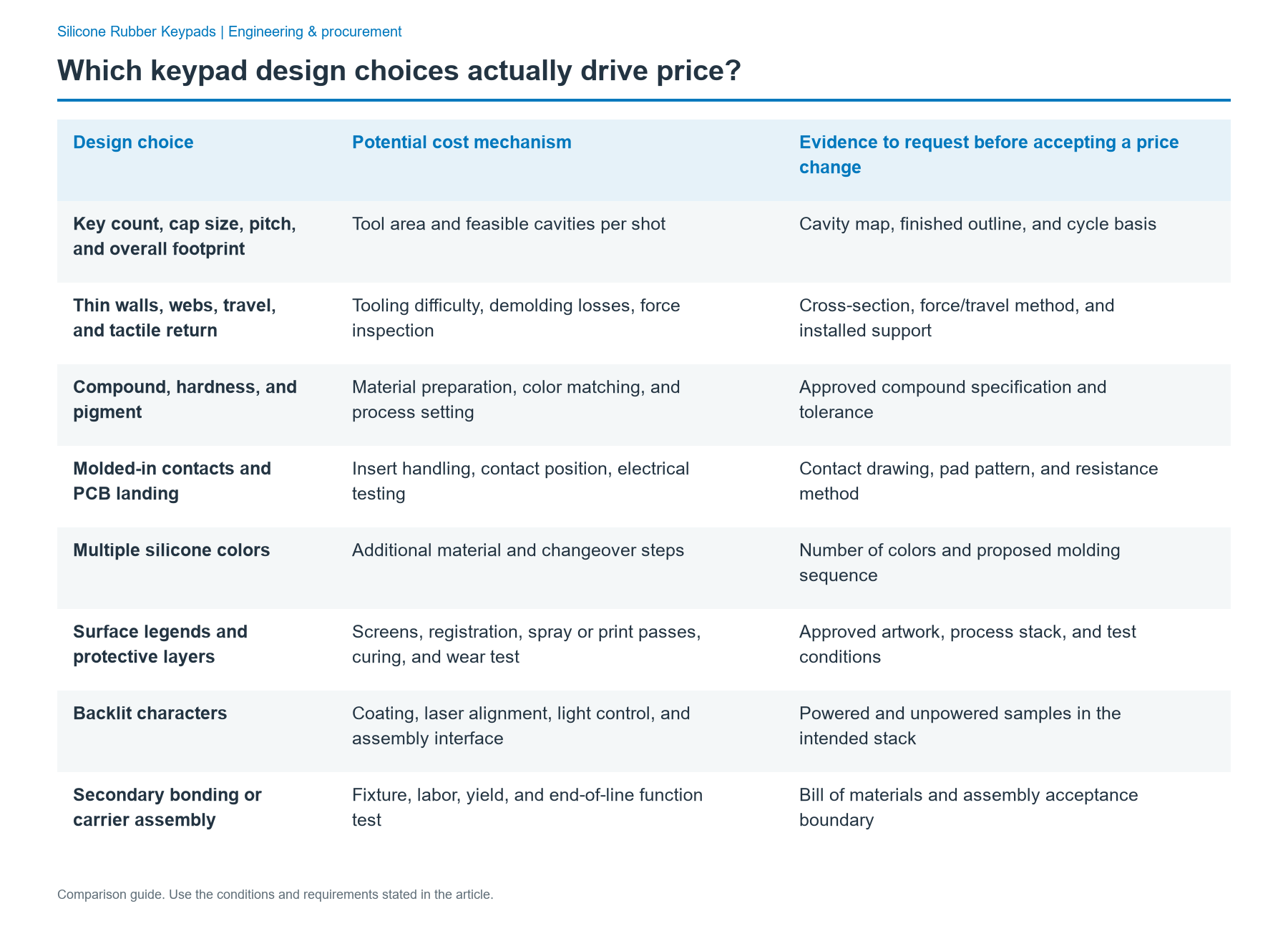
Geometry and process time often matter more than the mass of silicone. A thin web, closely spaced keys, deeper undercuts, or tight registration may affect tool construction, demolding, handling, scrap, and inspection. A larger footprint can also reduce the number of keypads produced per molding cycle. Ask for the actual proposed cavity layout and its throughput assumptions, not a generic price per button.
| Design choice | Potential cost mechanism | Evidence to request before accepting a price change |
|---|---|---|
| Key count, cap size, pitch, and overall footprint | Tool area and feasible cavities per shot | Cavity map, finished outline, and cycle basis |
| Thin walls, webs, travel, and tactile return | Tooling difficulty, demolding losses, force inspection | Cross-section, force/travel method, and installed support |
| Compound, hardness, and pigment | Material preparation, color matching, and process setting | Approved compound specification and tolerance |
| Molded-in contacts and PCB landing | Insert handling, contact position, electrical testing | Contact drawing, pad pattern, and resistance method |
| Multiple silicone colors | Additional material and changeover steps | Number of colors and proposed molding sequence |
| Surface legends and protective layers | Screens, registration, spray or print passes, curing, and wear test | Approved artwork, process stack, and test conditions |
| Backlit characters | Coating, laser alignment, light control, and assembly interface | Powered and unpowered samples in the intended stack |
| Secondary bonding or carrier assembly | Fixture, labor, yield, and end-of-line function test | Bill of materials and assembly acceptance boundary |
For material and molding, ask suppliers to quote only routes suitable for the approved geometry. Examples worth evaluating are high-consistency rubber (HCR) compression molding, HCR transfer molding, and liquid silicone rubber (LSR) injection molding. These are three defined RFQ alternatives, not a claim that every process suits every keypad. LSR's two-component handling and injection equipment are not interchangeable with a compression tool; changing process is a design and qualification decision, not merely a cheaper raw-material swap.
Post-curing may be part of a specified compound and performance route, while trimming, cleaning, and conditioning may be separate steps. The required post-cure depends on the cure chemistry, material and part requirements. A supplier should state whether each operation is included and which material or product requirement drives it. It is unsafe to remove a process line just because another supplier left it out of the quote.
For an installed electrical keypad, contact resistance, registration, actuation force, and travel must be judged with the PCB pads, enclosure stops, and support surfaces that the keypad will actually use. A keypad with a molded carbon pill, a conductive-silicone contact design, and a nonconductive key actuating a separate metal dome represent three different interface architectures. Compare the complete supplied boundary, including any separate dome, board, or assembly operation, before calling the lowest rubber-part price a saving.
JASPER's silicone rubber keypad product range provides a practical starting point for defining whether purchasing needs a molded part, a backlit construction, or an assembled interface. The cost comparison should follow that agreed supply boundary.
How do printing, coatings, and laser legends change a quote?
Decoration cost depends on the whole process stack, not just the number of printed symbols. Compare mutually understandable finished appearances rather than adding a generic “graphics premium.” These four routes are candidate designs for a particular RFQ; they are not a closed list of every available decoration method.
| Defined decoration route | What may add tooling or setup | What belongs in unit and acceptance scope |
|---|---|---|
| Molded-in symbols or unprinted molded surfaces | Mold detail and feature approval | Tool texture, readability, color, and defect limits |
| Screen- or pad-printed legends | Screens or pads, color registration, changeovers | Print passes, adhesion, cleaner and abrasion exposure |
| Coated keys with laser-opened legends | Coating setup, laser fixture, programming | Coating, laser opening, contrast, edge quality, and wear |
| Multicolor print with protective overcoat | Additional artwork tools, color and spray setup | Print colors, coating uniformity, curing, and cleaner resistance |
A coated, laser-opened legend and a screen-printed legend may both look correct at unpacking but differ under repeated finger contact, cleaning, and illumination. Lock the approved visual master, cleaner type, inspection lighting, and durability method before comparing a cheaper surface finish. If testing is omitted from one offer, add its cost to the comparison rather than silently dropping the requirement.
For backlighting, specify whether the price includes only translucent silicone and optical openings, or also the LEDs, PCB, barriers, carrier, and final test. Judge hot spots, cross-lighting, contrast, and leakage in an installed sample. A line item called “laser etch” does not prove that the delivered illumination system works.
Should the quote use annual volume or purchase-order quantity?
Use both, but do not confuse them. An annual forecast describes expected demand; a purchase commitment creates an agreed commercial obligation; a release quantity defines what must be set up, produced, packed, and shipped at one time. Suppliers can legitimately price the same forecast differently if one assumes a single factory run and the other assumes four small runs.
For the planning benchmark of 10,000 accepted units over 12 months, obtain offers for four releases of 2,500 units, with an explicit schedule and no assumed inventory-holding service. If there is no binding annual commitment, request pricing based on each 2,500-unit release as well. Show the effect of the supplier's minimum order quantity (MOQ), price validity, inventory ownership, warehousing, and any material purchase obligation.
| Quantity scenario to request | Commercial purpose | Critical assumption to state |
|---|---|---|
| 1,000 units | Pilot or low-demand sensitivity | Separate setup and sample/qualification costs |
| 2,500 units | Planned individual release | Full batch preparation and freight responsibility |
| 5,000 units | Reduced annual demand case | Two planned releases at 2,500 each |
| 10,000 units | Base annual planning case | Four planned releases at 2,500 each |
These four quantities are buyer-selected analysis scenarios, not industry-standard price breaks. Do not promise a discount at any threshold without a supplier quotation. Likewise, a 10,000-unit forecast does not entitle purchasing to a 10,000-piece production unit price when only 2,500 pieces are ordered and made per run.
Ask each supplier to show its unit-price break, batch charge, and NRE rule for the same quantities, lead-time clock, released artwork, and delivery term. An apparent materials discount can be outweighed by repeated print setup or storage charges. For supply planning, record whether the MOQ applies per part revision, per color, per purchase order, or per scheduled release.
Is paying for the mold separately cheaper than amortizing it?
Neither arrangement is automatically cheaper. Compare the same accepted cumulative units, the same release pattern, and the same deliverables. Paying non-recurring engineering (NRE) up front may lower the repeat-order price, but it creates an earlier cash requirement and potential exposure if the project stops. Recovering NRE in the piece price may reduce the first invoice but can remain expensive after volume grows; verify any recovery cap or price reset in writing.
Use this buyer-side formula, with all costs in USD and quantities measured as accepted keypads:
Comparable project cost (USD) = upfront NRE (USD) + number of releases × batch charge (USD/release) + accepted units × quoted unit price (USD/keypad) + buyer-paid extras (USD).
Effective accepted-unit cost (USD/keypad) = comparable project cost (USD) ÷ accepted units.
The following is an illustrative arithmetic example, not a supplier quotation or an industry price range. Both offers assume identical approved designs and reports, 2,500 accepted units per release, no rejected units, no freight difference, and no separately billed extras. Actual commercial offers must replace every input.
| Model input | Offer A: NRE paid upfront | Offer B: NRE in unit price |
|---|---|---|
| Upfront NRE | $6,000 | $0 |
| Batch setup per 2,500-unit release | $250 | $150 |
| Unit price per accepted keypad | $1.20 | $1.85 |
| Release quantity | 2,500 | 2,500 |
At the 10,000-unit planning benchmark (four releases): Offer A costs $6,000 + 4 × $250 + 10,000 × $1.20 = $19,000, or $1.90 per accepted keypad. Offer B costs $0 + 4 × $150 + 10,000 × $1.85 = $19,100, or $1.91 per accepted keypad. Offer A is only $100 less on this basis; a missing testing or shipping obligation could overturn the result.
| Accepted cumulative volume | Releases of 2,500 | Offer A total / effective unit | Offer B total / effective unit | Lowest modeled cash total |
|---|---|---|---|---|
| 5,000 | 2 | $12,500 / $2.50 | $9,550 / $1.91 | B by $2,950 |
| 10,000 | 4 | $19,000 / $1.90 | $19,100 / $1.91 | A by $100 |
| 15,000 | 6 | $25,500 / $1.70 | $28,650 / $1.91 | A by $3,150 |
Sensitivity test: if Offer A's mold and NRE rises by $1,000, its 10,000-unit total becomes $20,000, or $2.00 per unit, so Offer B is lower by $900. If demand falls to 5,000 accepted units, Offer B is lower by $2,950 under the stated release assumptions. These are scenario calculations, not measured savings. If scrap, claims, taxes, duty, inspection, currency, payment timing, or freight differ, use total buyer-paid cost and the actual number of conforming pieces delivered.
Before choosing either payment model, obtain written answers to four contract questions: who owns the mold; who stores and maintains it; who pays for a modification or replacement; and how the tool, CAD, artwork, and inspection records can be transferred at project exit. Tool ownership cannot be inferred from a line labeled NRE. If unit pricing contains an amortization amount, define the unit threshold, term, and rule after recovery; avoid paying a second NRE invoice for the same work.
What information makes silicone keypad quotes comparable?
A cost comparison is useful only when each supplier is pricing the same drawing revision and accepted scope. Send one RFQ pack with controlled mechanical drawings, an electrical/contact interface, surface artwork, installed conditions, and a purchase plan. Use the following copy-ready brief as a coverage check; each row describes the data purchasing should provide, not a claim that every project has the same design.
| RFQ field | Send or define | What purchasing should receive back |
|---|---|---|
| Keypad drawing and revision | Dimensioned 2D drawing, 3D model where applicable, key and web cross-sections | Quoted revision and DFM exceptions |
| PCB/contact interface | Pad geometry, locating datums, contact architecture, support and hard stops | Included contact pieces and interface responsibility |
| Key feel | Force/travel targets, measurement method, mounting and conditioning | Sample evaluation approach and tolerance proposal |
| Material and environment | Compound requirements, color, cleaner, temperature, exposure | Material/process assumptions and substitutions |
| Legends and lighting | Vector artwork, colors, finish, backlight conditions, LED/PCB boundary | Exact decoration stack and supplied components |
| Tooling | Cavity requirement or output goal, ownership and storage request | NRE breakout, cavities, repair and transfer terms |
| Quantity | 1,000; 2,500; 5,000; 10,000 accepted pieces for comparison | Unit tiers, MOQ, lot charges, and quote validity |
| Releases | Four deliveries of 2,500 for the 10,000-piece planning case | Production-run assumption, stock ownership and delivery term |
| Approval | Prototype quantity, first-article evidence, installed test and signoff owners | Sample price, timing, test responsibility and change fees |
| Production and claims | Lot ID, inspection record, agreed defect limits and response process | Release records, rejection and replacement responsibilities |
For each offer, label the supply boundary molded keypad only, keypad plus specified contacts and finish, or fully defined assembled module. These are three useful buyer comparison categories, not automatically equivalent products. If one supplier includes a board, LEDs, connector, adhesives, or functional testing, either normalize those items across quotes or compare them in a separate assembled-product lane.
Do not accept an attractive price without a named delivery milestone. The clock for tool design, first sample, sample correction, artwork approval, production release, and shipment may start from different events. Request elapsed working days for each phase, identify the dependency, and record whether first-article approval pauses production. Do not interpret an external supplier's published lead time as a JASPER commitment.
How should buyers score quote quality and supplier evidence?
Treat an undocumented low quote as unresolved, not as a passing score. Keep the approval gates tied to the actual cost drivers and probable failures.
| Review criterion | Good signal | Red flag |
|---|---|---|
| Quoted drawing and supply boundary | Revision, contact method, coating, assembly and exclusions named | One unit price with no specification reference |
| Mold economics | Cavities, NRE lines, ownership and modification triggers defined | Tool charge with no identifiable deliverable or exit terms |
| Release and forecast basis | Annual forecast separated from binding PO and run size | Annual-volume price applied without stated commitment |
| Sample and acceptance evidence | Installed first article, force/travel and contact criteria agreed | Loose visual sample treated as full electrical approval |
| Legends and chemical exposure | Artwork master, cleaner and wear method aligned | Decorative finish changed without qualification |
| Inspection and quality responsibility | Lot traceability, sampling method, defect resolution, cost owner | No documented rule for rejected or reworked lots |
| Schedule and change control | Milestones, approval holds and re-quote triggers specified | Lead time excludes undeclared artwork or tooling gates |
When comparing suppliers, mark each criterion acceptable, requires clarification, or disqualifying. Clarification is appropriate for a missing but negotiable document. A proposed substitution that cannot meet a critical contact or cleaning requirement is disqualifying until the design requirement itself is formally changed. A scoring average must not hide a failed safety-related or function-critical requirement.
What happens between the quote and the first production order?
Approval is a staged purchasing control, not a single sample photo. The responsible OEM and supplier teams should close each gate before irreversible tooling, material, or volume commitments.
- Freeze the priced RFQ revision. Record scope, artwork, contact route, environmental exposure, accepted-unit definition, order quantities, and open engineering deviations.
- Approve tooling and commercial terms. Release the mold drawing or agreed construction, cavity plan, NRE ownership, sample allowance, payment milestones, and change triggers.
- Evaluate first articles in the intended stack. Measure force/travel in the mounting condition, electrical closure at the PCB, cosmetic limits, legend appearance, and lighting where specified.
- Close discrepancies and record signoff. Capture each defect, drawing or process correction, disposition, paid change, and the approved retained reference sample. A redesign may reset the quote.
- Authorize the first production release. Confirm part revision, approved compound, process stack, MOQ, batch quantity, inspection plan, traceability, packaging, and shipment date.
- Control repeat orders and changes. Reconfirm agreed material and tool condition, order volume, claims handling, and any proposed substitutions before each new revision or changeover.
For purchasing handoff, keep a single record containing the approved drawing ID, tool ID, artwork revision, material requirement, sample signoff date, accepted lot criteria, PO release size, cost ownership for rejects, and change-approval contacts. A failure to name the owner of rework, replacement production, retest, or return freight can cost more than the original unit-price difference.
How can purchasing reduce cost without weakening the keypad?
The best negotiation target is usually an avoidable process or commercial assumption, not an indiscriminate cut to silicone price. Ask manufacturing to identify the operation removed, the amount re-quoted, and the new verification required.
- Reduce unnecessary color or finish changeovers by standardizing approved shades and grouping releases, while keeping the actual service and cleaning requirements.
- Review cavity count against committed demand. A larger tool can increase upfront spending while lowering molding cost per part; compare the entire planned lifetime and the risk of underutilization.
- Simplify tool-sensitive geometry only after force and enclosure checks. Thicker webs or relaxed details may change feel, return, contact closure, or sealing.
- Select decoration by exposure. A simpler printed legend can be appropriate where an approved cleaning and abrasion test supports it; removing a coating without evidence is not a valid saving.
- Price good units rather than raw molded output. A low process price coupled with high scrap, cosmetic rejection, retesting, or hand sorting may be more expensive per accepted keypad.
- Negotiate order consolidation carefully. A blanket order with call-offs may reduce setup frequency but can create stock liabilities, ageing risk, or cash tied up in unneeded revisions.
For each cost reduction, use a change sheet with four fields: the feature or step being changed, the cost bucket affected, the estimated total at the committed quantity, and the functional/quality approval needed. The supplier proposes the manufacturable alternative; the OEM approves any requirement change. Neither purchasing nor the mold shop should quietly change the released interface.
Frequently asked questions
What makes up a custom silicone keypad price?
A custom silicone keypad price can include one-time mold and engineering charges, per-batch setup and inspection charges, and a recurring price per keypad. The unit line may already include contacts, artwork, coating, trimming, and packaging. Request an inclusion-and-exclusion schedule so a bundled operation is neither omitted nor counted twice when comparing quotations.
Is the silicone keypad mold cost part of the unit price?
It depends on the contract. A supplier may invoice mold and non-recurring engineering separately or recover those charges through a higher unit price. Compare both offers at the same accepted cumulative volume and release schedule. Record mold ownership, any recovery threshold, and what happens to pricing after the recovery period.
Should I quote a keypad using annual demand or order quantity?
Provide annual demand, binding commitment, and production release size as separate inputs. A 10,000-piece annual forecast is not the same as an order for 10,000 made in one run. For example, four releases of 2,500 can incur repeated setup charges, so request a quote that states the planned number of manufacturing batches.
Do extra print colors and laser-etched legends increase cost?
They can add artwork tools, setup time, registration work, coating, laser processing, or inspection. The direction and amount depend on the proposed stack and batch size. Compare approved print, coating, and laser routes against the same readability, cleaner, abrasion, and lighting requirements instead of assuming one finishing technology is always cheaper.
Why are two keypad quotations different even with the same drawing?
The underlying assumptions may differ: mold cavities, compound, contact architecture, decoration, sample reports, lot setup, defect allowances, shipping terms, or order commitments. Reconcile the scope and acceptance plan first. A low unit number is not comparable if critical parts or testing are excluded, or if it assumes a larger production run than purchasing will place.
What is the best quantity for amortizing keypad tooling?
There is no universal best quantity. Divide recoverable one-time tooling cost by the number of accepted units genuinely expected under the purchasing commitment, then add per-batch and per-unit charges. As a buyer-side planning case, 10,000 units in four 2,500-unit releases is useful for comparison, but use a lower-volume scenario to test cancellation risk.
What should I approve before releasing a silicone keypad production order?
Approve the controlled drawing, mold and artwork revisions, silicone specification, contact-to-PCB interface, sample in the intended enclosure, force/travel and electrical checks, decorative finish, and relevant cleaner and wear tests. Also agree on lot inspection, traceability, defect responsibility, batch quantity, packaging, and the change process. A visually acceptable loose keypad is not enough to close the installed interface.
Request a quote with the cost drivers identified
Send the keypad drawing, legend artwork, PCB contact pattern and support details, force/travel target, cleaning environment, document revisions, and intended order and annual quantities. State whether you need the molded rubber component or a defined assembled interface, and identify which items need first-article evidence. Use JASPER's Request a Quote page to begin a project-specific review on a comparable scope.
Bring the drawing, stack and operating conditions
JASPER engineering will review the interfaces, open risks and evidence required for a production quote.