
An acrylic vs glass front panel decision turns on the operating environment and the complete HMI stack. Strengthened glass is usually the better starting point for a fixed touchscreen exposed to repeated wiping, grit, solvents, sunlight, or temperature cycling. Hard-coated PMMA acrylic is often better when low mass, rapid machining, formed geometry, or avoidance of loose glass fragments controls the design. Neither material wins until its grade, treatment, thickness, print, bond, support, and validation method are defined.
JASPER certifications: ISO 9001, ISO 13485, IATF 16949, and ISO 14001.
1. Quick Verdict: Acrylic or Glass at a Glance
| Design priority | Better starting choice | Engineering boundary |
|---|---|---|
| Repeated finger contact and abrasive wiping | Strengthened glass | Specify glass family, strengthening, surface treatment, and edge quality |
| Frequent cleaning with solvents or disinfectants | Glass HMI cover | Test ink, coatings, adhesive, gasket, and seal—not only bare glass |
| Lowest mass at equal area and thickness | PMMA acrylic | Named clear PMMA grades have roughly half the density of common cover glasses |
| Fast CNC routing, drilling, or design changes | Acrylic control panel | Control heat, burrs, residual stress, and solvent exposure after machining |
| Bent or thermoformed geometry | PMMA acrylic | Validate optical distortion, print registration, and post-form dimensions |
| High stiffness and stable display gap | Strengthened glass | Avoid point loading, unsupported edges, and damage after strengthening |
| Thick projected-capacitive touch cover | Often glass | Controller, electrode geometry, adhesive, glove, water, and thickness still require tuning |
| Avoiding loose glass fragments | PMMA acrylic | Consider polycarbonate if extreme impact, rather than optical finish, is the first requirement |
| Wide thermal cycling with a bonded metal frame | Often glass | Calculate differential movement for the exact substrate and joint geometry |
| Severe impact or vandal exposure | Neither by default | Compare retained/laminated glass, polycarbonate, bezel protection, and the full impact target |
This is a screening verdict, not a drawing release. Engineers comparing acrylic front-panel construction options should put the operating temperature, cleaners, impact target, touch stack, panel support, and optical acceptance limits on the same page as the material callout.
2. How to Compare an Acrylic vs Glass Front Panel Correctly
A front panel or cover lens is the rigid operator-facing layer over graphics, a display, touch electrodes, switches, or an enclosure opening. PMMA—polymethyl methacrylate—is the polymer normally meant by an acrylic control panel. “Glass” may mean annealed soda-lime, heat-strengthened, fully tempered, chemically strengthened aluminosilicate, borosilicate, laminated glass, or a coated optical product. Those constructions are not interchangeable.
The comparison must separate four levels:
- Base material: PMMA formulation or glass composition.
- Treatment: hard coat, anti-glare texture, anti-reflective coating, chemical strengthening, thermal tempering, lamination, or easy-clean coating.
- Part geometry: thickness, unsupported span, corner radius, hole location, edge finish, printed area, and local cutouts.
- Assembly: optical adhesive, foam tape, gasket, bezel, touch sensor, display air gap, frame stiffness, and enclosure seal.
A datasheet value belongs to Level 1 or 2. Field behavior belongs to the complete Level 4 assembly. For example, IEC 60529:1989+A1:1999+A2:2013 classifies protection provided by an enclosure; it does not grant an IP rating to a loose transparent front panel material. Likewise, IEC 60068-2-75:2014+A1:2025 supplies standardized hammer-impact methods from 0.14 J to 50 J, but material selection alone does not establish an assembly's impact result.
Use this comparison formula:
Material + treatment + geometry + support + environment + test method = defensible front-panel specification
Anything shorter invites false equivalence. A 2 mm chemically strengthened glass lens cannot be judged from ordinary window-glass behavior, and uncoated extruded PMMA cannot represent a hard-coated optical acrylic part.
3. Side-by-Side Engineering Data: Named Grades, Not Generic Materials
The figures below are screening data from named manufacturer documents. They are not a matched head-to-head qualification test. Polymer and glass suppliers use different specimens and methods, while impact strength is especially sensitive to edge condition, support, treatment, and flaw population.
| Property | Clear PMMA reference | Strengthened-glass reference | What the difference means in an HMI |
|---|---|---|---|
| Named product | ACRYLITE Premium FF / PLEXIGLAS GS or XT | Corning Gorilla Glass 3 | Confirm the production grade; generic material names are insufficient |
| Density | 1.19 g/cm³ | 2.39 g/cm³ | At equal area and thickness, the glass reference carries about twice the mass |
| Modulus | 2.8 GPa tensile and 3.3 GPa flexural for ACRYLITE Premium FF; 3.3 GPa short-term tensile for PLEXIGLAS | 70 GPa Young's modulus | Glass is about an order of magnitude stiffer; actual panel deflection also depends on thickness and support span |
| Clear-sheet transmission | 92% total for ACRYLITE Premium FF | At least 91.5% over 380–2,000 nm at 0.7 mm for Gorilla Glass 3 | Grade, thickness, wavelength, coatings, print windows, adhesive, display, and reflections control final readability |
| Thermal expansion | 7 × 10⁻⁵ K⁻¹ over 0–50°C for PLEXIGLAS GS/XT | 3.25 × 10⁻⁶ K⁻¹ over 20–300°C for SCHOTT BOROFLOAT 33 | The PMMA reference expands about 21 times as much as the borosilicate reference per degree; do not mix the two temperature ranges in a formal calculation |
| Surface/indentation data | 175 MPa indentation hardness H961/30 for PLEXIGLAS GS/XT | 653 kgf/mm² Vickers hardness at 200 g for strengthened Gorilla Glass 3 | The methods are not directly convertible, but they explain why untreated PMMA wears faster under gritty wiping |
| Thermal limit / processing | ACRYLITE Premium FF recommends 71°C maximum continuous service; thermoforming at 143–160°C | Glass service and strengthening limits depend on composition and treatment | A forming temperature is not a service temperature; obtain the actual glass supplier's limits |
| Thickness example | Sheet products cover many thicknesses; design-dependent | Gorilla Glass 3 standard range 0.4–2.0 mm | Thin strengthened glass may offset some density penalty; compare released geometries, not equal-thickness slogans |
Sources: Röhm's ACRYLITE Premium FF Technical Information, revision 08/24, Röhm's PLEXIGLAS GS/XT Technical Information 211-1, Corning's Gorilla Glass 3 Product Information Sheet, and SCHOTT's BOROFLOAT 33 Technical Data.
Optical transmission is close enough that neither material wins from one nominal percentage. A display stack adds two air interfaces, printed windows, haze, surface texture, adhesive, and LCD reflection. Measure the production-intent stack under ASTM D1003 rather than repeating a raw-sheet number.
4. Where a Strengthened Glass HMI Cover Wins
Scratch and abrasion resistance
Glass is the safer default when operators touch or wipe the panel thousands of times, particularly where silica dust, metal fines, or dirty gloves can turn a cleaning cloth into an abrasive. In Röhm's 1/4-inch comparison, Taber abrasion after 100 cycles produced 0.23% haze for glass, 1.34% for abrasion-resistant acrylic, and 26.88% for uncoated acrylic. Those numbers belong to that test setup, not every product, but they show why a hard coat changes the PMMA decision.
For procurement, “9H” is not enough. ISO 15184:2020 defines a pencil test for coating films and cautions against direct comparison of unlike coatings. A better optical wear requirement names ASTM D1044-24, the abrasive wheel, load, cycle count, and maximum haze change measured under ASTM D1003-21.
Chemical cleaning and long-term appearance
A bare glass substrate usually tolerates a broader range of cleaning agents than PMMA, but an HMI is not bare substrate. Anti-reflective layers, anti-fingerprint treatments, ceramic or organic inks, optical adhesive, perimeter foam, and elastomer seals can each be the first failure point. SCHOTT classifies BOROFLOAT 33 as HGB 1/HGA 1 hydrolytic, Class 1 acid, and A2 alkali resistant under named methods; those classifications do not automatically transfer to a decorated touch assembly.
Specify the actual cleaner brand, concentration, wipe material, dwell time, temperature, and cycle count. Inspect for haze, gloss shift, swelling, edge lift, ink transfer, coating change, and touch drift afterward. “Alcohol resistant” does not define a repeatable test.
Stiffness, flatness, and touch stability
Corning lists a 70 GPa Young's modulus for Gorilla Glass 3, while the cited PMMA references report 2.8–3.3 GPa modulus values. Although the methods differ, the scale of the gap is useful: glass resists flexing, maintains a stable sensor gap, and supports a flush interface with less local deflection at a given geometry. That helps projected-capacitive systems in which bending or variable air gaps disturb coupling.
Rigidity does not make glass immune to damage. Edge chips, sharp internal corners, fastener point loads, and contact between the glass edge and a metal frame can dominate failure. Complete all holes, slots, edge grinding, and decoration required by the glass process before strengthening unless the supplier documents a permitted post-process.
Thermal and dimensional stability
PLEXIGLAS GS/XT lists linear expansion of 7 × 10⁻⁵ K⁻¹ over 0–50°C; SCHOTT lists 3.25 × 10⁻⁶ K⁻¹ over 20–300°C for BOROFLOAT 33. A bonded PMMA panel can therefore demand much more joint movement than a borosilicate panel over the same size and temperature swing. The exact comparison must use the selected material datasheets and the same temperature interval.
Glass is usually favored for wide thermal cycling and controlled display gaps. It is not automatically the right answer beside a shock-loaded frame or where fragments are prohibited. A retained or laminated construction may be needed, and custom glass nameplates and cover panels should be reviewed as complete constructions rather than glass rectangles.
5. Where a PMMA Acrylic Control Panel Wins
Low mass and easier handling
Clear PMMA references have a density of 1.19 g/cm³ versus 2.39 g/cm³ for Gorilla Glass 3. At equal area and thickness, PMMA is therefore about half the mass. That matters in handheld controllers, hinged covers, service doors, portable instruments, vehicle interiors, and assemblies with strict shipping or drop-energy limits.
Equal thickness is not always equal function. Glass's higher stiffness may allow a thinner lens, while PMMA may need more thickness or closer support to limit deflection. Compare the final released parts, including coatings, print, adhesive, and bezel—not density alone.
Machining, forming, and design iteration
PMMA can be CNC-routed, drilled, laser-cut under a controlled process, polished, and thermoformed. ACRYLITE Premium FF gives a thermoforming window of 143–160°C, which is distinct from its recommended 71°C maximum continuous-service temperature. This flexibility suits low-volume equipment, evolving cutout patterns, formed bezels, and cosmetic contours that would make strengthened-glass processing slow or constrained.
Fabrication can also create latent problems. Heat-affected edges, tight inside corners, aggressive feeds, residual stress, and solvent contact may initiate crazing. The drawing should state edge finish, minimum radius, protective-film handling, flatness after forming, print registration, and whether stress-relief guidance from the selected sheet supplier applies.
Fragment avoidance and impact behavior
PMMA is difficult to shatter into loose glass fragments, making it attractive near food-handling zones, portable equipment, or assemblies where fragment containment controls the hazard analysis. Röhm's acrylic-versus-glass comparison reports 18.1 ft-lb impact for 1/4-inch acrylic, 1.0 ft-lb for plate glass, and a 15.5–29.1 ft-lb range for tempered glass in its stated setup. The overlap with tempered glass is the important lesson: “acrylic is X times stronger” is not a reliable universal rule.
If the requirement is severe blunt impact, projectile resistance, or machine guarding, PMMA may still be the wrong transparent front panel material. Evaluate optical-grade polycarbonate, retained glass, a sacrificial shield, and protected bezel geometry. Then test the complete supported assembly at the specified energy and impact location.
Cost-sensitive prototypes without a false production assumption
Acrylic is often the easier prototype. Glass often holds its appearance longer. Those are starting assumptions, not purchase specifications.
Acrylic often reduces prototype process complexity because late cutout or shape revisions can be made with common sheet-fabrication methods. That does not prove a lower production cost. Hard coating, cosmetic inspection, optical bonding, print scrap, protective packaging, and replacement rates may reverse the comparison. This article deliberately leaves price and supplier-specific lead time to the commercial sourcing process.
6. Optical Behavior, Printing, and Capacitive-Touch Integration
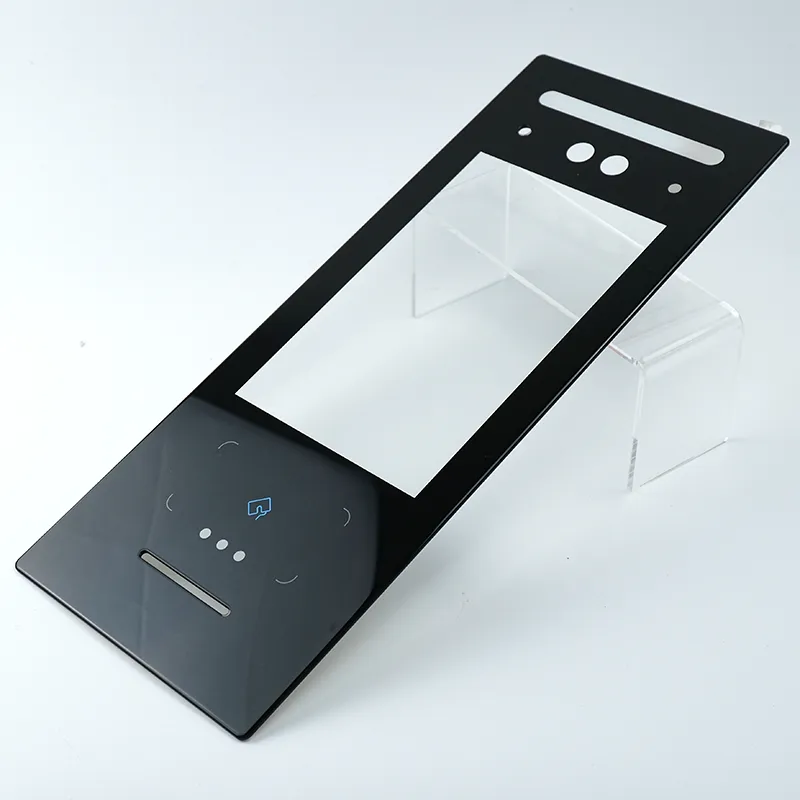
A clear lens does four jobs at once: transmit display light, hide inactive areas, carry legends, and protect the sensor or enclosure. Reverse printing places graphics behind the operator surface, protecting ink from direct wear. Dead-front designs use a neutral-density or translucent ink stack so icons appear only when illuminated. Both materials can support these effects, but ink adhesion, opacity, pinholes, cure, color shift, and window haze must be approved on the selected substrate and treatment.
One rule catches many expensive errors: build the optical stack before finalizing the artwork. A black border that looks opaque on a light table may leak points of LED light in a dark room. An anti-glare surface that suppresses reflections may also blur small LCD text. A pressure-sensitive adhesive can introduce Newton rings or visible texture. Record these judgments against a signed limit sample, measured ASTM D1003-21 values, and the production display at its minimum and maximum luminance. Shortcuts here are visible every time the machine starts.
A practical HMI stack looks like this:
Operator / glove / water film
Hard coat, anti-glare, AR, or easy-clean surface
PMMA acrylic or strengthened glass cover
Reverse-printed border, legends, dead-front ink
Optical adhesive or pressure-sensitive adhesive
Projected-capacitive sensor or discrete touch electrodes
Optical bond or controlled air gap
LCD / LED / indicator layer
Carrier frame, gasket, enclosure, grounding features
Every interface changes optical and electrical performance. Infineon AN85951, revision AI (May 26, 2026) gives approximate relative dielectric constants of 2.8 for acrylic, 7.6–8.0 for standard glass, and 1.0 for air. Capacitive coupling rises with dielectric constant and falls with cover thickness. Texas Instruments' CapTIvate Technology Guide likewise recommends eliminating low-permittivity air gaps and treating cover, adhesive, electrode size, and spacing as one design.
A thicker glass lens is not automatically more touch-sensitive than a thin acrylic lens. Nor can a controller tuned through 1.1 mm glass be assumed to work through 3 mm PMMA. Validate bare finger, specified gloves, water droplets or films, edge touches, multi-touch if required, electrical noise, grounded and ungrounded operators, and full temperature range. The production ink and adhesive stack must be present because printed borders and trapped air change the field.
Optically, use ASTM D1003 to specify luminous transmittance and haze at the finished display window, not only on clear incoming sheet. Add reflectance, color shift, sparkle, image sharpness, and viewing-angle checks where the LCD and anti-glare texture make them relevant. Specialty products can exceed generic material performance: SCHOTT's CONTURAN Tough AS, for example, lists more than 98% transmission and less than 1% reflection for its treated construction. Those numbers cannot be assigned to ordinary glass.
For sensor and assembly options, compare the complete capacitive touch panel and front-panel HMI assembly rather than selecting a lens in isolation.
7. Mounting, Sealing, and the Failure Chains Designers Miss
The panel edge and bond line often decide the outcome before the nominal material property does. A stiff glass lens dislikes point loading and damaged edges. A PMMA panel moves more with heat and moisture. Both can peel printed ink or an adhesive if the joint is built on the wrong surface.
| Design input | Failure chain if omitted | Drawing or validation control |
|---|---|---|
| Panel and frame CTE, length, temperature range | Differential movement → adhesive shear/peel → edge lift → water path or optical gap | Calculate movement; size bond width/thickness with the adhesive supplier |
| Edge clearance around glass | Frame contact or debris → local edge stress → crack initiation | Define minimum edge gap, protective bezel, and no hard contact |
| PMMA machining stress | Heat/cutting stress + cleaner exposure → crazing → cosmetic or structural crack | Qualify machining, polishing, cleaning, and any annealing guidance |
| Bonded surface identity | Adhesive bonds to ink/coating rather than substrate → cohesive or intercoat failure | Name surface stack; run peel/shear tests after environmental aging |
| Gasket compression | Excess compression → panel bow/edge load; too little → seal leak | Specify gasket material, compression range, stops, and fastener torque |
| Unsupported span | Touch force or impact → excessive deflection → display contact or sensor drift | Set flatness/deflection target and support geometry |
| Drainage and edge sealing | Water retained at cutout → adhesive attack, freeze damage, or corrosion | Define seal path, vent/drain concept, and finished-enclosure IP test |
| Coating at bezel contact | Hard particle trapped at interface → scratch or concentrated load | Control cleanliness, contact strip, and assembly inspection |
A pressure-sensitive acrylic foam tape can accommodate some differential movement in shear. The 3M VHB Tape Design Guide gives a typical guideline of up to three times tape thickness for shear-plane movement. That is not a universal HMI joint allowance. Tape family, temperature, sustained load, surface energy, print/coating adhesion, bond width, and peel loading remain project-specific.
For sealed equipment, the final front panel, gasket, enclosure, fasteners, cable entries, and vents must be tested together. IEC 60529:1989+A1:1999+A2:2013 does not support an “IP-rated acrylic” or “IP-rated glass” shortcut. A planned quality control and inspection route can hold the released visual, dimensional, optical, and functional criteria even if that internal page is not yet live.
8. Decision Matrix: Which Material Should the Project Pick?
| Project condition | Pick first | Why | Do not release until… |
|---|---|---|---|
| Fixed factory HMI, daily wiping, dirty gloves | Strengthened glass | Better intrinsic abrasion resistance and stiffness | Cleaner cycle, edge-impact, touch, and enclosure tests pass |
| Medical equipment interface with defined disinfectants | Often strengthened glass | Broad substrate chemical resistance and stable surface | Exact disinfectant regimen is tested on coatings, ink, bond, and seal; no regulatory claim is inferred |
| Portable controller with strict mass limit | Hard-coated PMMA | Roughly half glass density at equal geometry | Drop, scratch, cleaner, and touch tests pass |
| Curved fascia or frequently changing cutout | PMMA | Easier forming and machining | Form distortion, residual stress, print registration, and environmental aging pass |
| Outdoor kiosk with touch and abrasive contamination | Strengthened glass | Surface durability, stiffness, UV and thermal stability | Glare, solar load, thermal cycle, vandal impact, and wet-touch behavior pass |
| Food-processing area where free fragments are prohibited | PMMA or retained construction | Fragment control can outweigh scratch resistance | Hazard analysis, cleaner exposure, impact, and retention strategy are approved |
| Large bonded panel on aluminum frame | Often glass, joint-dependent | Lower CTE can reduce movement, but frame mismatch remains | Differential movement and adhesive aging are verified |
| Extreme impact or machine-guard duty | Neither by default | A cover lens is not automatically a safety guard | Polycarbonate/laminated alternatives and applicable safety tests are assessed |
The recommended construction is not the best choice when its main advantage does not address the dominant failure. Glass is not the best choice when fragment control, weight, or formed geometry governs. PMMA is not the best choice when gritty wiping, aggressive cleaners, high heat, or a thick PCAP stack governs. When both lists are severe, the answer is often a retained glass laminate, coated polycarbonate, replaceable sacrificial layer, or redesigned bezel—not a compromise grade selected from a brochure.
9. Drawing Inputs and Production-Intent Test Matrix
Project input checklist
Send these inputs before asking a fabricator to choose a rigid front-panel material:
- [ ] Overall dimensions, thickness envelope, unsupported spans, flatness, and mass limit
- [ ] Hole, slot, corner-radius, edge-finish, bevel, and cutout requirements
- [ ] Operating and storage temperature/humidity profiles, including cycle rate
- [ ] UV exposure, outdoor orientation, expected solar load, and color-shift limit
- [ ] Named cleaners, concentrations, wipe media, dwell time, and target cycles
- [ ] Impact energy, striker geometry, impact points, support condition, and pass criteria
- [ ] Surface-wear method: ASTM D1044 wheel, load, cycles, and maximum ASTM D1003 haze change
- [ ] Display active area, luminance, viewing angle, haze, transmission, reflectance, and color limits
- [ ] Graphics: Pantone/Lab target, opacity, dead-front state, registration, pinhole limit, and cure system
- [ ] Touch type, controller, electrode pattern, glove, water, multi-touch, noise, and sensitivity requirements
- [ ] Adhesive or gasket family, bond width, compression, frame material, and surface stack
- [ ] Enclosure target such as IEC 60529, with the finished-equipment test plan
- [ ] Flammability requirement and exact polymer grade/thickness if UL 94 screening is relevant
- [ ] Cosmetic inspection lighting, viewing distance, defect sizes, and acceptance sample
- [ ] Packaging film, interleaf, handling, cleaning, and installation method
UL 94 deserves a specific warning. it as small-scale testing of polymeric material specimens for parts in devices and appliances. A material classification at a stated thickness is not approval of the completed HMI. Verify the exact PMMA grade and thickness against the end-product requirements; do not place a generic “UL-rated acrylic” note on a drawing.
Production-intent sample approval matrix
| Test block | Sample construction | Method framework | Record before release |
|---|---|---|---|
| Dimensions and flatness | Finished printed/coated panel | Released drawing and calibrated metrology | Thickness, bow, hole/edge position, fit in bezel |
| Optical window | Full stack over production display | ASTM D1003 plus project reflectance/color method | Transmission, haze, image sharpness, color shift, black-state appearance |
| Surface abrasion | Production top surface | ASTM D1044 with stated wheel/load/cycles | Initial/final haze, gloss, visible tracks, coating damage |
| Cleaner compatibility | Coated, printed, bonded assembly | Named chemical, concentration, wipe/dwell/cycle schedule | Haze, gloss, color, ink transfer, swelling, edge lift, touch drift |
| Touch function | Production lens/print/adhesive/sensor/controller | Project functional protocol | Finger, gloves, wet surface, corners, multi-touch, noise, temperature |
| Impact | Panel installed in production-equivalent support | IEC 60068-2-75 method where applicable, with stated energy/locations | Cracks, fragments, retention, display damage, touch and seal function |
| Thermal/humidity cycling | Full bonded panel and frame | Product-specific environmental profile | Warpage, bubbles, delamination, print cracks, seal leakage, touch drift |
| UV/weathering for PMMA | Production grade, coating, and print | ISO 4892-2 exposure with project-defined dose and moisture cycle | Yellowing/color, haze, gloss, coating/ink adhesion; define acceptance limits |
| Enclosure protection | Finished enclosure | Applicable IEC 60529 procedure | Water/dust ingress and function; no material-only claim |
| Assembly process | Normal production run | Work instruction and inspection plan | Surface prep, tape/gasket placement, torque/compression, contamination, traceability |
A successful coupon does not clear the assembly. Approval samples must include production-intent ink, coating, adhesive, sensor, frame, edge process, and support. Keep the golden sample and the raw test records in the graphic overlay and rigid-panel quality plan.
10. Frequently Asked Questions
Is acrylic or glass better for an industrial HMI front panel?
Strengthened glass is usually better for a fixed industrial HMI exposed to frequent touch, gritty wiping, chemicals, UV, or temperature cycling. Hard-coated PMMA acrylic is better when low mass, rapid machining, formed geometry, or avoiding loose glass fragments matters more. Validate the complete supported and bonded assembly.
Does acrylic scratch more easily than glass?
Yes. Uncoated PMMA is substantially more vulnerable to abrasion than glass. A hard coat can narrow the gap, but its name or pencil rating does not prove field durability. Specify an ASTM D1044 setup and measure haze change under ASTM D1003 on the actual production surface.
Is acrylic stronger than tempered or chemically strengthened glass?
Not as a universal statement. Acrylic usually resists ordinary breakage and does not create glass fragments, but strengthened-glass performance overlaps or exceeds it in some impact tests. Grade, thickness, support, edge condition, strengthening process, impact energy, and striker geometry must be matched before comparing results.
Which material is lighter for a transparent front panel?
PMMA is lighter at equal geometry. The cited clear PMMA grade has a density of 1.19 g/cm³, while Corning Gorilla Glass 3 is 2.39 g/cm³. A finished glass HMI cover may be thinner because glass is much stiffer, so compare released part mass rather than density alone.
Can an acrylic control panel work with projected-capacitive touch?
Yes. PMMA can work with projected-capacitive touch, but it is not a drop-in substitute for glass. Infineon lists approximate relative dielectric constants of 2.8 for acrylic and 7.6–8.0 for standard glass. Cover thickness, adhesive, air gaps, electrodes, controller tuning, gloves, water, and electrical noise require validation.
Can a glass HMI cover be machined after strengthening?
Usually, critical holes, slots, cutouts, and edge finishing are completed before thermal or chemical strengthening. Post-strengthening machining can damage edges or release stored stress. The exact sequence depends on glass composition and supplier process, so the released drawing must identify all features before the strengthening plan is approved.
Does the front-panel material determine an IP or IK rating?
No. IEC 60529 applies IP classifications to complete enclosures, including seals, joints, fasteners, cable entries, and vents. Impact behavior also depends on thickness, support, bezel, edges, and test method. A PMMA sheet or glass lens alone cannot guarantee the finished HMI's IP or impact rating.
What information should be sent for a rigid front-panel material review?
Send dimensions, edge and cutout geometry, temperature and UV profile, cleaners, impact target, optical limits, graphics, touch stack, adhesive or gasket, frame material, sealing target, cosmetic criteria, annual volume, and production test plan. That package supports a defensible material and treatment recommendation.
11. Next Step: Choose the Construction, Not Just the Material Name
Prepare one drawing package with the checklist above, then compare a hard-coated PMMA build against the proposed strengthened-glass build using the same optical, abrasion, chemical, touch, impact, thermal, and sealing conditions. JASPER can use that input to review a rigid panel together with the graphics, sensor, adhesive, and front-panel HMI assembly.
Technical References
- Source: IEC 60529:1989+A1:1999+A2:2013. Accessed 2026.
- Source: IEC 60068-2-75:2014+A1:2025. Accessed 2026.
- Source: ACRYLITE Premium FF Technical Information, revision 08/24. Accessed 2026.
- Source: PLEXIGLAS GS/XT Technical Information 211-1. Accessed 2026.
- Source: Gorilla Glass 3 Product Information Sheet. Accessed 2026.
- Source: BOROFLOAT 33 Technical Data. Accessed 2026.
- Source: ISO 15184:2020. Accessed 2026.
- Source: ASTM D1044-24. Accessed 2026.
- Source: ASTM D1003-21. Accessed 2026.
- Source: Infineon AN85951, revision AI (May 26, 2026). Accessed 2026.
- Source: Texas Instruments' CapTIvate Technology Guide. Accessed 2026.
- Source: 3M VHB Tape Design Guide. Accessed 2026.
Review the overlay construction before release
Send the drawing, artwork, material stack, mounting surface, environment, and acceptance plan for a construction-specific engineering review.